Tuesday, 7 August 2012

 an admired management consulting business for many many years now recently put out a paper that looks, by the trends, at trillion 8 dollar growth markets.

I found its full of facts you can pick up on the net. But it does have unique insight, plus the data is all in one place. Here’s the intro:

'Daily turmoil on a global scale is giving business leaders and investors plenty of reasons to stay hunkered down as they confront huge challenges in the here and now. Spreading sovereign debt woes, volatile markets, unstable currencies, political gridlock and stalled growth plague the big developed economies. Meanwhile, China, India and other rapidly emerging economies are flexing their strength as they adjust to the phenomenal growth that has been the biggest economic story of the past two decades.
In the conventional view, the current turbulence portends deep, enduring structural shifts that will set the business agenda for the foreseeable future. We fully expect macroeconomic shocks over the coming decade, with discontinuities that will shape the options companies have to adapt and grow.
Yet behind the dire headlines and day-to-day frictions of the marketplace, eight trillion-dollar macro trends are at work in the global economy. The pursuit by businesses and governments of the macro trends’ growth potential will touch many corners of the globe.
Europe, Japan and the US certainly face an extended period of economic turbulence and slow growth, particularly in the first half of the decade. But as we will see, half of the macro trends affect both emerging and advanced economies. Thus, while we embrace the exciting opportunities in emerging markets, we also see opportunities where many commentators see none right now—in the home markets of many of the world’s leading businesses.

A shift in global growth. Although we will continue to see pockets of economic turbulence, look for the global economy to expand at a 3.6 percent annual rate over the longer term, resulting in world GDP swelling to $90 trillion by 2020—40 percent larger than it is today. The sources of economic growth will tilt increasingly toward emerging economies. Whereas the advanced economies currently generate two-thirds of global GDP, developing and emerging economies will contribute an outsized share of the growth in the future. By 2020, the advanced economies’ proportion of world GDP will drop to 58 percent, a sizable change over a relatively short period.

The growth of world population by 750 million, nearly all of it originating in developing and emerging economies, will account for about one-quarter of the rise in GDP. Increased productivity will generate the rest, as per capita GDP grows by 30 percent over that period. But, while we expect the next few years to remain challenging in the West, we can see a path for growth to accelerate in the latter half of the decade, particularly if governments begin tackling their public and private debt burdens. Indeed, our analysis anticipates that Europe and the US will contribute an additional $8 trillion to global GDP by 2020.'

Monday, 6 August 2012

PopFab — 3D printer fits inside a briefcase (Intro)

Pop-Fab is a 3D printer that fits inside a briefcase. At its heart is a computer-controlled motion platform and a means of attaching various tool heads. These enable PopFab to make objects from a digital plan in a variety of ways: current capabilities include 3D printing, milling, vinyl cutting, and drawing — with more on the way. PopFab has traveled the world as a carry-on item of luggage.

How to Spot the Future
    Photo: Brock Davis
Except form Wired website.

"Thirty years ago, when John Naisbitt was writing Megatrends, his prescient vision of America’s future, he used a simple yet powerful tool to spot new ideas that were bubbling in the zeitgeist: the newspaper. He didn’t just read it, though. He took out a ruler and measured it. The more column inches a particular topic earned over time, the more likely it represented an emerging trend. “The collective news hole,” Naisbitt wrote, “becomes a mechanical representation of society sorting out its priorities”—and he used that mechanism to predict the information society, globalism, decentralization, and the rise of networks.

    As clever as Naisbitt’s method was, it would never work today. There’s an infinite amount of ink and pixels spilled on most any topic. These days, spotting the future requires a different set of tools. That’s why at Wired, where we constantly endeavor to pinpoint the inventions and trends that will define the future, we have developed our own set of rules. They allow us to size up ideas and separate the truly world-changing from the merely interesting. After 20 years of watching how technology creates a bold and better tomorrow, we have seen some common themes emerge, patterns that have fostered the most profound innovations of our age.
    This may sound like a paradox. Surely technology always promises something radically new, wholly unexpected, and unlike anything anybody has seen before. But in fact even when a product or service breaks new ground, it’s usually following a familiar trajectory. After all, the factors governing thermodynamics, economics, and human interaction don’t change that much. And they provide an intellectual platform that has allowed technology to succeed on a massive scale, to organize, to accelerate, to connect.
    So how do we spot the future—and how might you? The seven rules that follow are not a bad place to start. They are the principles that underlie many of our contemporary innovations. Odds are that any story in our pages, any idea we deem potentially transformative, any trend we think has legs, draws on one or more of these core principles. They have played a major part in creating the world we see today. And they’ll be the forces behind the world we’ll be living in tomorrow."

    1. Look for cross-pollinators. Link to main text!


    Ramesh Raskar: Imaging at a trillion frames per second.


    This photographic technology can see light actually move.
    Ramesh Raskar presents femto-photography, a new type of imaging so fast it visualizes the world one trillion frames per second, so detailed it shows light itself in motion. This technology may someday be used to build cameras that can look “around” corners or see inside the body without X-rays.
    Photography is about creating images by recording light. Ramesh Raskar and his team members have invented a camera that can photograph light itself as it moves at, well, the speed of light.
    Well, I think as scientific discover and technological breakthrough continue to speed up, we are going to find it difficult to differentiated between emperical science and, well, magic. We can actual now see the speed of ligh!!!


    Behrokh Khoshnevis — contour crafting: automated construction

    Behrokh Khoshnevis, a professor of Industrial and Systems Engineering at the University of Southern California, has spent the last 15 years working on a machine that will “print” buildings. He calls the practice Contour Crafting.
    The technology, he says, will be faster than all conventional building methods (including prefab construction), cheaper, and use less energy. It can build whatever you can program into a computer, so it will offer unprecedented design flexibility — right angles, wild patterns, or soft curves.
    “Contour Crafting will most probably be one of the very few feasible approaches for building structures on other planets, such as the Moon and Mars, which are being targeted for human colonization before the end of the new century,” says Professor Khoshnevis.
    Music for free!

    Here's a link to a free-music site.


    '....Out there, it's only you and your music. No time for games. Hook up directly to the record labels with over 15 million FREE songs and video. 100% legal. 100% safe. Live your life through your music with BearShare - the newest, fastest and safest P2P program out there. It's all real, and it's all here."

    Link to BearShare
    Nike+ Olympic Tech?

    In an earlier post I discussed the issues of technological innovation and individual athlete performance enhancement.

    Here's a link to Nike+Fuelband site. Basically it's a light weight wristband 'Accelerometer' and database that measures your split, whether dancing, running, biking and and other physical activities. You can down load the data to an i-phone App.


    Watch the video for overview.


    dingbat

    Download for Free

    Doctorow is mainly known for writing great fiction, but he also co-founded Boing Boing, and this collection of essays on the nature of content is outstanding. He is a great example of how to use “free” as a method for actually turning a profit. He’s tried numerous experiments in this regard, which is the essence of innovation. Question: why is it mainly authors that are doing these experiments, when it is publishers that are under threat? I wish I knew the answer…

    'Below you'll find links to downloadable editions of the text of Content. These downloads are licensed under a Creative Commons Attribution-Noncommercial-ShareAlike license, which lets you share it, remix it, and share your remixes, provided that you do so on a noncommercial basis.


  • Download: Official files:


  • Sunday, 29 July 2012

    See video on Hyperinnovation

    Innovation for Gold: Canada’s under cover program.

    One of the most influential members of Canada’s Olympic team isn’t in London. Instead, he sits in his northwest Calgary office following the overseas action by computer or television, keenly glued to the little things that will probably go unnoticed.
    Like the way the Canadian women’s soccer team recovers from one match to the next. Or the way freestyler Ryan Cochrane “hydroplanes” through the water. Or how the rowers do their thing, the thing Jon Kolb can’t talk about because “it’s still a secret, and we don’t want our competitors to know what we’re doing.”
    Kolb is the director of sport science, medicine and innovation for Own The Podium and its uber-secretive Innovation for Gold program. He helped co-ordinate the plans and projects that helped Canada finish atop the medal podium at the 2010 Winter Olympics. For the London Games, as well as the coming Paralympics, Kolb has overseen a dozen projects aimed at helping Canada finish among in the top 12 medal-winning nations.
    He is not here in jolly old England because, science-wise, he is already working on preparations for the 2014 Sochi Winter Olympics and the 2016 Summer Games in Rio de Janeiro. Also on the agenda is a post-London session dealing with boat design – how to make canoes, kayaks, sail boats and rowing shells go faster in the water while meeting strictly enforced restrictions.
    “Right now we have a $3.5-million gap in research [funding],” Kolb said of OTP’s future ambitions. (Innovation for Gold’s predecessor, the Top Secret program, spent $8-million over four years on 55 projects so confidential that anyone involved with them had to sign a non-disclosure agreement.) “There’s so much more we can do but the funds are limited.”
    The imagination, however, is untapped. Kolb believes in what he dubs the three pillars: sports engineering, athletic performance through new training methods and optimizing an athlete’s health. The London Olympics will be a showcase for athletes’ health.
    Cochrane, a bronze medalist in 2008, competes Saturday in the 400-metre freestyle then doesn’t swim again until Aug. 4. To keep himself primed, Cochrane is moving out of the Athletes’ Village and taking company with him.
    “I’m having our team nutritionist cook for me,” Cochrane said. “That way I can go to the training facility and have a little bit of a different life and it might be a good recharge.”
    Kolb will be watching how Cochrane swims in the 400. Given his individual physiology, Cochrane’s stroking technique allows him to “hydroplane in the water,” said Kolb. “He has a definite look to his core section when he goes through the water. Ryan and his biomechanist Alan Wrigley have used that to work on Ryan’s stroke. I sort of have an eye for that.”
    Women’s soccer coach John Herdman has been equally receptive to new ways, new initiatives in terms of his players’ overall health and recovery. In the months leading up to the Games, the women’s team trained wearing heart monitors while taking in food and water at specific times. Everything was driven by the team having to play its first two matches in just three days.
    That aside, OTP is burrowing in on how to technologically advance the equipment its athletes use. While that’s best suited to the Winter Games, where athletes compete on snow and ice, Kolb and his ilk are keen to find those extra 1/100ths of a second that can transform fourth-place finishers into medalists.
    “You’re looking for ways beyond the human limits. We’re reaching the biological capacity. The way to get ahead is by the technology and equipment,” Kolb said. “If you’re not at the cutting edge of performance analyticals – the strain gauge and efficiency of the equipment an athlete is using – you’re not in the game.”
    Again, technological innovation is now and will continue to grow as central issues in the Olympics.
    Happy Olympics!

    Friday, 27 July 2012


    Olympics-Skateboarding a long-term project for cycling body.

    Cycling is willing to help skateboarders fight for Olympic gold but they face a long wait for inclusion.
    There are discussions going on about the probability, or possibility, of maybe getting BMX freestyle and skateboarding into the Olympic Games programme, the International Cycling Union (UCI) president told Reuters at the Sportaccord convention.
    "Discussions aren't very far advanced yet, it's just an idea that has come up in discussions with the IOC because of the success of BMX when we brought that into the Beijing Olympic Games," he added.
    McQuaid, a member of the International Olympic Committee, said the IOC had asked his federation whether they could accommodate skateboarding were it to become a serious consideration.
    "We said we could," said the Dubliner, adding that the UCI was willing to take the whole of skateboarding under their umbrella.
    The problem, apart from any resistance from skateboarders to being put under the governance of the cycling body, would be the strict limits on the number of athletes allowed to attend an Olympic Games.
    McQuaid said IOC president Jacques Rogge had repeated on Tuesday that there would be no change in the quota between now and 2020.
    "In order to bring in those disciplines (BMX freestyle and skateboarding), you need more medals and more quota and it can't be done from the existing cycling quota," he said.
    "It would have to be extra so that would have to be up to the IOC to sort out. It could be a long term project."
    Despite skateboarding, with its urban counter-culture image, appearing to be a very different sport to cycling, McQuaid said there were strong elements in common.
    "BMX is a bike and BMX freestyle is a bike and skateboarding uses the same venues as BMX freestyle," he said.
    "They are both... (similar) lifestyle events that attract very much the youth culture of today and it's important for sport to attract youth.
    "We have strong evidence that athletes come in through BMX and then go up into other disciplines afterwards," added the Irishman. "There's no reason why skateboarding wouldn't do the same."
    Britain's multiple track Olympic gold medallist Chris Hoy and Australian road racer Robbie McEwen started out racing BMX bikes.
    FOR YOU BMX/SKATEBOARDERS, IT'S A GOOD TIME TO LOBBY RIGHT NOW!!

    The Year 2020: The Birth of the ‘Innovation Economy.’

    Welcome to the year 2020! It hot, is it not? However, do you recall the recession back in 2012? Well, that was a breeze compared to what we now face in 2020! Most of us was aware of the consequences of an economy that is interconnected. What we didn’t know was how it would affect us now at the beginning of the 3rd decade of 2020!

    The connected economy was just the beginning. Because once the richness of interconnections hit a vital number, it reached a point of critically where the economy began to evolve at super-accelerated rates. And that meant that the rules of engagement fundamentally changed: It became an Innovation Economy. An innovation economy that is nonlinear, warp-speed and counterintuitive. And the rules of such an innovation economy are paradoxical, capricious and surprising.
    Here are 4 new rules and solutions for an economic situation we are all going to have to get used to negotiating:

    The rule of inverse productivity. Way back in the ancient 1980s (A.D) it took 1,000+ people to run a noisy, quite treacherous steel mill. Now it takes less than 10 people. Process technologies that control the mill are now that advanced that most people controlling the plant sit in offices the other-side of the world.
    In new product development it’s the same: what took 20 engineers 3 years (a landline telephone for instance) to put into production, now takes 1 multidiscipline engineer 1 month. Computer Aided Engineering and Analysis Systems have dropped so dramatically in price-performance, that even the smallest company can afford a full suite of kit from end-to-end of the design and manufacturing process.
    Intelligent service systems such as automated self-service pubs, clubs, cinemas and restaurants are common place now. This simply and clearly means more and more, faster and faster, smarter and smarter, for less and less direct human workers, materials and tools. And that means the once economic Holy Grail ‘productivity’ has been going inverse and more acute over time.
    If you think the worldwide total of 1.2 billion workers that were unemployed back in 2012 is large; once the dozens of emerging nations achieve full blown ultra-yield technological production systems; most of the world’s population will be unemployed.

    Solution. Pumping investment and creating sufficient numbers of new roles is important, but not merely enough. New enterprise start-ups do sustain jobs. But, the major effort is to inspire, create and develop a global culture of entrepreneurialship, innovation and enterprise.
    Avoid encouraging or threatening people to look for jobs that are not there. Promote, praise, idolize individuals that create their own productive and well paid work. Make a living out what you enjoy. Better still, become a GigaEntrepreneur.

    The rule of exponential price-performance improvements. In the 1970s, what took a room the size of a football pitch to house a computer the size of a building with hundreds of people to design, build and maintain the supercomputer, now costs ~30-dollars for a system that has 1,000,000 times the processing power that is the size of your palm (Hyperphones, Ultrabooks, nxPADs, et al).
    Technology is shrinking toward the invisible, whilst performance and functionality is expanding toward the multidimensional. Microprocessors are now Nanoprocessors handling multiple-terabytes of data. Computer speed and memory capacity, material strength, durability, environmental endurance is going in the same direction. In fact, technologically, this is happening virtually everywhere.

    Solution. The goal, then, is to offer leaps in functional performance at a sustained price point. Or more and different for less, thus driving-up volume and differentiation in sales.

    The rule of digital disintermediation. We have all heard of friction free economics. That the digital economy has much shorter, often direct supply/value chains. The long-value/supply chain’s tail with dozens of stages is and will continue to contract and reduce in stages.
    We saw this happen with digital virtual products and services with the likes of Amazon.com, iTunes.com, VEVO.com, eBay.com back in the 2000s.
    And now in 2020 rapidly growing 3D-printing and additive manufacturing at home. That is machines that output basic components (washers, screws, brackets, elemental shapes, et al) and simple electrical gadgets (TV remote controls, digital watches, torches, et al) in one go by downloading digital models, taking the data and turning it into real artefacts by laminated/additive synthesis.
    This is potentially the most disruptive and powerful challenge economically in 2020.

    Solution. As supply chains shrink; develop and promote systems that enable multiway supply and value creation networks (Hyperinnovation). That is, mass-custom innovation from home, den, garage, school, hospital, park, caravan, car, shall I go on!
    Next, integrate design and build; unleash the data on the web. Producers and consumers not only become pro-sumers, but economic champions and stewards. Hence, designers and artisans now flourish. That is jewellery stylists, sculptors, custom furniture designers and fashion aficionado thrive all from the comfort of their home. DIY innovation has arrived!

    The rule of instant retail. Commercial value-chains and associated supply-webs have shrunk to an iota in scale. Retail shops are now mostly automated. Again, few opportunities for employment. Another disruptive economic conundrum to fix!

    Solution. You still go for retail therapy. But the experience has not only changed, since 2012; it has turned into safari-adventures and wonderland excursions. High Street shopping is now a bright, fun night out on the town or a countryside relaxing enjoying encounter. Your local shopping mall is an adventure playground.
    But you don’t have to venture out the door to pick up your new goods or wait for FedEx to deliver! Instant Retail is here. High resolution holographic projectors beam your new tee-shirt or clutch bag in full colour 3D in front of you. Ultrasonic beam projectors make the hologram touchable. So you can not only look at it, you touch and feel it in real-time.
    You like the new gadget you’ve just eyed? So transfer your bank account details; down load the 3D digital model to your 3D printer. Make it, take it, and off you go! Instant Retail is here!!

    All of the technologies for this are beginning to roll out of the R&D lab now in 2012. So think we’ve got economic challenges today? The Innovation Economy is just over the horizon...Go figure!!!

    Thursday, 26 July 2012

    Olympic Futures.

    Sohail Inayatullah and Levi Obijiofor islecturer  are two thought leaders at the forefront of technology's - amongst other applications -  impact on human athletic performance. 

    In their popular article: 'Olympic Gold: New Futures For The Olympics?' they put forth (in my own words) the question of 'athletic performance equality' (A.K.A 'B of the Bang.' ). 


    That is (for example) two competing athletes with similar physiological and mental focus capabilities; yet one athlete has access to advanced and innovative training systems, cutting-edge technologies and healthy budgets; and the other, well, not so much. 

    This then calls into question whether the two competitors are on parity in, say, 100m final race when at the start-line! Or what former 100 Meter Olympic Gold Medallist Linford Christie calls the 'B-of-the-Bag.' 

    One Athlete runs a 100meter final in under 9.90; and the second runs 100.5 meters in under 9.95?

    Who won?

    Well, as I see it, this athletic performance equality (B-of-the-Bang) question is going to be an increasingly raw issue in the future of athletics (come to think about it probably many other areas of competitive life as well!).

    So, answers on a postcard to authors Sohail Inayatullah & Levi Obijiofor islecturer. I'm sure they'd be pleased to hear your view.

    Here's the article.

    Olympic Gold: New Futures For The Olympics?

    'So, you want to be an Olympic Superstar? How should you plan your career, to best ensure success? Three factors stand out in deciding which teams get Olympic medals.

    First is the size of the population. The more people, the larger pool of talent there is to draw on. However, size by itself is meaningless. Two other factors are far more important: wealth and organization. Wealthier nations can afford better training facilities, better managers and scientific techniques. Organizational excellence ensures that the entire weight of State and Market (corporate sponsorships) work for the national goal of winning. This means ignoring economic rationalism, but instead developing state support for athletes, marshalling resources for national victory.


    Generally, this means that the majority poorer nations (and the poor within rich nations) lag on the medal count. Well why should this matter? Aren’t the Olympics just sports, a fun television extravaganza? Yes and no. First, they are about marketing your city, hoping that the billions spent leads to future investment. Sydney spent Aus$8 billion on the hope of becoming a future trade and financial centre. The Olympics are also about marketing culture - showing others that one’s nation is modern. Second, they are about imagining the future, exhibiting to self and world what values the nation aspires towards. Whether or not most Australians want white and aboriginal reconciliation, a vision of the future has been globally announced. Now Australia has to live this vision, and details matter, such as Aboriginal Deaths in Custody. Ultimately, this will be far more important than how fast Cathy Freeman can run.


    The Olympics are thus filled with symbolic politics. The dark side of the Olympic equation is that they re-inscribe the rank ordering of nations and peoples. The strong and mighty and beautiful walk with heads held high, while losers continue the slide down the path, eventually becoming nations that do not matter.

    This partly occurs because the Olympics are seen (and marketed) as part of humanity’s global heritage instead of a unique Western construct. The Olympic flame passing on unblemished from ancient Athens to the modern era is about the ‘natural’ transmission of Hellenic values to global culture: the Olympics is partly about the ascension of the West.


    Type of Sports:
    The dominance of the rich is maintained as well by the type of sports that are conducted. The contest therefore is not only about sports, but about valuing certain sports, histories and cultures over others. If this is not the case, why do we have the Winter Olympics, games that are arguably designed for the West and the countries ‘blessed’ with winter? No one remembered to design another Olympics for those countries that, due to geography, have only dry and rainy seasons. Can’t we have a Steaming Olympics or Dry Olympics also?


    By promoting the Summer Olympics as a triumph of globalization and by ensuring that every country participates in the events determined by Western authorities, through the International Olympic Committee (IOC), the West indirectly promotes its own values. Ironically, the IOC has many members from the non-West. Yet decisions about the Summer Olympics almost always seem to leave the non-West with no viable alternatives. Of course there are options, such as boycotting future Olympic games if the IOC rejects traditional sports from the non-West.


    The dilemma here is that non-participation in the Olympics means to be marginalised in the international economic and political spheres as well. If one plays and loses badly, as most of the non-West does, a deep-seated cultural inferiority complex arises. All that is left to do is to join, to be ‘developmentalised.’.

    And if one plays and wins, beating the West in their own game, there are two common responses: “They are drug cheaters,” or the more famed, “They have better genes.” Hard work, excellence, sacrifice are assumed to be only Western values.

    So, to invest resources in preparation for the Games every four years is to play ‘catch-up’ with the West. Instead of spending money on developing traditional sports, non-Western nations buy into the sports development model. This devalues local culture, creating a further first world in the third.

    In these global times, there is no space for not playing the game; the challenge is to redefine the terms in which games are played and the actual games played.


    Genuine Sports?

    Traditional sports from the non-West are kept out of the Olympics because the West has not decreed them as genuine sports. But what if non-Western nations began to focus on sports in which they have a comparative advantage? How, for example, would the IOC react to including traditional non-Western sporting skills such as drum dancing, hand fishing, tree climbing with bare hands, 100 metres sprint race with disused car tyres or wheels, running with an egg delicately placed on the head, sack race, trap shooting with slings/catapult but no guns, wood chopping, and so on? Or kabadi - traditional wrestling - as in Pakistan? What about camel riding to accommodate the Maghrebs of the Sahara region? With all these included in a redefined Olympics, will the West continue to dominate? As a Somali proverb states, “what you lose in the fire you must seek in the ashes.”


    Is such a level playing field possible? The future options for the non-West in the Olympics must be to either build on its own model of traditional sports or to utilise its numbers in the IOC to force a change. The non-West cannot continue participation in an Olympics where winning on Western terms is the essence. To do so promotes financial inequity and helps the rich Western nations to market their products (in this case, athletics).


    More significant than winning on Western terms has been the over-emphasis on winning itself (not cultural exchange and the refinement of the human spirit, as Olympic propaganda proclaims). This theme was evident in advertisements during the Atlanta Olympic Games, as recorded by Roy MacGregor of The Ottawa Citizen. Here are a few: “You don’t win silver, you lose gold”; “If you’re not here to win, you’re a tourist;” “Second place is the first loser;” and “No one trains for second place.” By promoting these views, the Olympic Games are saying: winners are superior; winners are from the West; the non-West are losers and are inferior to the West. The Sydney Olympics as shown in Australia focused exclusively on those who won gold, except for the occasional hero story of the loser still finishing (“My country sent me here not to start but to finish”).

    Each culture has its own sports. Some are individualistic, some competitive, some based on ancient myths. By only giving official credence to the sports of a particular culture, our sporting bio-diversity is lost.


    Transforming the Olympics
    Thus, we argue for a transformed Olympics. In generations ahead, we need a re-definition of the concept of the Olympics. New indicators instead of the simplistic medal tally might be useful. For example, Bruce Wilson argues that chatter about Australia in 1996 surpassing its 1956 record should be seen in the context of a Aus$32 million sports investment, nearly a million per medal. And what of the ratio for 2000? Perhaps we need a ratio after the medal tally, i.e. medal/investment in sports. Here, Burundi or Nambia might have won the 1996 games. Perhaps also an indicator such as medal/GNP? Or perhaps we should only allow nations whose budgets focus on education, health and housing to participate?


    We also need an Olympic Games for the non-West and women where there is neither victor nor vanquished, where excellence is achieved without domination. Ultimately that is the solution: an alternative Olympics where traditional games and the cultural stories behind them are enshrined. Hawaii already has a day for traditional Hawaiian sports. These are critical because they teach the young ancient ways of knowing, of relating to the environment. Sports teach us about each other, about our myths. They create inner and outer discipline. They concentrate the mind. They also are a way for inter-generational solidarity, where the old teach the young. Above all, sports should promote a culture of peaceful co-existence and friendliness.'

    Happy Olympics!

    Wednesday, 25 July 2012

    High-Tech Edge Sharpens Olympic Games

    At the very first Olympic Games, in 1896, an American won a gold medal in the pole vault event after jumping 3.30 meters using a wooden pole.  Four years ago in Beijing, an Australian won gold in the same event with a 5.96-meter jump. The pole he used was lighter and stronger and made from carbon fibers.  

    When the 2012 Olympic games opens Friday night, athletes will not only be better-trained than ever before, but also better-equipped.


    In fact this really is nothing short of a revolution, particularly in the use of advanced materials, integrated with engineering design.


    Breaking records.

    Athletes with lighter and stronger bats, rackets and golf clubs can hit balls further, harder or with more spin. Often these engineering innovations can be tracked by the records in the sport.  

    Until the Beijing Games in 2008, there was an average of 22 record-breaking performances during each Olympiad. 

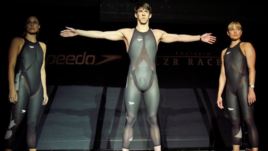
    At the Beijing Games, 108 new records were set. In swimming, 94 percent of the races were won by athletes wearing full-body swimsuits made with engineered materials.

    This ignited a debate over so-called ‘technological doping,’ that materials - like those in the swimsuit - give the 'haves' an unfair advantage over the 'have-nots.'  The governing body for swimming later banned the special suits from competition.

    So if you have technology dominating, or if you have a technology that’s limited to richer nations, then the ethos of fair competition comes into question.

    Boosting performance

    While the full body swimsuits made a big splash in Beijing, new equipment won’t be as visible in London. Most of the technological innovations boosting athletic performance are more evident during the training process.

    Huge amounts of advancement in miniaturisation of sensors, in wireless technologies, in the way athletes communicate with their performance teams, in the way we monitor an athlete’s recovery from a training program, in the way we look at their nutritional status and make changes to what they are eating and drinking and so on.

    The materials engineered for elite athletes, like the strong, flexible carbon fibre used in clubs, rackets and bikes, have also found a solid foothold in the market place. They are common components in cars and airplanes and have been incorporated into the design of modern wheelchairs.  

    Motion tracking is another sports-training innovation, developed for monitoring the swing profile of tennis players and golfers. It is now being used for stroke rehabilitation, where you can look at the gait patterns of the patient and how closely they are to a normal gait pattern.
        
    So, it is clear that there is need to balance innovation and tradition in sport is set to remain an enduring and compelling challenge.


    This question will come up - I suspect - as we role further into the London Olympics. Reason being, if 'significantly' more World and Olympic records are broken in sports that rely heavily on equipment, then, well technological innovation will be called into question.

    Are you listening Gabby Logan?


    Happy Techno Olympics!
    Believe Me: Storytelling Manifesto for Change Makers and Innovators.

    Our brains are wired for narrative. That we not only enjoy tales and yarns (even as adults), structured anecdotes embed meaning that we can easily relate to and understand.

    In contrast, data flooded speed-sheets, after all, have taken over the asylum. People just turn off.

    Tell the facts in narrative form and you have them hooked. 

    So, if you are charged with a change program, or have to get buy-in for a new innovation, or even simply sell an idea or business concept, the book ‘Believe Me’ will highlight points so that you can structure and get your massage (story) across in a way the listener will grab.

    Or to reverse Marshall McLuhan famed message: stories, after all, are the ‘medium’ in which the ‘message’ is truly strung.

    The book is designed for today. Easy and fast to read and take in.

    Tuesday, 24 July 2012

    4 Things You Thought Were True (but)!


    One of the bedrocks of creativity and innovation is to condition the brain to think differently. Not differently as in wacky; but a mind-set that enables new insights in the face of conflicting evidence and age old habitual thinking. After all, if you want an innovative breakthrough or original solution then often you need to challenge conventional wisdom.


    So, here's 4 so-called immutable truths that mostly go unchallenged!

    1. 'You cannot unscramble an egg.' It is too complex and messy to put back together. But, yes you can! Feed it to a Hen. Read Daniel Dennett’s book ‘Darwin's Dangerous Idea,’ and he’ll explain what happens.

    2. 'The earth goes around the Sun!' Yes, but!!! The Sun also resolves around the Earth once every Galaxy cycle in a ‘hyperbolic curve.’ As the Milky-Way Galaxy rotates every 200 million years, the Sun follows an orbit within that Galaxy. So, as the Earth goes around the Sun once a year, the Sun goes around the earth in a sweeping 200 million year hyper-waltz. Picture it above.

    3.  'The Earth is not flat!' But, a flat earth may actually be the case. According to the latest cosmological principles, the Universe is holographic, and basically a 2D plane with the 3rd dimension merely an illusionary projection. The flat Earthers may be right after all.

    4.  'Christopher Columbus discovered America.' But he didn’t. The Polonaise people did by boat thousands of years before, island hopping across the Pacific Ocean. And before that the Intuits crossed a land-bridge from Siberian to Alaska during the last ice-age 10,000 year ago. After all, how did the native Indians get there. DNA tests have given evidence for this: Click here for link.


    Monday, 23 July 2012


    Self ‘Motivation’ in a time of deep economic recession, and recurring negative medium, is quite often difficult to muster.

    So I came across this site containing lists of successful people and their favourite sound bite quotes!


    Warning there are 100s!