The 3Doodler Pen (wotevernext)
Friday, 8 March 2013


 Eradicating the Bottom of the Pyramid: ‘Open Source Ecology’ True Frugal Hyperinnovators
If you don’t know
about ‘Frugal Innovation and the Bottom
of the Pyramid (BoP)’ here’s a
quick précis.
Basically, there 4
billion people on the planet living in a spectrum of relative-to-absolute
poverty. That within that BoP 4-billion, sits approximately 1 billion people living on under 2
dollars a day ($730 per year).
So just over a decade
ago the late Prof. C.K Prahalad proclaimed that the
best way to tackle poverty at the $2
dollars a day BoP, is to fight it by turning it into a profit centred market-space.
A worldwide market worth 7.3 trillion dollars!
Prahalad Hyperlogic is this: if you innovate life
subsistence and enabling products and sell them at a price the BoP can afford and still
make a return, then you set off a virtuous circle. People at the BoP begin you
climb the wall of the Pyramid and out of crisis.
Well that is the
first step in the BoP innovation equation.
A further step is slightly – or fantastically - more ambitious: to innovate systems of
technologies and tools that build basic infrastructure development that supplies clean water and
foods, habitats and agriculture systems, etc, that the BoP can invest in through micro-loans and community pooling investures.
Well, it never ceases
to amaze me on my research into Innovating
to enable the BOP, and I recently came across these guys: ‘Open Source Ecology (OSE).’
OSE explain:
‘Open Source Ecology is a network
of farmers, engineers, and supporters that for the last two years has been
creating the Global
Village Construction Set, an open source, low-cost, high performance
technological platform that allows for the easy, DIY fabrication of the 50 different Industrial Machines that
it takes to build a sustainable civilization with modern comforts. The GVCS
lowers the barriers to entry into farming, building, and manufacturing and can be seen
as a life-size Lego-like set of modular tools that can create entire economies, whether in
rural Missouri, where the project was founded, in urban redevelopment, or in
the developing world.’
OSE
was founded by Marcin JAKUBOWSKI in 2003 and true Hyperinnovator. His ambition is ‘closed-loop
manufacturing a reality.’ His main focus is ‘evolving to freedom by
eliminating resource scarcity as the main force behind human relations - with
the wise use of modern technology adapted for human service.’
And
this is OSE strategy.
‘The Global Village Construction Set (GVCS) is an open
technological platform that allows for the easy fabrication of the 50 different
Industrial Machines that it takes to build a small civilization with
modern comforts. Key Features of the
GVCS: Open Source – Low Cost Modular – user Service able – DIY – Closed-Loop
Manufacturing – Heirloom Design – Flexible Fabrication.’
OSE
say:
‘A modern, comfortable lifestyle relies
on a variety of efficient Industrial Machines. If you eat bread, you rely on an
Agricultural Combine. If you live in a wood house, you rely on a Sawmill. Each
of these machines relies on other machines in order for it to exist. If you distill this complex web of
interdependent machines [Hyperinnovation] into a reproduceable, simple,
closed-loop system, you get these:’
‘The GVCS 50’ in development; 50 tools to
realise their goals.
3 examples:
3D Printer: an additive manufacturing technology where a three
dimensional object is printed by laying down successive layers of material,
just like a printer except in 3D.
3D Scanner A device that can generate a 3D
digital scan from a real-life object, where the file can be used to reproduce
the object in 3D with a device such as the 3D printer or CNC Precision
Multimachine.

Linear Solar
Concentrator an infinitely-scalable, linear device which
concentrates solar radiation onto a linear target for generating heat or steam
to produce electricity.

Click here to see full list.
Also:
‘Download
the CAD data here and the
entire set of CEB Press documentation can be found here, in addition
to the assembly videos. Please watch and download them and drop us a line to
let us know what you thought. Were the videos easy to follow along? Think the
instructions fell short? Were they useful? Do you have suggestions for how to
make them better? We look forward to your feedback.’
OSE Guys, I am truly humbled.
Your project is amazing. Thrilling, actually...It's people like you who really give me hope for the future.
Chris Anderson, TED Curator.
Wednesday, 6 March 2013

The End is Nigh!
What does a self-consistent, intelligent and capable person do? Which
goals are so sound, so promising and so exciting that you can allow those goals
to fully motivate you? Which goals can you embrace in the knowledge that you
stand on a firm foundation, that your thinking is clear, and that you can be a
pioneer to excel in a significant part of a vast new future?
What is more important to you:
competitive patterns of thought or a sequence of DNA? Ultimately, there is
no inherent reason to be more attached to the sequence of nucleotides
that defines the human form than to the one that defines the form of an
ant. The part that is interesting to us is the emergent world of thought and
perception.
If you would like to see a future that includes improvements
beyond our species’ status-quo, then you should work on a transhumanist
strategy that optimizes pattern survival and competition, namely work on
substrate-independent minds and mind uploading. There are signs of a shift from
gene-survival to pattern-survival, and Universal Darwinism favors the pattern
competition winners.
Of all the transhumanist strategies, advancing substrate-independent
minds (ASIM) is both connected with its originating human interests and it most
directly embraces and plays the game of competitive natural selection.
Devices aim to deliver on stem-cell therapies
Bendable needle increases reach of a single injection to the brain
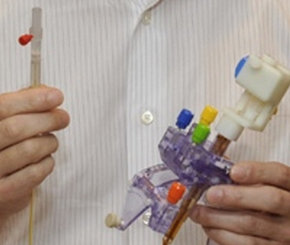
Neurosurgeon Daniel Lim’s injection system can bend sideways, delivering therapeutic stem cells to the brain through fewer holes in the skull (credit: J. Bardi/UCSF)
Working with bioengineers and neurosurgeons, Daniel Lim, a neurosurgeon and stem-cell scientist at the University of California, San Francisco, has designed a needle that bends for for delivering stem cells to the brain,
The device can deposit cells anywhere within a 2-centimetre radius along a track, a volume bigger than an entire mouse brain.
Several researchers hope to use Lim’s device for clinical trials in brain cancer and neurodegenerative disease.
Lim’s device could cut down on the number of injections required for cell treatments and give more precise control of the volume of cells delivered and ensure that the cells delivered into the brain stay in the brain, avoiding the problem of reflux, in which cells injected using straight needles flow back out to the brain surface along the needle’s path.
Also, unlike other needles used for cell therapies, Lim’s device contains no ferromagnetic metals and so is compatible with MRI.
Link to Nature News reports.
I know how to tell who you are thinking about?!
And you have been having an affair with my wife!
But thank luck for that - you can have her!
I just won the lottory!!!!!
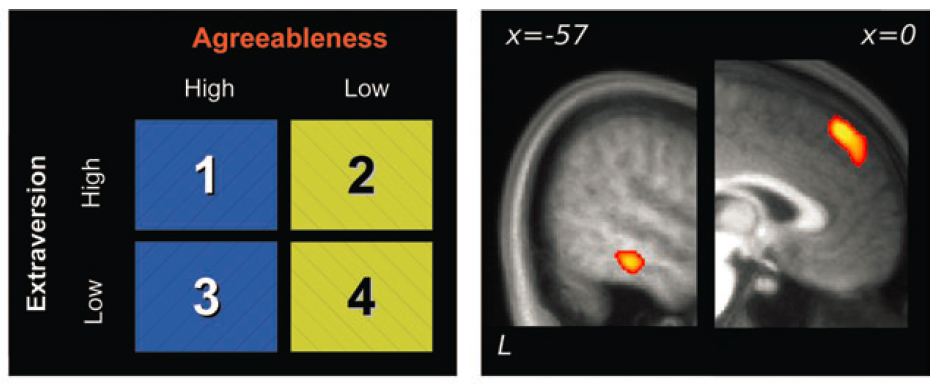
It is possible to tell who a person is thinking about by analyzing images of his or her brain.
Our mental models of people produce unique patterns of brain activation, which can be detected using advanced imaging techniques according to a study by Cornell University neuroscientist Nathan Spreng and his colleagues.
“When we looked at our data, we were shocked that we could successfully decode who our participants were thinking about based on their brain activity,” said Spreng, assistant professor of human development in Cornell’s College of Human Ecology.
Understanding and predicting the behavior of others is a key to successfully navigating the social world, yet little is known about how the brain actually models the enduring personality traits that may drive others’ behavior, the authors say. Such ability allows us to anticipate how someone will act in a situation that may not have happened before.
To learn more, the researchers asked 19 young adults to learn about the personalities of four people who differed on key personality traits. Participants were given different scenarios (such as sitting on a bus when an elderly person gets on and there are no seats) and asked to imagine how a specified person would respond. During the task, their brains were scanned using functional magnetic resonance imaging (fMRI), which measures brain activity by detecting changes in blood flow.
They found that different patterns of brain activity in the medial prefrontal cortex (mPFC) were associated with each of the four different personalities. In other words, which person was being imagined could be accurately identified based solely on the brain activation pattern.
The results suggest that the brain codes the personality traits of others in distinct brain regions and this information is integrated in the medial prefrontal cortex (mPFC) to produce an overall personality model used to plan social interactions, the authors say.
“Prior research has implicated the anterior mPFC in social cognition disorders such as autism and our results suggest people with such disorders may have an inability to build accurate personality models,” said Spreng. “If further research bears this out, we may ultimately be able to identify specific brain activation biomarkers not only for diagnosing such diseases, but for monitoring the effects of interventions.”
Eureka! Intelligent tyre sensors measures vehicle weight


Continental Auto Design Engineers are working to develop a tyre pressure monitoring system that can accurately calculate the weight of a vehicle.
In the past, it was more or less up to drivers to guesstimate to the best of their abilities whether or not the maximum permitted payload of a car had already been reached, says Andreas Wolf, who heads up the company's body and security group.
Future vehicles will be able to tell the driver whether the payload has already exceeded the maximum permitted limit, or whether the tyre pressure would simply need to be adjusted accordingly. In this way, our tyre pressure sensors will not only help to save fuel, but also offer active assistance in terms of vehicle safety.
The ContiPressureCheck system will rely on sensors that can accurately detect the size of the contact patch where the tyre meets the road.
By registering the rolling characteristics of the tyre with every revolution, and taking into account the existing tyre pressure and data about how the tyres are fitted, Wolf says the system will be able to ascertain the vehicles weight after just a few hundred meters of driving.
This data would then be relayed wirelessly to the driver, informing them whether they have exceeded the recommended payload for the vehicle, or whether the tyre pressure should be adjusted.
The 10 Smartest People Alive Today
Judging how smart a person is can be a very subjective matter. Does their IQ score make them the smartest? Or is it more about accomplishments? The debate over this likely will never cease. Below, though, SuperScholar.org took a look at 10 people (in no particular order) nobody would deny are worthy of being called some of the smartest people alive today.
Fifty percent of people have IQ scores between 90 and 110, 2.5 percent of people are mentally deficient/impaired (under 70 IQ), 0.5 percent of people are near genius or genius (over 140,) 2.5 percent of people are very superior in intelligence (over 130).

Tuesday, 5 March 2013


New Plastic Helps Mend Broken Bones
A new type of
plastic someday could make fixing broken bones a snap.
Richard Oreffo, a
professor of Musculoskeletal Science at the University of Southamptonin
England, and colleagues have created a blend of three plastics that is tough
yet highly porous. This may make it an ideal "scaffold" for a broken
bone – a placeholder structure that can be replaced with real bone tissue
as the body heals.
 The polymer
"has this lovely honeycomb structure," Oreffo said. That allows
living cells to "crawl all over it. Blood vessels can
penetrate it. So it's really nice."
The polymer
"has this lovely honeycomb structure," Oreffo said. That allows
living cells to "crawl all over it. Blood vessels can
penetrate it. So it's really nice."
Oreffo's team has
tested the polymer using mice that had parts of their femur bones removed. The
hole was of a size “that won't heal normally," he said. "We can put
these scaffolds into that [gap] and look at their repair over four to eight
weeks."
When the scaffold
was seeded with human bone stem cells,
the bone healed faster, but even without the stem cells, the mice's bones began
to fill in along the scaffolding structure.
In humans, the
structure should serve to repair bone breaks that are too severe to heal on
their own. "If you've had a car accident where you've had significant bone
breaks … ideally, you want your own stem cells in there," Oreffo said.
"This is a real opportunity: A scaffold that can be colonized with the
patient's own stem cells."
In fact, given
enough time, the new material should fully degrade inside a living body,
leaving the repaired bone to stand alone.
The scaffold
material is a blend of chitosan (derived from shrimp shells), polyvinyl acetate
(also a component in Elmer's Glue) and poly-L-lactide, a biodegradable polymer
already used in medical applications.
Researchers
worldwide are pursuing approaches to healing bones using mixtures of scaffolds
and stem cells. A group in Washington state made bone shapes out of a ceramic
powder by using a 3D printer; another method involves creating artificial bones
in a vacuum out of elastic polymers and nanoparticles.
"It's too
early to say one is better than the other. We're looking at a whole range of
approaches," Oreffo said. But, he added, his team’s latest approach has the
advantage of being successful in animal trials.
Monday, 4 March 2013
The Mad Billionaire Behind GoPro
The World's Hottest Camera Company
 Nick Woodman is 37 years old. His
constantly tousled sepia hair and permanent, mischievous half-grin make him
look 27. And he acts 17, as I learn 30,000 feet above the Rocky Mountains,
after Woodman packed me, his wife, Jill, and a dozen of his favorite colleagues
and buds into a chartered Gulfstream III en route to Montana’s Yellowstone
Club, the most exclusive ski hill in the U.S.
Nick Woodman is 37 years old. His
constantly tousled sepia hair and permanent, mischievous half-grin make him
look 27. And he acts 17, as I learn 30,000 feet above the Rocky Mountains,
after Woodman packed me, his wife, Jill, and a dozen of his favorite colleagues
and buds into a chartered Gulfstream III en route to Montana’s Yellowstone
Club, the most exclusive ski hill in the U.S.
Already hopped up on Red Bull, tempered
by a liter of coconut water, Woodman darts about the cabin, occasionally
breaking conversation to unleash his trademark excited wail that friends liken
to a foghorn. “YEEEEEEEEEEEEEOW.” A flight attendant emerges with breakfast on
a silver platter. “You know what the best thing about morning ski trips are?”
he asks the cabin rhetorically. “McDonald’s!” And with that he inhales a
McGriddle in all of three bites.
The
man-teen routine is more than an act: It’s the recipe for how he’s become one
of America’s newest and youngest billionaires.
A decade ago Woodman craved a camera he could strap to his wrist so that his
buddies could see his surfing exploits. The result is now a consumer phenomenon
called GoPro, America’s fastest-growing digital imaging company.
Go
anywhere active these days, whether it’s the mountains of Vail or the
scuba-diving depths of Honolulu’s Hanauma Bay, and you’re bound to see a GoPro
or 20. Kids these days don’t film their wave rides or half-pipe tricks. They
GoPro them, strapping the $200 to $400 cameras to helmets, handlebars and
surfboards. The cinema-grade, panoramic “point-of-view” footage that comes out
of a GoPro transforms mere mortals into human highlight reels, without blowing
a huge hole in the budget. Shaun White, who says he used to tape old cameras to
his hand, used GoPros on his runs during the Winter X Games. Hollywood
directors, including Michael Bay, keep
crates of them on set. The NFL has tested them in their end zone pylons to
capture touchdown replays. The Rolling Stones deployed them on stage. Police
forces and the U.S. military have started to incorporate the cameras into
training exercises. Woodman, who calls it a “life” camera, proved the point by
wearing one on his chest at the deliveries of his sons. On the plane to
Montana, Woodman’s GoPro crew rigged their devices in every cranny in the
cabin, including on the pilots’ heads, to document their journey.
GoPro
sales have more than doubled every year since the first camera’s debut in 2004.
In 2012 the company sold 2.3 million cameras and grossed $521 million,
according to Woodman; with $100 million in sales in January alone, that annual
figure should again double this year. For the month of December GoPro was the
highest-grossing digital imaging brand at Best Buy, knocking out Sony for
the first time in the chain’s history. Just ten years old, GoPro was
responsible for 21.5% of digital camcorder shipments nationwide in the first
half of 2012, according to IDC data. Among “pocket camcorders” that figure
swells to a third.
This
type of growth and niche dominance have made for a “rad” business proposition,
with Chinese electronics manufacturer Hon Hai Precision Industry
Co., better known as Foxconn, making a $200 million investment in GoPro in
December. That valued the San Mateo, Calif. firm at $2.25 billion and shot
Woodman, who sources say still owns about 45% of the company, onto the FORBES
World Billionaires list with a net worth of $1.3 billion.
It’s a head-spinning turn of events for
a 37-year-old Peter Pan running a billion-dollar technology company. As he
barrels through Yellowstone’s freshly groomed powder in a pea-green helmet,
it’s clear he’s found bliss. “YEEEEEEEEEEEEEEEOW,” he howls from his bloodied
and chapped lips as he GoPros his every turn.

Thursday, 21 February 2013
Japan
Expectant parents in Japan

The nine-centimetre resin model of the white
foetus, encased in a transparent block in the shape of the mother's body, is
fashioned by a 3D printer after an MRI scan.
"As it is only once in a lifetime that you
are pregnant with that child, we received requests for these kind of models
from pregnant women who... do not want to forget the feelings and experience of
that time," said Tomohiro Kinoshita of FASOTEC, the company offering the
service.
The "Shape of an
Angel", which costs 100,000 yen (£1000), comes with a miniature version
that could be a nice adornment to a mobile phone, he added. Many young women in
Japan
The company said the
ideal time for a scan is around eight or nine months into the pregnancy.
It will use ultrasound images taken at a medical
clinic in Tokyo
FASOTEC, originally a supplier of devices
including 3D printers, uses a layering technique to build up three-dimensional
structures. The technique has been touted as a solution to localised
manufacture on a small scale.
 Kinoshita said the company hit upon the idea of
making 3D models of unborn babies in the hope that people would become more
aware of the technology.
Kinoshita said the company hit upon the idea of
making 3D models of unborn babies in the hope that people would become more
aware of the technology.
The company said some medics could also foresee
diagnostic possibilities with the models that may help predict difficulties in
the birthing process.
Three-dimensional printers have been around for
several decades but advances in the technology mean it is now gaining in
popularity in several fields.
Sunday, 10 February 2013

If you are into the future in a rational way then this magazine will blow you away! It has a ultramodern feel and content that is smack bang up to date.
Click to review
Click for back issues.
The Fantastic Voyage
 Ray Kurzweil and Terry Grossman have put together another breakthought text that anyone serious about living for a lot longer than you first though must read.
Intro:
‘Immortality is within our grasp… In Fantastic
Voyage, high-tech Ray Kurzweil teams up with life-extension expert Terry
Grossman, M.D., to consider the awesome benefits to human health and longevity
promised by the leading edge of medical science
– and what you can do today’s to take full advantage of these starting advances.
Citing extensive research findings that surround as radical as the most
speculative science fiction, Kurzweil and Grossman offer a program designed to
slow aging and disease processes to such degree that you should be in good
health and spirit when the more extreme life-extension and life enhancing
technologies – now in development – become
available. The bridge to the future will enable those who dare to make the
journey from century to the next…. And beyond!’
Click here to review.
MaxLife: Where Biotech, Infotech and Nanotech Meet to Reverse Aging by 2029.
 On the theme of radical life-extension and age
reversal, here’s an interesting website:
On the theme of radical life-extension and age
reversal, here’s an interesting website:
MaxLife asks lots of questions and gives some
interesting answers to the longevity question. There are plenty of links to
within and to other sites on the subject.
Take a few minutes to explore the future of long-healthy-living.
How Far Away is Nanomedicine?
Read Robert Freitas Book:
‘Nanomedicine Volume I: Basic Capabilities.’
‘The
coming ability to carry out targeted medical procedures at the molecular level
will bring unprecedented power to the practice of medicine. Within a few short
decades we can expect a major revolution in how the human body is healed. Nanomedicine
lays the foundations for understanding this revolution and points to where it
is taking us.’
E
Drexler.
 Nanomedicine
might seem a little esoteric for an off the shelf read, but I have to say I was
over whelmingly surprised to the point where I couldn’t put it down. In fact,
for any aspiring medical physicians out there, before or in the early stages of
your careers, I strongly recommend it. After all 10 years hence you are going
to be up to your neck in this tiny world nanorobots and artificial hemoglobin.
Nanomedicine
might seem a little esoteric for an off the shelf read, but I have to say I was
over whelmingly surprised to the point where I couldn’t put it down. In fact,
for any aspiring medical physicians out there, before or in the early stages of
your careers, I strongly recommend it. After all 10 years hence you are going
to be up to your neck in this tiny world nanorobots and artificial hemoglobin. And it’s the
same for any future Engineer, Designer, Architect, or anybody who is in the
creative-build business; this book will give you untold insights into the
future of Nanoscale Engineering and Architecture.
And it’s the
same for any future Engineer, Designer, Architect, or anybody who is in the
creative-build business; this book will give you untold insights into the
future of Nanoscale Engineering and Architecture.
Read the
piece on the history of empirical medicine, you’ll see how far we have come
today and how far we can go tomorrow.
A PDF
version of the book is available by clicking here.
 But I would
say, get hold of a Hardback copy for a keepsake. After all, it
is the world’s first volume on perhaps the most significant medical breakthrough
since ‘Hippocratic Corpus (ca. 440-340 BC) the foundation of Greek written
medicine, explicitly grounds the art upon a quite different basis — a healing
system independent of the supernatural and built upon natural philosophy; and
of course Galen of Pergamum (130-200 AD) providing the final medical synthesis
of antiquity and the effective medical standard for the next 13 centuries; and of
course.’ Now where did I get that?
But I would
say, get hold of a Hardback copy for a keepsake. After all, it
is the world’s first volume on perhaps the most significant medical breakthrough
since ‘Hippocratic Corpus (ca. 440-340 BC) the foundation of Greek written
medicine, explicitly grounds the art upon a quite different basis — a healing
system independent of the supernatural and built upon natural philosophy; and
of course Galen of Pergamum (130-200 AD) providing the final medical synthesis
of antiquity and the effective medical standard for the next 13 centuries; and of
course.’ Now where did I get that?
Click
here for preview of Hard Copy Book.
Friday, 8 February 2013
Lean Six Sigma for
Service: How to Use Lean Speed and Six Sigma Quality to Improve Services and
Transactions, by Michael George

I
recall back in 1989, my boss Tony Lawrence (then Design Director at Concord
Lighting) and I taking a long winding motorway trip to Lucus Aerospace Systems, Coventry, UK.
Back
then, it was a bit of an can-opener
to the world of not merely world class quality assurance in new product
development; but the commitment to what it takes to achieve a status where literally
products have less than 1.3 defects out of one million: yes 1.3 out of
one-million units!
For
those of you who are unfamiliar with 6-Sigma, it is a fact these days that 1.3 Parts Per Million (PPM) quality assurance is becoming standard. And because
of that, customers expect that level of quality in everything, and that includes
not just consumer gadgets, but trips on holiday, banking transaction, shopping
experience, even hospital treatment and – yes – even YMCA hostels are beginning
to look at 6-Sigma.
The
good news is that 6-Sigma is now being rolled-out in the service industries too.
 In
fact, the UK’s Royal Wedding last year was a 6-Sigma occasion (and now you know
why it went so smoothly). Now Marks and Sparks, many large scale Law firms, and
many of the best practice service institutions such as Bank One (Chase
Manhattan) and Stanford University Hospital are adopting 6-Sigma.
In
fact, the UK’s Royal Wedding last year was a 6-Sigma occasion (and now you know
why it went so smoothly). Now Marks and Sparks, many large scale Law firms, and
many of the best practice service institutions such as Bank One (Chase
Manhattan) and Stanford University Hospital are adopting 6-Sigma.
The book: Lean Six
Sigma for Service: How to Use Lean Speed and Six Sigma Quality to Improve
Services and Transactions, really does move all this on. It is practical,
insightful and above all, useable with plenty of references to other reverent sources
of information.
Ending Aging, by Aubrey de Grey
Aubrey de Grey is an English author and theoretician in the field of gerontology and
the Chief Science Officer of the SENS Research Foundation. He is editor-in-chief of
the academic journal Rejuvenation Research, author of The Mitochondrial Free Radical Theory of Aging.
He is perhaps best known for his view
that human beings could, in theory, live to life-spans far in excess of
that which any authenticated cases have lived to today.

 De Grey's research focuses on whether regenerative medicine can thwart the aging
process. He works on the development of what he calls "Strategies for Engineered Negligible Senescence"
(SENS), a tissue-repair strategy intended to rejuvenate the human body and allow negligible senescence.
De Grey's research focuses on whether regenerative medicine can thwart the aging
process. He works on the development of what he calls "Strategies for Engineered Negligible Senescence"
(SENS), a tissue-repair strategy intended to rejuvenate the human body and allow negligible senescence.
To this end, he has identified seven
types of molecular and cellular damage caused by essential metabolic processes.
SENS is a proposed panel of therapies designed to repair this damage.
The book ‘Ending-Aging’ is not a
technical book at such, but it does have few heavy medicine themes in to. However,
de Grey is the one to watch when it come to the end of aging.

Thursday, 7 February 2013

The author of this book changed his name to FM2030 to represent his passion and belief in the distant future.
Your name, for example, reflects your ancestry and history. His scribe represents the future. He wrote this futures book while suffering a terminal illness back in the 1970s.
It is profound, embedded with some big surprises. Dare you read it!
Wednesday, 6 February 2013
Printable Organs? Breakthrough: 3D-Printed Stem Cells

Researchers claim that they have cracked the code when it comes to using 3D printing to create stem cells — so what happens next?
Unfortunately, organ donors are few and far between. Even if you have a potential match, after spending a long time on a waiting list, conditions worsen and an organ may not be accepted. The lack of available organs is one that causes hospitals to enter continual battles over the rationing of such resources. As a surgeon I know told me, this can not only strain the relationship between different hospitals, but of course also impact patients.
So what can be done, except finding artificial methods to prolong life until organs become available, or creating substitutes for organs?
A new technique, pioneered by researchers at Heriot-Watt University in Scotland in collaboration with stem cell technology company Roslin Cellab, uses 3D-printing technology — otherwise used in robotics, gun manufacture and as a replacement for photography — in the hopes to eventually eliminate the need for organ donation, immunosuppressant drugs and organ transplant rejection.
The new valve-based process takes advantage of the fact that stem cells can now be grown in labs. A printer creates a three-dimensional sphere which contains delicate embryonic cell cultures that float in a liquid medium. These cells are then built up using an adjustable “microvalve” to create layers and encourage cells to spawn.
As stem cells can become any organ in the body, being able to quickly produce them could result in 3D-printed organs specifically tailored to a patient’s body.
Dr. Shu said:
“In the longer term, we envisage the technology being further developed to create viable 3D organs for medical implantation from a patient’s own cells, eliminating the need for organ donation, immune suppression and the problem of transplant rejection.”
The team say this is the first time that cells have ever been printed using 3D-printing techniques. More importantly, the cells survived the experimental process, and in the first stages the breakthrough will be used to develop drug-testing products.
Jason King, business development manager of Roslin Cellab, commented:
“Normally laboratory-grown cells grow in 2D but some cell types have been printed in 3D. However, up to now, human stem cell cultures have been too sensitive to manipulate in this way.This is a scientific development which we hope and believe will have immensely valuable long-term implications for reliable, animal-free drug-testing and in the longer term to provide organs for transplant on demand.”
Subscribe to:
Posts (Atom)