Monday, 30 September 2013


Intel’s investment arm, Intel Capital, last week made a “significant” investment in Recon Instruments, a Canadian startup, which makes heads-up displays (HUD). This investment is now seen as a potential Intel entrance into the wearable computing market, an alleged revolution in computing, which some say could earn tech firms billions of dollars.
Recon has been developing its wearable offerings for the past five years, creating HUDs for the most active of users. At present the company offers an unobtrusive display which can be used with third-party snow goggles for $199. In March 2014, however, the company plans to release Jet, a pair of glasses meant to be used by bikers, runners and even woodsman, which looks to outperform Google’s Glass for nearly half the price. In a press release, Recon said it has already sold 50,000 HUDs before briefly mentioning a partnership with Apple.
“Wearable computing is a major, accelerating phenomenon that re-defines how we use and interact with information,” said Mike Bell, the vice president and general manager of the new devices group at Intel, in a press statement. “In Recon Instruments, we see compelling technology and a solid strategy to capitalize on the wearable revolution. This is an area of significant focus for Intel Capital, and our investment in Recon Instruments is a key part of our approach to innovation in this emerging space.”
Though neither company has given any specific information about how much money has been invested, Recon says it’ll use the money to support “product development, market and global sales expansion.” The company also says they plan to benefit from Intel’s experience in “manufacturing, operations and technology,” further hinting towards a possible piece of wearable tech from Big Blue.
It’s interesting Intel chose only to invest rather than buy the company outright. With this investment Intel is essentially ensuring it will be able to buy the components it wants when the time comes. This also means companies such as Apple can also use these components in any potential device as well. Though he doesn’t mention any specifics, Recon CEO Dan Eisenhardt claims his company is already working with Apple.
“We have spent the last five years leading the Heads-Up Display category in the consumer space. In fact, Recon has shipped more than 50,000 Heads-up Displays worldwide, including a very successful campaign in Apple retail stores,” said Eisenhardt.
Like Intel and even Microsoft, Apple has only been rumored to enter the wearable market. While most rumors suggest Apple will be building an iWatch, CEO Tim Cook has briefly discussed an interest in glasses as well. During the All Things D conference in May, Cook called Google Glass “difficult” before saying, “we have more game changers in us.”
Recon’s Jet glasses are available now for pre-order for $599, considerably less than Google’s $1,500 Glass. Jet weighs only 28 grams (less than an ounce) spread out evenly across the device and packs in a dual-core 1GHz processor, Wi-Fi antennas, Bluetooth, GPS, HD cameras and the usual assortment of sensors.
Though immediately helpful for athletes, Recon also says these glasses can be used by doctors or any other profession that needs information beamed to their eyes while they’re hands are otherwise occupied.
Michael Harper for redOrbit.com – Your Universe Online

Thursday, 19 September 2013

Oxford researchers say that 45 percent of America’s occupations will be automated within the next 20 years


'Rapid advances in technology have long represented a serious potential threat to many jobs ordinarily performed by people. A recent report from the Oxford Martin School’s Programme on the Impacts of Future Technology attempts to quantify the extent of that threat. It concludes that 45 percent of American jobs are at high risk of being taken by computers within the next two decades. The authors believe this takeover will happen in two stages. First, computers will start replacing people in especially vulnerable fields like transportation/logistics, production labor, and administrative support.

Jobs in services, sales, and construction may also be lost in this first stage. Then, the rate of replacement will slow down due to bottlenecks in harder-to-automate fields such engineering. This “technological plateau” will be followed by a second wave of computerization, dependent upon the development of good artificial intelligence. This could next put jobs in management, science and engineering, and the arts at risk.

These results were calculated with a common statistical modeling method. More than 700 jobs on O*Net, an online career network, were considered, as well as the skills and education required for each. These features were weighted according to how automatable they were, and according to the engineering obstacles currently preventing computerization.

'Our findings thus imply that as technology races ahead, low-skill workers will reallocate to tasks that are non-susceptible to computerization — tasks that required creative and social intelligence. For workers to win the race, however, they will have to acquire creative and social skills.'


Really?

Spoken like true academics and the vision of bat. My new book which will be out early next year, has a number of chapters on just this issue. Those automation systems, industrial and service robots and ubiquitous computerization will cull 90 percent of blue collar jobs in under a decade. And eventually march into white collar, more complex care, and higher thinking roles over the following decade.

For example, here's some jobs that will not exist after 2025.
  • Domestic robot maintenance.
  • Domestic instant production technology maintenance fitters.
  • Fast food servers.
  • Office administrators.
  • DJs.
  • Taxi drivers.
  • Pilots.
  • Dog walkers.
  • Painters and Decorators.
  • Trawler Fishermen.

Basically, tasks that can be simply repeated, robots and smart systems will undertake them.

But it is not all doom and gloom, and for many quite good:

10s of millions of new, unheard of jobs will be invented over the next 20 years. Many of the jobs created will not even look as though people are working, but having fun, adventure and theatrics. 

But more, the majority of the new fangled jobs will be further and further up the food value food chain, meaning better pay and conditions. And further, these new jobs will be in industries most have no idea of now, such as Consumer Tourist Space Travel Agent, Deep Ocean Marine Farmer, F1 Flying Car Grand Prix Racing Drivers; Life Extension Therapists, Solar Energy Engineers, Nanomanufacturing Design Engineers, Cognitive Enhancement Clinicians, and countless more!... It is gonna be existing even way before the Singularity is here!

The core issue, as you can see, is our kids, today's mid career professionals and blue collar craftsman must re-imagine their work life-cycle. Innovation, Entrepreneurism, and Enterprise must shoot up the agenda!

Keep in reading, I will be rolling out snippets of my new book toward the end of the year.
Entrepreneurship taught in schools?

This is a Bee on my bonnet issue. I have talked to much officials in the UK about getting Innovation, Enterprise and (below) Entrepreneurism in high school curriculum.

 Tyler Falk, writes a buzz article about the ‘E’ in Smartplanet.blog

'“Entrepreneurship is one of the fastest growing subjects in today’s undergraduate curricula,” according to the Kauffman Foundation. 

On college campuses in the United States, the number of courses on entrepreneurship have increased from 250 in 1985 to more than 5,000 by 2008 (PDF). 

But should the U.S. education system offer more of these courses earlier on in a student’s academic life?...

...NFTE’s conclusion from the results: “Entrepreneurship education is the fundamental tool for helping young people from low-income communities see a bigger future for themselves.”'

I will be head butting this into the public domain next year.

See Tylers whole article.


    Why electric car prices could plummet by 2020

    If car companies are true to their word, 2020 is set to be a good year. That’s because numerous car companies — including Nissan, GM, and Mercedes — say they expect to have fully-driverless (or nearly-driverless) cars on the market by the end of the decade. Now, an executive of one of the largest lithium-ion battery makers in the world says that he sees the cost of expensive batteries used in electric vehicles decreasing by half by 2020, as the Wall Street Journal reports:
    “We have an internal target to go down by at least a factor of two by 2020,” said Prabhakar Patil, chief executive officer of LG Chem Power Inc., a division of one of the world’s largest lithium-ion battery makers, LG Chem Ltd. “I am very positive in terms of the slope that I see.”
    But while it’s a positive outlook, there will be some things that need to change before we can start seeing truly significant price cuts on EVs and hybrids.
    Brian Kesseler, the president of Johnson Controls Inc.’s JCI Power Solutions division said cell costs may indeed fall by half, but overall costs of battery packs, which include the control systems that surround the energy source, are unlikely to decline that quickly without standardization across different auto makers.
    Still, it’s news that companies like GM and Tesla are betting on. Both say they are working on along-range electric car that will sell for around $30,000. Reducing battery costs will be key to making that a reality.
    The first private mission to Mars will launch in 2018 and use poop for radiation shielding


    'Dennis Tito, the world’s first space tourist, plans to send a married couple to Mars in 2018. The married couple will leave Earth in January, orbit Mars at an altitude of 100 miles (160km) in August, and then return home. The entire journey will last a total of 501 days; the longest continuous time ever spent in space. Spending so long in space will result in the astronauts being bombarded by a lot of solar radiation, increasing their risk of developing cancer by 3% — but Tito’s CTO has a plan: creating a radiation shield out of the astronauts’ poop.....'

    Wednesday, 18 September 2013

    NASA discusses its warp drive research, prepares to create a warp bubble in the lab


    Harold White's possible warp drive, and star ship
    'Late last year, it emerged that a small team of NASA researchers were working on warp drive technology in the lab. Led by Harold “Sonny” White, the team devised a variation of the Alcubierre warp drive that could almost be feasibly produced — if we can work out how to produce and store antimatter. Now, White is ready to discuss some other facets of his warp drive, such as the energy requirements, what a spacecraft with a warp drive would look like, and what it would be like to travel at warp speed.'
    It's 2023 in London. You can make a phone call on your watch and report a traffic jam with a button on your glasses. But how will we really live, work and play? What kinds of constraints and opportunities will future Londoners face?

    This series of imaginary Londoners was produced for a workshop in September 2013 by a collaboration between Arup, Social Life, Re.Work, Commonplace, Tim Maughan and Nesta. They build on the team's knowledge, from urban neighbourhood engagement to smart technologies in the city. These profiles can never be perfect or all inclusive. They are a tool for exploring the needs and desires we should consider when designing a smarter London. More details: background information and the key urban trends we developed.   


    Sessions 2 and 3 of TEDCity2.0 in New York will be streamed live at Nesta on the evening of 20 September. 


    Consulting industry braces for disruption 


    By 


    'It was only inevitable that the consulting industry — which has long been telling everyone else they were being disrupted — would be disrupted itself.
    Photo credit: Joe McKendrick
    Photo credit: Joe McKendrick
    Clayton Christensen, the Harvard professor who defined the disruption paradigm, teamed up with co-authors Dina Wang and Derek van Bever to look at the near future of the consulting industry.
    Until now, consulting firms, which are structured to be agile, have been relatively immune from disruptive forces, unlike more rigid businesses such as automobiles and steel. This is about to change, Christensen and his co-authors write in The Harvard Business Review. Typically, industry leaders tend to cede the lower ends of their markets to upstarts, while they are chased upstream to the higher-margin customers.
    Accordingly, Christensen and his co-authors observe, the biggest consulting companies — McKinsey, Bain, and Boston Consulting Group (BCG) — are seeing fewer large strategic engagements, and more “value-based pricing” arrangements.
    For a prime example of what will likely happen to consulting, look to the legal industry in recent years, Christensen and his co-authors point out.  A new generation of upstart legal services, offering 24-hour service and menus of commodity-priced items, has already usurped large segments of the market.
    Consulting businesses face competition from upstart firms which subcontract project work to freelancers, who are often experienced consultants themselves. These alternative firms also take on smaller clients not served by the large consulting firms.
    The authors see four scenarios unfolding for the consulting industry: consolidation, growing bases of smaller clients, more cross-disciplinary firms (such as the big four accounting firms offering a wide range of professional services}, and increasing adoption of big data analytics.'
    Start your week smarter with our weekly e-mail newsletter. It's your cheat sheet for good ideas. Get it.

    Tuesday, 10 September 2013

    NEURO-AMPLIFIER 

    We are about to get smarter 
    (and it's Legal)!


    NEURVANA Family of Neuroamplifier-High Performance Products amplifies neurotransmitters for longevity, improved mental activity, slower aging, peak performance and youthfulness. 


    They rapidly create beneficial effects on your mood, cognition, energy, focus, stamina, pleasurable feelings and awareness.

    NEURVANA provides natural drug-free alternatives to stimulants, sleep meds and more. Formulations are available for peak body-and-mind performance, mood elevation, sleep, anxiousness, weight loss and sexual enhancement.


    Link to Neurvanaproducts.

    Thursday, 5 September 2013

    Brain Hacking

    Is technology now mature enough to allow hackers to penetrate our mind?


    Brain hacking refers the possibility to attack the human brain to extract sensitive information such as data and memories, including also the capability to inject new information. Hacking the brain makes possible the disclosure of sensitive information such as the debit card PIN, home location and month of birth. Exactly as any other information processor, the human brain may be vulnerable to hacking attacks, and state of the art of technology already allows researchers to measure changes in the electromagnetic field related to brain activity enabling the reading of peoples’ thoughts.
    Neurotechnologist Philip Low is currently working to the designing of a portable brain monitor called iBrain that can detect the brain’s electrical activity from the surface of the scalp, individuals with amyotrophic lateral sclerosis or similar pathologies still have healthy brain activity and the iBrain could be used to control a mouse pointer on a computer screen. But also the device might be used to hack the brain.
    Recently researchers at the Usenix Security conference have demonstrated that exploiting a zero-day vulnerability in a brain computer interface it is possible hack it. The scientists used a commercial off-the-shelf brain-computer interface for the brain hacking, resulting in the disclosure of private information that victims had in their minds.
    The brain-computer interface consists of several components
    • the hardware composed by a (an EEG; an electroencephalograph) equipped with a series of sensors that are placed directly on the human scalp
    • the software designed to interpret brain activity signals
    The price for a Brain Computer Interface device has steadily decreased in the last several years, and today just $200-$300 is sufficient to buy an Emotiv or Neurosky BCI. With these devices one is immediately able to control the computer by thought.
    Brain hacking emotiv
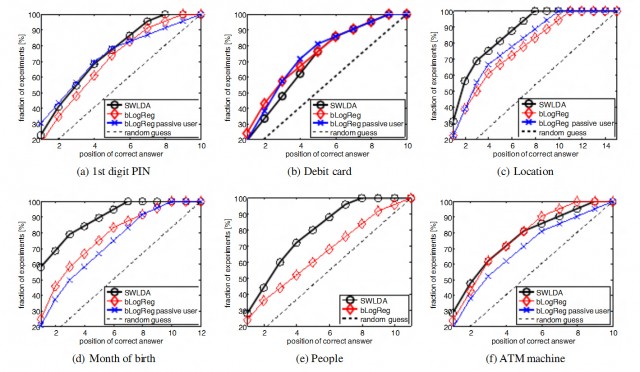
    Brain Computer Interface devices generally come with an API which developers use to build applications based on the BCI’s output.  Researchers from the Universities of Oxford and Geneva, and the University of California, Berkeley for example have designed an application able to access to sensitive data in the human brain. The following graphs illustrate the results of the tests conducted with 28 participants, it is important to specify that participants in the program were cooperative because they were not aware of the brain hacking.
    brain hacking data
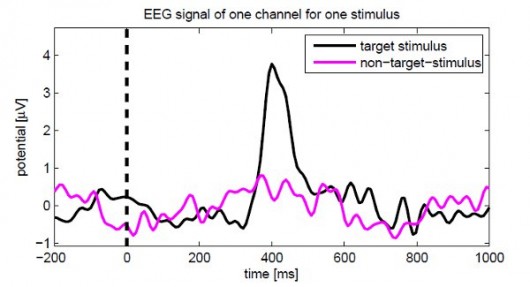
    The information reading is based on the analysis of P300 response brainwave pattern defined by Wikipedia as:
    “The P300 (P3) wave is an event related potential (ERP) component elicited in the process of decision making. It is considered to be an endogenous potential, as its occurrence links not to the physical attributes of a stimulus, but a person’s reaction to it. More specifically, the P300 is thought to reflect processes involved in stimulus evaluation or categorization.”
    brain hacking P300 response
    The pattern is observable when humans see something that is meaningful or recognize something that is related to their current task.
    “The researchers basically designed a program that flashes up pictures of maps, banks, and card PINs, and makes a note every time your brain experiences a P300. Afterwards, it’s easy to pore through the data and work out — with fairly good accuracy — where a person banks, where they live, and so on.”
    The attacks appear to be ineffective with noncooperative subjects; this means that this technique is not usable during an interrogation, but victims could still be deceived with social engineering techniques. For example, they could led to believe they participating in a simple test or they could be told they are playing a video game controlled by the brain.
    So, brain hacking is reality! Hackers soon could be able to extract sensitive data from a human brain with high reliability. Moving forward we can imagine malware able to compromise our brain by capturing the electric impulses generated by our brains.What will be the next step? What could be the effect of an even more malicious attack on the human mind?
    The principal nightmare is related to mental modification, the possibility to alter the state of a human brain in situ, transforming the human perception of reality. But brain hacking could also focus the brain in an extreme state, such as extreme anger or fear, or move the mind in what is called “in the zone” status. Working “in the zone” might allow conventional hackers to work with extreme focus and concentration for extended periods of time or to consider more complex tasks and attacks.
    The zone state is characterized by a specific signature in the brain activity that could be artificially reproduced.
    “The Neurotech company Berka runs are developing technology to monitor people’s brain activity during a task, such as archery, and notify them when they have reached their “peak performance state,” aka, the zone. Essentially, the technology gives people the ability to hack into their own brains in order to improve their performance.”
    The future is now … let’s start to think how to secure our brains!

    When 3D Printing is a Matter of Life and Death


    Mashable Spotlight

    I've personally been involved with advanced manufacturing systems for over 30 years now; and in last 20 odd years 3D Printing (3DP) and additive manufacturing. I saw its birth in 1996 with Chuck Lee's 3D Stereolithography machine printing 3D physical objects. Almost 20 years on 3D printing is still in its infancy and still at the early adopter stage of market adoption and diffusion.

    But, it never fails to amaze me what comes out of the blue. Here's a snippet from Mashable Spotlight, which presents in-depth looks at the people, concepts and issues shaping our digital world.


    'When Kaiba Gionfriddo was born prematurely on Oct. 28, 2011, everything seemed relatively normal. At 35 weeks, his doctors' main concern was lung development, but Kaiba was breathing just fine. Doctors deemed him healthy enough to send him home within a few days.
    Six weeks later, while the Gionfriddo family — parents April and Bryan, and two older siblings — were eating dinner at a restaurant, Kaiba stopped breathing and turned blue. After 10 days in the hospital and another incident, physicians diagnosed the infant with severe tracheobronchomalacia; his windpipe was so weak that his trachea and left bronchus collapsed, preventing crucial airflow from reaching his lungs. So Kaiba underwent a tracheostomy and was put on a ventilator, the typical treatment for his condition.
    It didn't work. Almost daily, Kaiba would stop breathing and his heart would stop. The prognosis wasn't good. So his doctors tried something revolutionary: a 3D-printed lung splint that could save his life.'
    Click to read rest of article: Link to Mashable Site of 3DP

    Monday, 26 August 2013

    Hyperreggae!

    In my book Hyperinnovation I talk of how ideas within culture are rapidly interconnecting across intellectual boarders. 

    Here are 2 posters a friend sent me via my Facebook. They are advertising Reggae Gigs in Thailand. 

    Not from West Indian origins or even Ethiopia. The band are indigenous Thai People gone Raster!

    The multidimensional interconnection of idea holds no bounds!


    Saturday, 24 August 2013


    Sparks of Brilliance: Your Invitation
    Creativity is the essence of our humanity, the great enricher of our lived experience, and the key to our shared resilience. It is found in every person and in every field and endeavor.
    But where does our creativity come from? Necessity or daydreams? Ambition or laziness? Purpose or play? Natural genius or rigorous process? All of the above … or some other, nameless place? Can it be taught or amplified? How is the creative instinct expressed differently in business, the sciences, society and the arts? What can these learn from each other? What does science reveal about the inventive mind? How do new platforms of connection and collaboration change the process of innovation? What new imperatives do they create? And how do we meet a world of fierce challenges with a spirit of creative possibility?
    October 24-26, 2013, PopTech will convene a group of imaginative visionaries from many different fields for a joyful, jaw-dropping, urgent, anti-disciplinary exploration of creativity in the 21st century. We invite you to join us!

    What You’ll Experience
    Each year, PopTech welcomes 600 leaders in business, industry, science, technology, design, social and ecological innovation, the arts and humanities, philanthropy and many other fields to come together for three days in the beautiful seaside town of Camden, Maine. In a beautifully restored, 19th-century opera house, and at events throughout the surrounding town, participants meet in an authentic and informal setting, sharing breakthrough ideas at the edge of change.
    Bold and visionary presentations from some of our world’s most compelling innovators are interwoven with extraordinary live performances and other one-of-a-kind surprises. The tone is at once intimate and expansive, and designed to foster deep relationships and the space and time to think, reflect, connect, and collaborate. At PopTech, you will meet dozens of people doing some of the most innovative and vital work in the world. You will be able to share your work with an engaged and influential community. You’ll take home powerful new innovation insights. Most importantly, you will meet some unbelievable people who are fantastic potential partners, allies and friends.

    But the PopTech experience does not have to end there. For our annual convening is also the hub of a year-round community of global innovators, working in more than 100 countries. For those who wish it, participating in PopTech provides meaningful entrée into a network that is collaborating on new and creative approaches to some of the world’s toughest challenges.