Wednesday, 11 July 2012

How the Tupac ‘hologram’ works


Tupac Shakur appeared in concert at the Coachella music festival Sunday night, wowing audiences who watched his image rap with Snoop Dogg.


And now, the Wall Street Journal is reporting (with the puntastic headline “Rapper’s De-Light”) that the late rapper, despite having died in a shooting 15 years ago, may be going on tour.
The image of the rapper is not, in fact, a hologram. The 2D-image is an updated version of a stage trick that dat


es to the 1800s. In the old version, an actor would hide in a recess below the stage as stagehands used mirrors to project the image of a ghost.Tupac Shakur appeared in concert at the Coachella music festival Sunday night, wowing audiences who watched his image rap with Snoop Dogg.
According to a 1999 patent uncovered by theInternational Business Times, the trick used by the company AV Concepts employs an angled piece of glass placed on the the stage to reflect a projector image onto a screen that looks invisible to the audience.
The team pulled together Tupac’s performance by looking at old footage and creating an animation that incorporated characteristics of the late singer’s movements.
AV Concepts president Nick Smith told the Journal that the company had used the technology to digitally resurrect some deceased executives — though he gave no details on that. The patent on the technology shows an example of a presentation where the presenter is on stage with the projected image of a car.
Over at MTV, writer Gil Kaufmann questioned whether the success of the virtual Tupac would set a trend, particularly for performances including multiple artists. The potential for a surprise appearance from a beloved celebrity performer could be a draw for audiences.
But the trick could be overused, Kaufmann wrote: “For example, if Paul McCartney announced a tour with a virtual John Lennon, Beatles fans would likely see that as being in bad taste and not show up.”
Speaking to Kaufmann, Dave Brooks of the magazine Venues Today said that the trick could have gotten tired quickly even in the Coachella performance, but that the effect was impressive when used sparingly.


Superyacht Toys:

New Spire Boat to Debut at Monaco Yacht Show

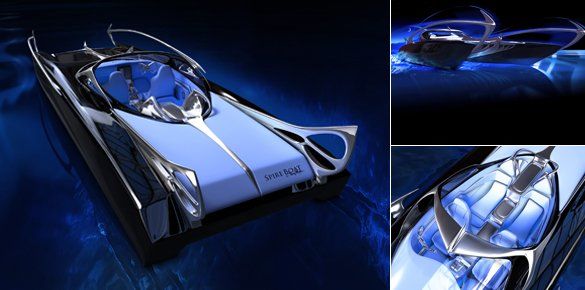
Powerboat specialist Spire Boat is to showcase its stunning new 9.5-metre concept, the Mugler Spire Boat tender, at next month’s Monaco Yacht Show.

Created by French designer Thierry Mugler, the four-seat tender is inspired by the high performance ‘muscle cars’ of the 1950s, and boasts a carbon, composite and leather interior finish.
The vessel is powered by twin outboard engines, producing between 250 and 300 hp, achieving a maximum speed of 90 knots.
Christophe DeLataillade, design director at Mugler Studio, said: “After years of creating the most desired competition boats, the Spire Boat designers wanted to work on a outboard pleasure boat project that would combine competitiveness, safety and aesthetics.
“They turned to the Mugler Studio to design a rare and fantasy version of their new speed boat.”
Mugler Design Studio has worked on a number of high profile projects, including private jet interiors, 3D concept cars, and the re-design of the Gentry Eagle – the world’s fastest motoryacht. Link.
In this brilliantly well throughout book, Tyler Hamilton explains in some detail the coming-age of clean-energy; exploring the prime fundamental technologies and innovations, the possibilities and limitations, and ultimately showing a migration path to Tera-Watts of squeaky clean power within only a decade. Well worth the read.

Click here for book Introduction, or here for Overview.

Friday, 29 June 2012

The most important decision in business and innovation!

Imagine, if you would, a commercial innovation that centres so tightly around the most important decision in business. What gadget, service, process or experience can be innovated that is so well thought-out around the most important decision in business that it personifies the answer to that question!

Clearly customers will naturally gravitate toward that innovation.

So, what IS the most important business decision?

Answer: ‘The purchase decision!’

Centre your new invention round that question and that’s another weapon in your sales arsenal.

See page 227 in my book 'Hyperinnovation.'


Thursday, 28 June 2012

How to Beat the Age Old ‘Right First Time’ Vs ‘Innovation’ Conflict:

‘Accelerated Learning Before Output.’

I was talking to some colleagues last night about the current emphasis on operational process reliability and new product innovation - heated discussion to say the least.

For me (and many), innovation means ‘The Successful Introduction of New Ideas.’ Whether the 'Idea' is a new gadget, inspired service, glitzy Broadway show, exciting experience, a production process, whatever! And 'Success' in terms of economic growth, or profit, or a cultural change, or piece of technology, or just plain good fun!

However, it is the word ‘New’ that is in conflict here with the term ‘Right First Time.’

‘New’ means some degree of Novelty (from fairly new to fundamentally new). And that means that the new idea is inherently unknown in all or some or its dimensions. Thus Novelty leads to a range of unknowns, uncertainties, risks and compounding complexity.

But think of this: can you remember the first time you learned to ride a bike  (knee grazes)? Recall your first driving lesson (scary)? First Personal Computer encounter (frustrating)?

All those first time encounters were unfamiliar. They were ‘Novel’ experiences. You didn’t have an inherent experience and expertise to ride, drive or compute effectively 'Right First Time.'

So, how is anyone expected to innovate – especially complex game changing innovation – right first time?

And there is more here:

Instill a mandate, and ultimately a culture of ‘Right First Time’ and you won’t be doing anything that original in the first place. Because demanding and measuring people’s performance on Right First Time will eliminate risk taking, eliminate pushing the envelope, and totally eliminate adventurous ideas.

Your people will temper behaviours and outcomes they cannot get right at the first bat. Pursue stuff that is easy to do. Stuff that is easy for the competition to copy. Stuff that is easy to measure for success. And design and make stuff the customer can buy anywhere else.

So what to do?

Change the ‘Right First Time’ mandate to ‘Accelerated Learning Before Output.’

How?


Learn before output. Experiments will blow up in the lab. There will be acts of nature on the prototype production line. Your people will faux pas. That's innovation and learning beyond knowledge. If you weren't learning beyond knowledge, then it has been done before; and that ain't innovation. Innovation is centrally driven by learning. It drives out uncertainties and risks. The faster you learn and adapt, the more you appreciate and empathize the problems you face, the more cogent the solutions you devise. You are in Terra Incognito after all!

Create a learning environment. This is not just about tools and toys to design, experiment and test the idea (although they are central). It's about a learning  culture. We’ve all heard of the ‘Fifth Discipline’ the so-called Learning Organisation. But how many commit and institutionalise the philosophy into the bones of their businesses? Few, I can tell you. Get the kit, the methodologies, and do team learning and team dialogue development. If you don’t you stay at square-one: slow, staggered, disjointed and round in cycles learning.

Start with a series of small steps. Babies start with small journeys, often holding on to your hand or the furniture. In business terms such small steps are taken through tests, trials and prototyping. The quicker this happens the bigger the success. As Michael Bloomberg wrote of his business media company:

While our competitors are still sucking their thumbs trying to make the design perfect, we’re already on prototype version-5. By the time our rivals are ready with wires and screws, we are on version #10. It gets back to planning versus acting: We act from day one; others plan how to plan-for months.’ 

Of course, to succeed such learning-innovation cycles require a culture of openness. Encouraging people to share their failures as well as their successes, and celebrating both, will give your team the motivation to try new things. Instead of wasting time hiding failure at performance reviews, your people will be onto the next iteration (or two, or three) of the concept.

Be persistent. No matter how many times they fall over, little tikes will dust themselves down and have another go. Similarly, I have written elsewhere about Tesco’s persistence in developing their Express format. Far from being an overnight success, it took six years for the company to develop a model they could roll-out. The key to their ultimate success was their refusal to give up. Management believed that the convenience format would be a key driver of future growth. It was therefore not a question of if they should develop the new concept, but simply a question of how it should be developed – even after failing to get it right first (second and third) time. 

Get real tests from the highest value and most sensitive experiments; first. To further accelerate learning, focus on the highest value and most sensitive experiments earliest. The greater the success rate experienced with the most valuable and sensitive experiments, the more reliable and valuable an innovation is likely to be. A high value experiment is one that is unlikely to be successful, yet is successful. That is, if a complex or novel piece of technology or process is made to work reliably, you are likely to gain a competitive advantage and increase the premium for that technology. In parallel, a sensitive experiment is one that is either uncertain in terms of outcome, or one that dramatically affects down-stream activities. Without attention to the highest value and most sensitive experiments earliest, a prototype can move down a less than satisfactory path. For example, aircraft engines have to contend with the possible ingestion of flocks of birds. So one of the vital things you do to qualify an engine is to go out at some point to your local chicken farm, buy several gross of chickens, put them into the barrel of a huge 'Chicken gun' and fire them at the engine. It is the ultimate sensitivity test. Now consider this: a well known aerospace firm spent several years and about a £100 million on a new graphite based jet turbine; then it fails the Chicken test. Reworking cost them a big share of the market. Furthermore, if the more sensitive tests are left until later, many of the more certain outcome experiments will simply be a vein and wasted effort. The key here is to search for the most uncertain problems or concepts. Ask: what can you quickly do right now, without fuss, that will prove or disprove the direction you think we should go?

Get prototypes to breaking point as quickly as possible. Accelerated strife (stress-life) experiments push the design to its limits prematurely. After all, the true nature of any performance experiment is to move what you are trying to learn to its breaking point. If not, learning before (output) production and market launch will be wholly disabled. This is achieved by gradually raising the loads and changing the environmental strains to the point where the prototype or final product, passively or catastrophically fails. This gives insight into areas for improvement and/or potential early failure in the field. TCT prototype experiments is key to this. For example, durable products, such as Sony’s MP3 players or Apple's razor-thin i-phones go through traumatic strife experiments and tests covering any failure mode from zapping with static electricity, dropping on to concrete from 3 meters, baking at elevated temperatures for months on end, and so on. Through rapid prototype experiments Sony and Apple are continually finding new ways to make their product’s performance more robust and reliable under extreme environmental and user stresses and strains.

So:

How Do You to Beat the Age Old ‘Right First Time’ Vs ‘Innovation’ Conflict?

‘Accelerated Learning Before Output.’

Wednesday, 27 June 2012


Metamaterial Step Into the Light.

A silver-and-glass nanofishnet brings the weird optics of metamaterials into the range of light we can see.

Scientists in have constructed what may be the first practical (click) meta-material that manipulates visible light. The researchers, who predict it could be used for sub-pico-second optical switches and finely controlled laser pulses, reported the results at the March meeting of the American Physical Society. The layered structure of the material, in contrast to the makeup of earlier visible-light devices, means it can conceivably be built up into a usable, full-size object.

Metamaterials are engineered to interact with light in unnatural ways. Most metamaterials are constructed of repeating features that interact with electromagnetic waves to give the material both a negative electric permittivity and a negative magnetic permeability. Electric permittivity is a measure of how resistant a material is to electric fields forming within it; the higher the permittivity, the smaller the electric field that forms per unit of charge. Magnetic permeability is similar, but the higher a material’s permeability is, the larger the magnetic field it can support. Materials with both negative permittivity and permeability have a negative index of refraction, so they bend light the wrong way.

These metamaterials, for the most part, don’t let much light through in the visible spectrum. Visible light waves dwindle to nothing after passing through material a fraction of a wavelength thick. But a unique manufacturing technique lets a small piece of the spectrum pass through the new metamaterial.

The researchers, led by Carlos Garcia-Meca and based at the Valencia Nanophotonics Technology Center and King’s College London, laid down alternating 15- to 35-nanometer-thick layers of silver and hydrogen silsesquioxane (a type of glass). They then etched rectangular holes through the layers with a focused ion beam to make a structure that looks something like a fishnet. This “nanofishnet” structure has become a standard arrangement in metamaterials, with each hole acting as an artificial atom. But Garcia-Meca says his group’s nanofishnet has two unprecedented features: its multilayer composition and its use of second-order magnetic resonance to create negative magnetic permeability for red and near-infrared light. To understand the concept of resonance, think of a guitar string. Its pitch correlates to the fundamental vibration of the string—the note that exactly fits its wavelength on the length of that string. But a guitar string produces more than just that frequency. It makes a complex sound with multiple resonances, each a whole number of half wavelengths.

The fishnet metamaterial is more complex than a guitar string, because it is two-dimensional, but the same idea holds. The researchers tuned their material so that the second-order magnetic resonance, which vibrates along the diagonal between the holes in the nanofishnet, is much stronger than the first-order resonance for red and infrared light. That difference creates the negative magnetic permeability for wavelengths in those parts of the spectrum. Combined with silver, which naturally has a negative electric permittivity, the negative permeability gives rise to a low-loss negative index of refraction.

The group was able to adjust the material’s index of refraction simply by varying the size of the holes in the fishnet. One version they produced had a negative index (and therefore low loss) for wavelengths from 620 to 713 nm; a second version had a negative index at wavelengths from 694 to 806 nm.

Garcia-Meca’s group “got the negative index, with a good figure of merit,” saysCostas Soukoulis, a physicist at Ames Laboratory at Iowa State University who was not involved in the research. In visible wavelengths, Soukoulis says, this is unique. “But some people don’t believe it,” he says, because of the indirect way the team measured the negative refractive index. “[The skeptics] want to see a wedge experiment at optical wavelengths,” says Soukoulis, referring to the classic experiment in which a wedge of material bends light. A wedge would give an easily observed negative index of refraction, and Soukoulis’s own team is now trying to produce just such a wedge of metamaterial.

The new material’s formulation also takes advantage of the fact that the more layers it contains, the better the resonance and the less lossy it gets. The thickest piece of silver-and-glass metamaterial Garcia-Meca’s team has made so far has eight layers. Garcia-Meca says their technique can make a material 15 to 20 layers thick, totaling about 450 nm. But each layer needs to be precisely engineered. New manufacturing techniques will be required to make bulkier versions.


Meta Meets Consumer Gadgets

The quest to build more-powerful multiband mobile handsets has gotten a boost from a relatively new class of materials. Called metamaterials, they are specifically engineered to have properties that do not occur naturally, such as the ability to bend light the wrong way. For manufacturers of mobile devices, recent advances in metamaterials promise a way to shrink size while still retaining multiband functionality.
LG Electronics’ new Chocolate BL40 mobile handset, from its high-end Black Label Series, will incorporate a metamaterial antenna made by San Diego–based Rayspan, a start-up that’s pioneering the commercialization of metamaterials. LG is the first company to use metamaterials in mobile handsets. Metamaterials have allowed LG to "achieve the dramatically sleek, slim dimensions of the new LG Chocolate and unsurpassed radio-frequency capabilities," says Woo Paik, LG’s president and chief technology officer.
Anirudh Srinivasan, an analyst with Frost & Sullivan, says, "Metamaterial antennas satisfy this void by enabling the antennas to be sized on the order of one-tenth the signal’s wavelength and yet providing performance on par or better than conventional antennas sized one-half the signal wavelength, thereby providing a whopping five times the size reduction."
Maha Achour, Rayspan’s chief technical officer, says the antenna used in the LG handset is a few millimeters long and as thin as paper, and it simplifies the integration of both GPS and Bluetooth protocols. The same antenna array is also shared by the cellular and Wi-Fi radios within the handset.
Though the BL40 is the first handset to incorporate a metamaterials antenna, Netgear’s 2008 RangeMax wireless routers were the first commercial devices to use them. The Rayspan antenna allows the routers to reduce radio-frequency interference and boost the router’s range.
The metamaterial antennas, which are fabricated directly on the router’s printed circuit board, have proved to be robust. "There are over 20 million metamaterial antennas in the market," says Achour. "None of them require any customer support." They are inexpensive as well, she adds.
Metamaterials have become a very popular research topic in the past decade, partly because they could lead to such oddities as invisibility cloaks. The major impetus for metamaterials research came from the work of Sir John Pendry of Imperial College London. In 2000, he wrote about creating a perfect lens with a metamaterial. He also theorized that you could design magnetic materials using structures made of nonmagnetic materials. For instance, although copper isn’t magnetic, he hypothesized, a construction made of minuscule copper loops embedded on fiberglass should be. Experimentalists seized upon the idea, and as Pendry predicted, electromagnetic wave propagation through metamaterials is fundamentally different than through conventional materials.
Rayspan set out to harness metamaterials for wireless technology. "For 4G devices, you need to be able to handle multiple frequencies," Achour explains. "With conventional antennas, you cannot put two antennas together with coupling. Metamaterial antennas allow you to support four to six frequency bands." It is also difficult to get high performance from a small, ordinary antenna, she adds, but metamaterials make it easier.
Because metamaterials seem to allow mobile-phone manufacturers to reduce the size of handsets while maintaining good performance at low cost, Achour predicts that others will follow LG’s lead. "Metamaterials will be in your living room," she says.
Scientists twist light to send data at more than 2 Terabits per second.

A multinational team led by USC with researchers in the U.S, China, Pakistan, and Israel have developed a system of transmitting data using twisted beams of light at ultra-high speeds — up to 2.56 terabits per second.
Broadband cable supports up to about 30 megabits per second. The twisted-light system transmits about 85,000 times more data per second.
Their work might be used to build high-speed satellite communication links, short free-space terrestrial links, or potentially be adapted for use in the fiber optic cables that are used by some Internet service providers.
“You’re able to do things with light that you can’t do with electricity,” said Alan Willner, electrical engineering professor at the USC Viterbi School of Engineering. Willner and his colleagues used beam-twisting “phase holograms” to manipulate eight beams of light so that each one twisted in a DNA-like helical shape as it propagated in free space. Each of the beams had its own individual twist and can be encoded with “1″ and “0″ data bits, making each an independent data stream.
Their demonstration transmitted the data over open space in a lab, attempting to simulate the sort of communications that might occur between satellites in space. Among the next steps for the research field will be to advance how it could be adapted for use in fiber optics, like those frequently used to transmit data over the Internet.
“We didn’t invent the twisting of light, but we took the concept and ramped it up to a terabit-per-second,” Willner said. His team included Jian Wang *(now with Huazhong University of Science and Technology in China), Jeng-Yuan Yang, Irfan M. Fazal, Nisar Ahmed, Yan Yan, Hao Huang, Yongxiong Ren and Yang Yue from USC; Samuel Dolinar from NASA’s Jet Propulsion Laboratory; and Moshe Tur from Tel Aviv University.

Cubify Cube, 3D Printers Plus Portable Wifi With Affordable Prices.


Price of 3D printer today is still very expensive


But Cubify Cube 3D printer might be your choicebecause it offers a fairly affordable price for a 3D printer.

Cubify Cube 3D is a portable printer that seems created for home use because it's a very simpleform with a function that is also limitedmaybe that's why the price is rather cheap.

when you buy it, Cube has become one entityso you do not need to dismantle these pairs of 3DprintersIn addition to USB, Cube has also been equipped with Wifiso you can print wirelessly3D.

Cube itself can produce a 3D item with a maximum size of 140 × 140 × 140 mm and using a type of ABS plastic material consisting of 10 colorsCubify Cube will be sold at a price of U.S. $ 1,299.

Monday, 25 June 2012


Bot learns language just like a real baby.


A UK-based robot has learnt to say basic words in the same way children listen to and repeat syllables. This may not only advance androids, but also the field of early language acquisition
Can a robot learn to understand and speak a human language?  New results from researchers from the University of Hertfordshire’s School of Computer Science, show it can develop basic language skills through conversation with humans.
 

In the same way that an infant picks up the frequency of sounds in speech, the child like iCub humanoid robot called DeeChee has learnt some simple word forms. Experiments carried out with DeeChee by Caroline Lyon, Chrystopher Nehaniv and Joe Saunders as part of the iTalk project have shown how language learning might emerge. Increasing our understanding of how we learn languages as we grow up. Like an infant, DeeChee can only babble and perceives speech as a string of sounds. 
 
But after humans speak to DeeChee as if it was a small child, the robot adapts its output to the most frequently heard syllables. It “speaks” word forms such as the names of simple shapes and colours.
 
Although DeeChee is learning to produce word forms, it does not know their meaning – and learning meanings is another part of the iTalk project’s research.
 
Teaching DeeChee to speak using methods similar to those used to teach children is a key part of the learning process of the human-robot interaction which could have a significant impact on the future generation of interactive robot systems.

Sunday, 24 June 2012

The Race to the Top.


Lord Sainsbury
The Race to the Top, a report by Lord Sainsbury, lays out a path for the UK's British economy to create Premium Higher Value through top-end innovation in manufacturing and industrial services.

Basically, it is what many have known and have touted for a long time. That cheap, bargain basement goods and services won't lead to a long-term financially sustainable, high growth economy. Britain has to go way up-market and into complex, supertech, premium and luxury markets. 

Great Britain must become the archetypal Rolls-Royce, Fortnum and Mason of the world. And let's face it, considering the UK's legacy, they are known around the world for their highest standards of excellence.


Read the proposal by clicking on the 'original report' and latter 'implementation plans.'

Click for Original Report.

Click for Implementation Plan.

Thursday, 21 June 2012

Marry Meeker's Future of the Internet Report

From KPCB's website:

'This report talks about today’s Internet growth and provides an in-depth look for the following new trends: 1) review of Internet stats and notes that Internet growth remains robust and rapid mobile adoption is still in early stages; 2) run through a number of examples of business models that are being re-imagined and re-invented thanks to mobile and social; 3) highlight mixed economic trends and 4) observe that while there’s a lot to be excited about in technology, there are things to be worried about regarding America’s financial situation. 

Click here to view slides.

Tuesday, 19 June 2012

'The Innovator's DNA'


Yet another classic book from Jeffrey Dyer, Hal Gregersen, and the Master of Disruption, Clayton Christensen


Perhaps one of the most important questions facing corporations today, especially those seeking more innovation, is:  what characteristics or attributes signal innovation capability in an individual?  Further, is it possible to embed those key attributes in the corporate culture, so that a corporation mimics the characteristics and capabilities of a strong innovator?  Could we distill what made the late Steve Jobs, Thomas Edison and other leading innovators so successful?
There’s another unspoken question but inherent in the first:  Is innovation capability an innate skill or can it be learned?  The 'nature versus nurture' debate continues for innovation skill.  On one hand many will argue that Jobs and other innovators like him are genetic mutants, unusual and specifically gifted for innovation success.  Others, increasingly, will argue that the skills and characteristics of innovators can be identified, developed and learned.  If innovation skills and aptitudes can be acquired and learned, innovation can be accelerated in far more organizations.

By identifying behaviours of the world's best innovators - from leaders at Amazon and Apple to those at Google, Skype, and Virgin Group - the authors outline five discovery skills that distinguish innovative entrepreneurs and executives from ordinary managers: Associating, Questioning, Observing, Networking and Experimenting.

Once you master these competencies (the authors provide a self-assessment for rating your own innovator's DNA), the authors explain how to generate ideas, collaborate to implement them, and build innovation skills throughout the organization to result in a competitive edge.

This innovation advantage will translate into a premium in your company's stock price as an innovation premium - which is possible only by building the code for innovation right into your organization's people, processes, and guiding values and vision.

Practical and provocative 'The Innovator's DNA' will strengthen your innovation prowess.


Grocery Bag Holder Lets You Carry a Bunch of Bags and Keep Your Fingers


I have friends that are - well - over weight. I keep telling them that one answer to weight loss is 'don't use you bloody car when go to the local shops, even shopping mall. Get a bus, train, even walk. You'll burn off the calories.'

The usual retort is 'how will I carry all my shopping, dumb arse?'

Answer: buy a couple of these Bag Holders and the problem's solved. It's the simple inventions that prove a lot: Zip, Velcro, Safety Pin, Cat's Eyes, and now Grocery Bags Holders).

The One Trip Grocery Bag Holder is a great idea that should have come about twenty years ago. 
Basically, it is just a simple plastic handle with a clip mechanism that lets you add plastic bags to it – thereby allowing you to carry up to 50lbs in one hand (as long as your muscles are up to the challenge) without cutting off the circulation to your fingers… ingenious.
Unfortunately, in my neck of the woods most people no longer use plastic bags thanks to punitive measurements put into place by local governments.

Innovative Toys Kids just Love

Do have any young Children? Well don't show them this post!  

Innovation, in fact, is taken quite seriously within the Toy business. No holds bared here. Here's list of innovative toys that kids under 10 years old seem to crave for.


Little Tikes Super Splash Waterpark

Little Tikes Super Splash Waterpark
If you ever dreamed of turning your backyard into a water park, Little Tikes can make it happen. The Little Tikes Deluxe Water Park has a slide with sprinkler, two water cannons, two tunnels , an obstacle course and a turtle-shaped lounge to chill out in style.

Step2 Extreme Coaster
video of step2 extreme coaster
'Thrill-seeking children, rejoice!' Step2 Extreme Coaster can turn any garden or basement into a one ride amusement park. Bike helmet not included but strongly recommend. Video of Step 2 Extreme Coaster here


LEGO Creator Monster Dino

video of lego monster dino
Introducing an advanced new Power Functions System designed to bring Creator sets to life via the integration of two interchangeable motors, the Monster Dino can walk and roar at the touch of a button. Controlled by an independent hand-unit, Monster Dino can move forwards, backwards and emit a bloodcurdling roar with fully mechanized joints making it terrifyingly realistic.The unique LEGO Creator concept challenges builders aged 9+ to combine and create each kit into three different build options. In this case, Monster Dino can be re-assembled to introduce two alternative predators – a tail-whipping crocodile and scuttling deadly spider each powered by remote control.

iCoaster

video of Magnetix I-Coaster
The Magnetix I-Coaster looks like barrels of fun. What can be more fun than sending stainless steel ball bearings racing around a track while listening to your favorite MP3s. It also has a sound effects mode which allows it to emit certain sounds as the ball passes certain points. You can plug your MP3 player of choice into it if you prefer music to sound effects. Video of iCoaster here.


Brian the Brain

Video of Brian The Brain
This animatronic brain incorporates The Concise encyclopedia from Britannica, a dictionary, and a world history timeline, and uses voice recognition technology to respond to verbal prompts, for an interactive roommate that children can use as an academic resource or as a toy. Not only an academic aide, Brian the Brain asks questions concerning the child’s likes and dislikes, using the child’s responses to personalize conversations and to tell jokes. Brian’s database can store telephone numbers and the device connects to a phone jack, allowing Brian to become a child’s personal operator that dials the phone numbers of friends and family in response to verbal commands, or children can use the attached keyboard to prompt Brian to initiate a p hone call. Brian the Brain plays word, memory, and trivia games, and he can say thousands of trivia facts. With digital clock, calendar, MP3 player jack, integrated speaker, and retractable keyboard for text communication with Brian the Brain.

Air Hogs Havoc Heli Laser Battle

Video of Battling Havoc Laser Heli.jpg
The Air Hogs Havoc Heli Laser Battling set allows you to have laser air battles with your friends. To shoot them down from the sky , just fly into position, fire from your controller and your opponent goes into a tailspin . The Havoc Heli Battling set comes with 2 helicopters and 2 controllers. Video of Air Hogs Havoc Heli Laser 

Electric Plane Launcher

Electric Paper Plane Launcher
What makes the Electric Paper Airplane Launcher cool? It gives you the ability to shoot paper planes out at 31 MPH (50 km/h) and that my friends is freaking cool.


Smart Cycle

Video of smart cycle
Exercise may seem overrated to a majority of children today, but if parents can get kids to exercise, have fun and for an added bonus, learn along the way, both parties will end up happy. Fisher Price seems to accomplish all these things with the Smart Cycle. The Plug & Play device gets the child to pedal to play while reinforcing important preschool concepts like letters, numbers, shapes and colors. Think of it as spinning with pop quizzes.
Just because it’s raining, snowing or otherwise blustery outside, that doesn’t mean that your child can’t get the exercise she needs. The Fisher Price Smart Cycle combines the fun indoor activity of video game playing with the physical activity the great outdoors will give you. Designed for kids ages three to six, the Smart Cycle “physical learning arcade system” is an all-in-one stationary bike, video game console, and educational tool. Your little one will exercise her brain and her body — and have loads of fun in the process.

RipRoar – Creation Station

Video of RipRoar - Creation Station
RipRoar – Creation Station gives you the power to create, share, and star in your own videos. Use the included Green Screen to change the background, replacing it with any image or video that you wish. With the included editing software manipulate extra objects add sound f/x, and music. When you are done with your Oscar winning performance, upload to YouTube with one click or burn yourself a DVD. Watch theRipRoar commercial here.

Transformers MP3

Video of transformers MP3
Transformers was a big hit on the silver screen and an even bigger hit with toy collectors. I had a hard time picking just one transformer toy, but I’m giving the honor to the Transformers Music Label SoundWave MP3 Player edging out the close second, Darth Vader Transformer. The Transformers Music Label SoundWave MP3 Player is an action figure and a one-of-a-kind MP3 player. Soundwave’s cassette door opens to reveal a Mini SD card reader (Mini SD card is not included). “Soundwave is available in two colors, the more traditional blue color scheme and also an all white color scheme in honor of the iPod”. Extensive video (aka. LONG) review of Transformers MP3 here.

Real-Time R/C Spycopter

radio-control-recon-camera-helicopter.jpg
Just imagine the possibilities. Take aerial video footage with an on-board spy camera as you maneuver this helicopter with its handheld remote. Video images display on the transmitter’s 2″ LCD screen.

Jakks Eyeclops Bionic Eye

Video of Jakks Eyeclops Bionic Eye
Much more fun than a microscope, the EyeClops transforms any television into an interactive TV toy. With the EyeClops, the ordinary becomes extraordinary. Magnified to 200 times the normal size and viewed on any TV screen, minuscule salt crystals morph into blocks of ice; hair and carpet turn into giant noodles; and small insects become fearsome creatures. The Bionic Eye has three built-in LED lights so kids can illuminate any object, including their own skin.