Monday, 24 December 2012


It's Christmas so here's some of the Most Ridiculous Old Transportation Innovations of all time


Email
Nobody was ever more crazy than old-time inventors. The same semi-diseased minds that gave us the light bulb also dreamed up vehicles so bafflingly ludicrous that it seems their inventors learned the fundamental principles of physics and engineering from a Wile E. Coyote cartoon.

That's why, if you crack open an issue of Popular Science from 80 or so years ago you see that every issue featured a bizarre transportation gadget seemingly designed to murder you and everyone you love. Like ...

The Gas-Powered Baby Carriage (1922)


Amazingly, in 1920s England, motorized baby carriages briefly caught on as a novelty, because apparently nothing soothes the frantic sobs of an infant like the sputtering backfire of a primitive internal combustion engine. A "nurse-chauffeur" would stand on two footrests in the rear of the carriage and use the handlebars to steer the contraption at a top speed of 4 miles per hour, which doesn't sound fast enough to ramp something, but we'd be willing to try.
The carriage was also constructed so that "no engine vibration can possibly reach and disturb the sleeping or irritable child," a phrase that here means "British nannies don't need a machine to shake children to death." It even had a canopy to block the sun's harmful rays and helpfully keep the suffocating exhaust fumes collected in a pocket at baby-face level.

The Family Bike (With Sewing Machine) (1939)


This ludicrous four-person bicycle/sewing machine was called the Goofybike. It was created by inventor Charles Steinlauf -- that's him and his family in the picture. Note that he has placed his daughter in a position to go flying off into traffic should they stop suddenly.
History will never know whether he spent weeks building this thing thinking that he could sell it, or if he just wanted to get his picture in a magazine at the mere cost of his time and his entire family almost assuredly getting crushed under a bus just seconds later. Note how Mrs. Steinlauf is busy sewing a blanket for the EMTs to lay over their mangled bodies after dislodging them from the underside of a Greyhound.

The Stilt Cycle (1934)


If you can't quite make it out from the grainy old photo, that is a man riding a very tall unicycle on which the wheel has been replaced by two mechanical legs wearing dress shoes. I can't believe there isn't at least one hipster riding one of these things to work right now.
The stilt cycle was built by a man in Los Angeles so that he could "sit down while walking" (call him crazy, but if you think about it, this line of reasoning has been the guiding light of all transportation technology throughout history). It also combines the breezy fun of a unicycle with the thrilling risk of traumatic skull fracture, all while making you look like a jackass. It is unclear whether the shoes were meant to help with traction or simply to satisfy the service guidelines of Montgomery Ward.

The Baby Walker (1939)


To prevent the embarrassment of watching his son learn to walk through the natural course of human development, a Swiss engineer threw together the baby walker, possibly with the mind to later sell it to horrible parents and/or aliens raising a stolen Earth fetus. It's essentially two pairs of wooden poles strapped from an adult's shins to a toddler's calves, the idea being that every step the adult takes would force the child to do the same, thus teaching him how to walk.
The problem is, the poles translate the graceful, smooth movements of an experienced walker into violent, stabbing shoves that are guaranteed to knock over anyone attached to the other end, regardless of age. If you latched a kid into this thing, you'd spend the day dribbling his skull across the ground like a Harlem Globetrotter (which admittedly is a powerful lesson).

The Poochmobile (1939)


The poochmobile, built by an 80-year-old dog trainer named Z. Wiggs, was an admirable attempt to wean people off of oil back in the 1930s, although it was destined to fail because Wiggs made the understandable mistake of confusing "hilarious" with "practical."
Sharp readers may notice that a German shepherd couldn't push a full-grown man any distance, let alone a full-grown man in an H. G. Wellsian contraption. Based on the photograph, we assume that the idea was to let Dust Bowl farmers get a few more miles out of the family hound before it succumbed to hydrophobia from a raccoon bite. You could do little else with this vehicle besides hand-painting "Redneck Time Machine" on a sandwich board and charging admission.

The Roadplane (1934)


No, that is not a flying car, if that's what you're thinking. When the headline says "half auto and half plane," that in no way means that it has any of the advantages of an airplane. What they mean is "It's 1934, and malnutrition has driven us mad."
The roadplane was invented by Professor T. Edward Moodie for reasons that can best be described as "nonexistent" and never made it beyond the testing phase. Once his "half auto and half plane" got up to speed, the front wheel, and only that wheel, lifted up into the air, balancing the car on two wheels and allowing the driver to steer using a yoke to control the vehicle's rudders, providing an advantage over standard road travel that no one has yet been able to determine. All we know is that there's no way you'd be able to see out of the windshield with the thing popping a permanent wheelie.
Wait, why the hell didn't he just call it the wheelie car? We'd have bought that.


Merry Christmas all, and an Innovative New Year!

(Right, I'm off down the Pub on my Rocket Propelled Skateboard, wearing my new Invisible Santa Beard, to read my 1936 December addition of Popular Mechanics. Cheers!!!)

Friday, 21 December 2012

Become an Astronaut with the Space Expedition Corporation

fly to space
Photo Courtesy of Space Expedition Corporation
Traveling across the globe can be great, but constant jet-setters generally hit a point where they feel as if they have seen it all. If you have stars in your eyes – and by that, I literally mean stars – then this holiday season the Space Expedition Corporation has something that might be right up your trajectory; a luxury flight into space.

Part of the Founding 100 Astronaut Program, a once in a lifetime opportunity, offers 100 lucky travelers the chance to be part of its inaugural flight to space in 2014 and fulfill their childhood dream of becoming an astronaut.
Read More on SpaceXC.com

Here comes 'zSpace!'
I started on an A00 Engineering Drawing Board in small town manufacturing company in 1981. It took months on end to draw up details and assemblies for even the simplest products.
Then in 1982 Autodesk published AutoCAD 1.1. It still took many weeks to draw even sophisticated engineering assemblies.
Then came solid modelling in 1985. It took a few weeks to model and draw complex injection mouldings and castings.
In 2006 came the first consumer priced NURBS based 3D modelling and detailing CAD system. Same time scale of few week but cheaper at the front end.
Now comes zSpace unleashing the full potential of human creativity. By blending the physical world with a sensory-rich virtual world that people can naturally and intuitively manipulate and navigate, we significantly advance the way we solve problems, learn, teach, communicate and create our world. zSpace is a revolutionary, immersive, interactive 3D environment for computing, creating, communication and entertainment. On the physical level, zSpace includes new computer hardware, software, and most importantly a true 3D user experience. In zSpace:
  • Objects appear in open space, with full colour and high resolution.
  • You cannot tell a real object from its virtual-holographic twin.
  • You directly interact with these virtual-holographic objects.
  • You engage with an easy to use yet powerful 3D user interface.
  • You have total viewing comfort.
  • Developers can quickly enable their applications or build new ones.
To accomplish this, our unique technology transforms today’s computing environment. We integrate human perception into an incredibly realistic, interactive experience that is simultaneously virtual and real. The multisensory platform provides a highly realistic way to view, manipulate, and communicate complex ideas through direct interaction with zSpace virtual-holographic simulations. They appear realistically “solid” and can be directly manipulated by using a stylus as if they were actual physical objects. It is designed to transform your PC into a virtual-holographic system where you can collaborate with colleagues and friends by directly interacting with stunningly realistic virtual objects and environments.
In zSpace, you don comfortable, lightweight passive polarized eyewear and pick up the zSpace stylus. When the zStation is activated, 3D objects of incredible clarity are fully rendered. When you examine an object in zSpace, you understand its depth and volume. Pull it toward yourself or push it away exactly as you would with a real object. Move your head around to visualize details from every angle. Create 3D objects from scratch or alter pre-existing models. Access a virtual camera to zoom in and examine the internal content of objects.
The richness of the zSpace platform provides breath-taking, interactive graphics and an unsurpassed, highly visceral experience.
  • Discover hidden information
  • Learn more quickly
  • Simulate and model more accurately
  • Represent ideas more effectively
  • Create incredibly realistic virtual prototypes
The applications of zSpace are as limitless as your imagination.

See video in post below and review by clicking here!

Wednesday, 19 December 2012


“I’ve been in 3D and tech for years…I was amazed. It was one of those “Ah-ha!” moments…WOW, we’re really doing this now!”

Designers and engineers talk about the zSpace experience in this short video.

What Will You Create
In zSpace?

The ultimate platform for creating, computing, communicating and entertaining. Take your design to the next level and unleash your creativity in an interactive 3D environment zSpace provides developers an engaging and immersive experience with sensory-rich features for visualizing and interacting with all elements in a virtually-holographic 3D environment.

Take Control and Manipulate Virtual Holograms With
Your Hands.

zSpace’s intuitive design allows you to iterate ideas and interact with 3D models and designs quickly and with precision. Objects are virtually simulated in a highly visual, engaging, and intuitive manner.

Collaborative Environment

zSpace is a collaborative virtual medium that includes high-resolution, stereoscopic 3D, eye tracking, and direct interaction with a highly precise stylus. Multiple users can remotely view, modify, and communicate information in real-time.

Change Your Perspective.

zSpace is changing the way we work, how we solve problems and how we see the world.

“I’ve been in 3D and tech for years…I was amazed. It was one of those “Ah-ha!” moments…WOW, we’re really doing this now!”

Designers and engineers talk about the zSpace experience in this short video.

Immerse Yourself In zSpace

  • Maximize engagement
  • Manipulate complex imagery
  • Communicate information clearly and effectively
  • Conceptualize, prototype, and speed time to market

 Slingshot WaterPurification System Will Bring Hope to Billions.

Coca-Cola Co plans to deliver and operate water purification systems in rural parts of the developing world, working with the inventor of the Segway transportation device in a project that will also help further Coke’s sustainability targets.
The world’s largest soft drink maker said that it is teaming up with American inventor Dean Kamen to roll out his new invention, called the Slingshot, to bring clean water to areas where it is limited.
Kamen, whose organization is called Deka R&D, has made many inventions in the medical device field but is best-known for his Segway personal transporter. He also worked with Coke on its Freestyle fountain dispenser.
Kamen expects to deliver 30 Slingshot machines to Coke by the end of 2012. Next year, Coke will place machines in rural areas of South Africa, Mexico and Paraguay, in places like schools, health clinics and community centers.
By 2014, the distribution should widen to include thousands of units, and later to extend to India, the Middle East and Asia.
“For us to partner with Deka and embark on a project with huge societal implications gives me huge excitement,” Coke Chief Executive Muhtar Kent told Reuters. “And it fits perfectly with our other sustainability pillars, such as our goal for water neutrality.”
As part of Kent’s “2020 Vision” Coca-Cola has committed to replenish 100 percent of the water used in its drinks and their production. Through 3slingshot machine Coke DEKA86 water projects in 94 countries, the company is 35 percent of the way toward the goal.
The Slingshot uses a vapor compression distillation system that runs on very low levels of electricity. Through boiling and evaporation, the system can clean and purify anything from ocean water to raw sewage, Kamen and Coke said. One Slingshot unit can purify up to 300,000 liters of water a year, or enough daily drinking water for about 300 people, Kamen said.
Coke declined to quantify its financial investment, but Kent said the company would dedicate “whatever funds are necessary” to make the project meaningful. Still, significant investments in time and effort by Coke and its local bottlers will translate to millions of dollars.

Lack of access to clean water can lead to diseases including diarrhea, the second-leading cause of death in children under five years old, according to data from the World Heath Organization.
Kamen, who has developed insulin pumps, said that giving everyone access to clean water would be a major contribution to preventing such diseases.
“Talk about low-hanging fruit,” Kamen said in an interview.
He said he reached out to Coca-Cola for its vast distribution network and ability to deliver small products everywhere.
Kent said he envisions the Slingshots, which each weigh about 200 pounds and can fit in the back of a truck, being placed in kiosks that will run on solar power or biofuel and could provide rural communities with other benefits, such as refrigerated vaccines, mobile-device charging stations and entrepreneurial opportunities for women.
Last year, Coke and Kamen’s organization conducted a field trial of the Slingshot, testing it at five schools outside Accra, Ghana.

Thursday, 13 December 2012


star, trek, into, darkness, 9, minute, imax, preview, before, the, hobbit, —, a, look, at, the, mysterious, villain,
'Star Trek Into Darkness' — A Look At the Mysterious Villain

Over the past few weeks, Director J.J. Abrams has been leaving a trail of breadcrumbs for fans across the world to follow. So far, we are able to piece together an awesome picture of what this new Trek installation will contain. Here is what we know so far, and what we hope we will see during the Star Trek Into Darkness  
This is coming just a scant few days after the first teaser trailer popped up on the internet. 
With 2009's Star Trek, director Abrams did the impossible. He took an aging franchise that had been put on the backburner, recast a seemingly irreplaceable cast and turned it into a hit with the perfect mix of action and heart. 
If the amount of mystery surrounding this film is any indication, we're going to be getting one hell of a movie.
Screen Rant has said that the film opens up with a brief sequence that may seem rather detached at first, but helps to introduce characters that will later prove vital to the film. Later on fans will be introduced to a more experienced crew of the USS Enterprise, answering the question for some fans that would wonder if the film would jump ahead several years like The Wrath of Khan, or if it would pick right up where the last one left off, like The Search For Spock.
There will also be several short scenes that will tie into the main plot of Star Trek Into Darkness, however it appears that they were intentionally left vague. This is not exactly a surprise considering how deceptive and secretive Abrams and the cast members have been. The main plot points and names of some of the characters have been more protected than some U.S. military secrets.
There will also be an appearance by the films main villain, played by Benedict Cumberbatch, although it apparently does not give much of an indication as to what his character is about. Way to keep us on the edge of our seats, J.J.!
Aside from that, we get to see a cohesive crew helming the crew of the Enterprise that has come to admire and respect one another.
Benedict Cumberbatch’s character has been under much tighter scrutiny. First people believed him to be a new take on Khan, who many would argue to be the most infamous villain in the Trek universe. Then people l believed that he could be a new take on Gary Mitchell, another villain from the original series. Now we know that Cumberbatch will be playing John Harrison.
Co-writer/producer Roberto Orci initially got those rumors going by saying that the films villain would be a character from the original series. What none of us ever expected was that it would be someone who was a very small part of the original series.


What does ‘Innovating Innovation’ mean?

For me, I think the academic and corporate community is missing the point. When I see the ‘Innovating Innovation’ logo and read a-another essay about innovating innovation, I’ve not yet seen one on ‘Innovating Innovation.’ What I always see are essays that reinforce the authors current or old paradigm. But I have not one yet seen an essay on ‘Innovation Innovation.’

So here a framework for such essay(s):

Innovating Innovation is – for me – about the transcendental concept of innovating innovation. That is, innovation as a subject about itself.

Not another subject about how to innovate in new ways or processes; or even context like radical innovation, or game changing innovation, or scrumdiddilyumpshus innovation.

No, ‘innovating innovation’ for me is about the limits of the contextual framework for innovation. As in how far and how many kind of innovation paradigms are there or could possibly be?

Take the concept of ‘The-design-space-of-possibilities.’ How many possibilities are there for design in the universe until the universe’s heat death trillions-upon- trillion of year from now?

According to Claude Shannon’s Information Theory there is not enough time in the universe to explore all the meaningful possibilities of innovating innovation.

So my hope and point is: when are we going to see an essay/paper/article on the ‘Innovating Innovation’ in this transcendental context?

Innovating Innovation.


Forbes' Steve Denning interviews one of my favourite business authors Gary Hamel. I like the interview because there is a new buzz in my head called 'Innovation Innovation.'

I find it a profound idea, innovation innovation open up a whole new design space of possibilities, as in how much potential is there for the management Innovating Innovation?

Are we near the edge of the end of the space of all possible innovation management concepts, or have we just blown the doors off and opened up a portal to an infinite ecology of management innovation concepts?

Gary begins to address this. Read the intro here and click on below: 

'I talked with Gary Hamel last week about the new M-Prize challenge on Innovating Innovation. The challenge is organized by the Management Innovation eXchange (MIX), an open innovation platform that aims to “crowd-source the future of management.” Among other things, it launches idea-challenges called “M-Prizes” to stimulate contributions from their community of management practitioners. Previous M-Prize challenges have focused on “Management 2.0” and “Beyond Bureaucracy”. This time, the focus is on “innovating innovation”.'

Wednesday, 12 December 2012


Innovation Models

Truly successful innovation is never easy to accomplish. As much as the myths of innovation and fables of inventors have lead us all to to believe that creativity arrives with a brilliant flash of inspiration, the reality is that the successful innovative products and services we see are the culminating result of tremendously hard work, a great deal of failure, and endless iteration. The most successful innovative products are often heralded for their most obvious innovative surface characteristics as well; such as their industrial design or unique interaction models. Unfortunately, this simplifies what is really happening with these breakthrough products that is enabling their amazing success in the market and their resilient defense against the competition. These successful organizations are not simply innovating along one or two dimensions with such products and services. They have intentionally createdcompound innovation models to evolve and disrupt the existing experience ecosystem along multiple dimensions simultaneously.
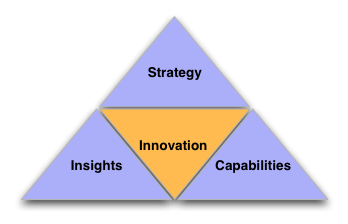
To compete in today’s competitive marketplace with its accelerating rate of change and disruption, an organization must be capable of creating a robust model for forging compound innovation. First, a sustainable and successful innovation process must exist at the intersection of StrategyInsights, and Capabilities.
Innovation at the intersection of Strategy, Capabilities, and Insights

Unguided, freeform innovation can certainly yield interesting discoveries and this may indeed be an appropriate approach for university researchers and well-funded R&D organizations. But, business organizations can rarely afford the investment in innovation programs that may never yield a return. To greatly increase your chances of success, innovation must be guided by business and product strategy, inspired by customer insights and marketplace opportunities, and grounded in technology and talent capabilities to ensure execution success.
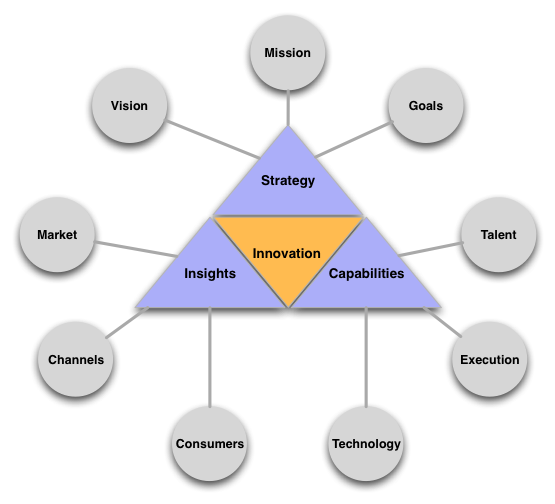
Next, you must develop a compound model of innovation that identifies the multiple dimensions along which innovation can be created in order to ultimately forge a successfully innovative product and/or service that dominates the market. It is very difficult for a competitor to unseat you when you have multiple layers of innovation like this.
A compound model of innovatio
Apple’s amazing success with the iPod, iPhone, and iPad is a tribute to this compound model of innovation. Those products would not be the market leaders that they are today if they were simply innovating along one or two dimensions, such as the industrial design of the device or the features of the iOS software. Carefully examine what Apple accomplished and you will see that they brought multiple dimensions of innovations together to dramatically shake up the market. To name just a few:

  • Technological innovation in the hardware (e.g., Retina display) and software (e.g., App Store)
  • Visual design and interaction design innovation (e.g., touchscreen gestures)
  • Channel innovation (e.g., a unique agreement with music companies, beautiful Apple Store experiences)
  • Business strategy innovation (e.g., song pricing, AT&T partnership)
  • Insights innovation (e.g., huge amounts of mobile data flowing back from consumers)
  • Brand and marketing innovation (e.g., aspirational brand experiences that lead people to wait in line for days for new product launches)
Now, does every innovation along every single dimension need to be an earth-shattering disruptive force? No, not at all. But, if you do this well enough, the fact that you are delivering synergistic innovations means that it is all the more difficult for a competitor to attack you along just one or two dimensions. Many, many competitors continue to attack Apple’s products by creating MP3 players with more features at a lower price, tablets with more open software at a lower price, smartphones that replicate touchscreen experiences in a sexy industrial design. What they have been unable to replicate is the holistic product and service experience ecosystem that Apple created with its compound innovation model.
You can begin this process today to assess your own organization’s level of excellence and innovation capabilities for each of these dimensions, relative to your competitors. Some examples of questions you should be asking and be able to answer:
  • Vision: Who do you want to be?
  • Mission: What is your purpose?
  • Goals: What problem are you going to solve or what new opportunity are you creating?
  • Strategy: How can you do it better than anyone else?
  • Talent: Have you hired the right people and are you organized for success?
  • Technology: What is possible?
  • Execution: Are your processes helping or hurting your ability to innovate and execute?
  • Capabilities: What can you create and deliver?
  • Consumers: Who are they and what are their unmet wants and needs?
  • Channels: Are there new and better ways to reach customers and partners?
  • Market: Can you stop “chasing the puck” and instead envision where the industry is heading?
  • Insights: What do you know that is helping you identify new opportunities?