Friday, 21 September 2012

Ray Kurzweil’s next book — How to Create a Mind: The Secret of Human Thought Revealed — will be published Nov. 13, Viking announced today. It can now be pre-ordered.
In the book, Kurzweil explores the most important science project since the human genome: reverse-engineering the brain to understand precisely how it works, then applying that knowledge to create vastly intelligent machines.
Drawing on the most recent neuroscience research, compelling thought experiments, and his own research and inventions in artificial intelligence, he describes his new theory of how the neocortex (the thinking part of the brain) works: as a self-organizing hierarchical system of pattern recognizers.
A roadmap to superintelligence
Kurzweil shows how these insights will enable us to vastly extend the powers of our own mind, and provides a roadmap for the ultimate creation of superintelligence — humankind’s most exciting next venture.
“We are now at the dawn of an era of radical possibilities in which merging with our technology will enable us to effectively address the world’s grand challenges,” he says. “We are already seeing artificial intelligence go mainstream with the recent innovations of IBM’s Watson, the iPhone’s Siri, and Google’s self-driving cars.
“The inevitable next step is that our brains will soon be merged with the intelligent technology we are creating. By around the 2030s, nanobots in our bloodstream and brains will keep us healthier and smarter, most of our thinking will be in the cloud — unhindered by the natural limits of our biological brain and easy to back up like a hard drive, and we will vastly speed up the learning process.”
How to Create a Mind is Ray Kurzweil’s seventh book, joining The Age of Intelligent MachinesThe 10% Solution for a Healthy Life, The Age of Spiritual Machines, Fantastic VoyageLive Long Enough to Live ForeverThe Singularity Is Near, and Transcend: Nine Steps to Living Well Forever.
“One of the eminent AI pioneers, Ray Kurzweil, has created a new book to explain the true nature of intelligence, both biological and non-biological,” said AI pioneer Raj Reddy. ”The book describes the human brain as a machine that can understand hierarchical concepts ranging from the form of a chair to the nature of humor. His important insights emphasize the key role of learning both in the brain and AI. He provides a credible roadmap for achieving the goal of superhuman intelligence, which will be necessary to solve the grand challenges of humanity.”

Tuesday, 18 September 2012

It's ASIMO's 12th Birthday this November!


I've been following ASIMO since he emerged as the P2 prototype back in  2000. But most people still don't know about it (him)?

Here's Honda's pitch:


Robots Image Gallery 
'Want a robot to cook your dinner, do your homework, clean your house, or get your groceries? 

Robots already do a lot of the jobs that we humans don't want to do, can't do, or simply can't do as well as our robotic counterparts. 

In factories around the world, disembodied robot arms assemble cars, delicately place candies into their boxes, and do all sorts of tedious jobs. There are even a handful of robots on the market whose sole job is to vacuum the floor or mow your lawn.
Many of us grew up watching robots on TV and in the movies: There was Rosie, the Jetsons' robot housekeeper; Data, the android crewmember on "Star Trek: The Next Generation"; and of course, C3PO from "Star Wars." The robots being created today aren't quite in the realm of Data or C3PO, but there have been some amazing advances in their technology. Honda engineers have been busy creating the ASIMOrobot for more than 20 years. In this article, we'll find out what makes ASIMO the most advanced humanoid robot to date.
The Honda Motor Company developed ASIMO, which stands for Advanced Step in Innovative Mobility, and is the most advanced humanoid robot in the world. According to the ASIMO Web site, ASIMO is the first humanoid robot in the world that can walk independently and climb stairs.
In addition to ASIMO's ability to walk like we do, it can also understand preprogrammed gestures and spoken commandsrecognize voices and faces and interface with IC Communication cards. ASIMO has arms and hands so it can do things like turn on light switches, open doors, carry objects, and push carts.
Rather than building a robot that would be another toy, Honda wanted to create a robot that would be ahelper for people -- a robot to help around the house, help the elderly, or help someone confined to a wheelchair or bed. ASIMO is 4 feet 3 inches (1.3 meters) high, which is just the right height to look eye to eye with someone seated in a chair. This allows ASIMO to do the jobs it was created to do without being too big and menacing. Often referred to as looking like a "kid wearing a spacesuit," ASIMO's friendly appearance and nonthreatening size work well for the purposes Honda had in mind when creating it.'
Innovation Methodologies: From Dilemma to Die lama!

It was James Lovelock the environmentalist and originator of Gaia hypothesis (*) that got me thinking about why different methods of studying and testing phenomena lead to different results and outcomes.

In his book ‘The Vanishing Face of Gaia: A Final Warning: Enjoy It While You Can.’ He tells of the infighting amongst the Intergovernmental Panel for Climate Change (IPCC). How approximately one-thousand lead scientists (and the institutions they represent) are in strong contention about the actual physical numbers of climate change (temperature rises, sea levels, rainfall, et al) and the outcomes that will amount from such changes (population displacement, food supply, economy, etc).

The point he makes clear is that for the most part, each scientific institution uses different methodologies, producing different mathematical models, giving different results. Simply that different strokes lead to different folks. Hence the IPCC’s contention!

Well, it is the very same for innovation, whether a new product, core-technology, novel service system, even new ways in education, medicine and even law.

I know this, because of my many years as a design engineer spending considerable time overseeing the performance testing of new gadgets. That different ‘Design-of-Experiment’ methodologies give slightly (and sometime dramatically) different performance results and outcome.

The main point here is harmonisation!

I'm not talking about the test parameters and targets here. They are specified in the numerous international qualification and certification standards (IEC, BSI, ISO, WEEE, JAR/FAR, etc). But harmonise the system!

First, it is important to select a method that is empirically based. A technique that is based on real physically measurable numbers rather than pure or abstract mathematical modelling.

Second, chose a method that is systematic (See side-bar 'Get Real: Rapid Prototyping').

Third, by all means improve the system, but harmonise and keep that same system when comparing results with former (and latter) results. That is, if each time you test a new product (or service system), you use a different set of test methods you are going to get different results and outcomes over time. 

In fact, we can take a leaf out of The Dalai Lama’s iPAD of philosophy, the Dharma,’ saying ‘that which upholds, supports or maintains the regulatory order of the universe.’ As well as referring to Law in the universal sense, the dharma designates those behaviours considered necessary for the maintenance of the natural order of things.

Hence: Innovation Methodologies: From Dilemma to Die lama!’


(* The postulate that the biosphere is a self-regulating entity with the capacity to keep our planet healthy by controlling the chemical and physical environment).

Sunday, 16 September 2012

'The Prototype'

Official teaser trailer. An Andrew Will sci-fi Movie.

The Prototype - due out in early 2013 - is a science-fiction thriller, where the military tries to track down a humanoid drone that escapes from a government facility. The bot has to defend itself while on the run, all the while playing around with ideas of what it is to be human! 
If nothing else, it is prelude to understanding the consequences of a design before output, before its time is really due.

I'm not sure how Andrew Will goes from being a second unit production assistant on the 2009 Star Trek flick to directing his own movie, but his directorial debut The Prototype seems all right. I mean, it's The Fugitive with a few touches of Avatar and Terminator; but there's nothing wrong with that. 

Friday, 14 September 2012

Coka-Cola Fuel Cell Anyone?


Whether this is serious proposition remain to be seen, however Daizi Zheng brings us the interesting concept: a Nokia phone that runs on Coca-Cola. 

Yes, you read right. It may sound incredible, but it seems this eco-friendly cellphone model really works.

Daizi Xheng, wanted to find an alternative to the lithium-ion power supply we all rely on today because they are both bad for the environment and don’t last that long between charges.


The designer has called it Nokia ‘green’ phone and it works generating electricity through carbohydrates such as the sugar contained in this and other similar drinks. It does not pollute because the end-product of the process is water and oxygen. And to top it all off, Daizi herself assures us that this completely biodegradable battery can last up to 3 and 4 times the normal life of lithium batteries.


Knocking Down Barriers to Innovation

'We've all seen them in action: the rules, bureaucracies, and wrongheaded policies that prevent us and our organizations from being as innovative as we could be. These obstacles seem to rise up at every turn, stifling our creativity and keeping our companies from getting a step on the competition. They're tough to overcome, and even if we succeed in eliminating one, another pops up.
And then there are the psychological constraints on our thinking and the untested assumptions that we live by, barriers that are even more pernicious because they are hard to see in the first place.
With the 'Knock Down Barriers to Innovation' Insight Center, HBR.org aims to help you identify innovation barriers that have been hiding in plain sight and to show you novel ways of defeating them.
Over the next four weeks, blog posts from some of the leading lights on innovation — as well as a number of thinkers who will be unfamiliar to you — will take you on a tour of the conventional wisdom about innovation, pointing out illusions along the way. They'll also provide tools for freeing the mind and implementing sound ideas. The posts will inspire as well as inform.
The Insight Centre, also offers a sampling of some of the provocative books, articles, and blog posts that HBR has recently published on overcoming innovation barriers.
Part of this insight center draws on one other group of experts — you. What's stopping you from being more innovative in your work right now? If you could change one thing about your job or your workplace to make you more effective, what would it be? Here's a chance to knock down some barriers of your own.'

There are 2 videos that may be of interest: Create an App Club & How Disruptive Innovation Happens!

The Future Of Work 
'Technology and the Web are destroying far more jobs than they create. We will need to develop a "Third Way" based on community rather than the Market or the State to adapt to this reality.
Long-time correspondent Robert Z. recently shared an essay on just this topic entitled Understanding the 'New' Economy.
The underlying political and financial assumption of the Status Quo is that technology will ultimately create more jobs than it destroys. Bob's insightful essay disputes that assumption:
Over the past 15 years, the global economy has experienced structural changes to a degree not seen in nearly 150 years. Put simply, the Industrial Revolution of the 1800s has given way to a post-industrial economy. In this post-industrial economy, technology has now evolved to the point where it destroys more jobs than it creates.
Still, most people are Luddites to some extent. Human nature is to resist dramatic change, either actively or passively, until we have no other choice. If you don’t believe that, just listen to our presidential candidates.
Both Mitt Romney and Barack Obama will give us happy talk about maintaining entitlement benefits (e.g., Medicare and Medicaid) that cannot possibly be sustained. They will talk about energy self-sufficiency. They will talk about creating jobs. They will tell us that we can somehow ‘grow’ our way out of our economic distress. But neither candidate will admit that technology now destroys more jobs than it creates, because to do so would be to commit political suicide. The fact is that none of the happy talk will ever come true. Instead, the Federal Government, with the tacit approval of both major political parties, continues to run trillion-dollar-plus deficits year after year in a futile attempt to spend our way out of our economic problems and to sustain an economic model that cannot be sustained.
Those who believe that bringing manufacturing back to the US will also bring back jobs are trying to fight a war that has already been fought and lost. Why? The answer is technology. It’s actually a fairly simple process now to bring production of many items back to the US, simply because of automation and robotics. A factory filled with robots can operate 24 hours a day, 7 days a week, 52 weeks a year, so long as the raw material inputs keep flowing into the factory. Robots don’t take breaks, don’t make mistakes, don’t call in sick, don’t take vacations, don’t require expensive health insurance, and don’t receive paychecks. A fully automated robotic manufacturing facility might require only 100 workers, while a traditional assembly line facility might utilize 3,000 workers. That’s a huge difference in the number of jobs. The simple fact is that most of the lost manufacturing jobs are never coming back.

What about all the marketing, administrative, accounting, and IT jobs that we think can’t be outsourced or automated? Well, retail enterprises now tailor any number of special offers directly to individual customers by mining data from reward programs. That doesn’t take an expensive ad budget or a huge marketing department, since it’s all automated. Have you ever noticed that most of the advertising you see while you surf the Web is tailored to things you might be interested in buying? That’s all automated – huge numbers of marketing professionals are just not needed.
In the accounting world, ‘lean accounting’ attempts to streamline accounting processes and eliminate accounting inefficiencies. A byproduct of ‘lean accounting’ is often greater use of technology and a significant reduction in the number of accountants and accounting clerks. In the IT (Information Technology) sector, computer algorithms for high-frequency stock trading (HFT) have become so complex that specialized software now writes new HFT programs and algorithms. That reduces job opportunities for programmers. The net result of all these examples is not job creation. It’s job destruction.
How about government jobs and government-related jobs? Well, think about the US defense budget. It’s a huge example. We surely do not need as many tanks and fighter jets as we used to, now that we have remote-controlled drones to do many of the jobs required. And with the availability of these drones, we might not need as many aircraft carriers, ships, or military personnel either. What about the Post Office? Do we really need daily mail service in an electronic world?
The point is that as we let go of old methodologies, whether in the private sector or in government, huge numbers of jobs simply disappear. As a society, we need to admit that ‘free-market’ capitalism is not going to bring back these lost jobs. Thanks to technology, society is capable of meeting basic human needs (food, clothing, shelter, transportation) with far fewer workers percentage-wise than were needed in the past. But as a society, we also need to admit that socialistic solutions won’t work either, simply because human nature is to take care of ourselves and our families first. Once we have provided for ourselves and our families, very few of us are both willing and able to provide for every stranger that might knock on our door seeking assistance.
As a nation, we must at some point address any number of major economic issues, including the massive overhang of debt (public and private) that cannot possibly be repaid and demands for future entitlement payments that cannot possibly be met. As a society, we ought to admit that we cannot borrow our way to prosperity. Unless interest rates are zero forever and creditors are willing to forego scheduled repayments forever, borrowing our way to prosperity is a mathematical impossibility.
One point is certain. Even if we find the political will to deal with the mathematics of our economic problems, we will never find long-term solutions to our economic issues until we recognize the profound economic changes wrought by technological advances. This is especially true with respect to our traditional view of a job and a paycheck. While it is true that new opportunities will always exist, these opportunities may not be as plentiful as the jobs of the past once were. And these opportunities will generally require more advanced skills than many of the jobs of the past. Technology has fundamentally changed the nature of paying work, and it is also one of the major economic issues of our time. 
About the author:
Bob Z., of Vancouver, Washington, is a Corporate Finance executive who retired in 2007 from an upper management position with a Fortune 500 corporation.
Thank you, Bob, for your forthright appraisal of technology and jobs. The decline in labor's share of the GDP (gross national product) is sobering:
chart


Here are some other points to consider:

1. The build-out of a new technology creates a large but temporary number of jobs. This has been the case for some time: the construction of the railroads created a jobs boom that soon disappeared in a financial bust as rail was over-built and profits were non-existent for many of the extraneous or duplicate lines. Telephony and telecom followed similar arcs, and did the build-out of the Internet infrastructure.
2. Technology maturation leads to diminishing return on labor as incremental advances in productivity are capital-intensive. Semiconductor manufacturing is a good example; fabrication facilities (fabs) cost upwards of $2 billion each even as the number of workers need to operate the fab declines. Profit margins on many high-technology products are razor-thin, flat-screen displays being a prime example, and diminishing margins further pressure labor costs.
3. Software is leading the next-generation industrial revolution, automating many tasks that were considered "safe" from automation. As Bob pointed out, this includes securities trading and accounting. (I would add tax preparation for the majority of tax situations.) Can the law, academia and government remain immune? Unlikely.
4. Although few dare contemplate this, the low-hanging fruit of technology may have already been plucked. Take healthcare as an example: antibiotics and vaccines virtually eliminated many diseases at a very low cost per dose (though some diseases are coming back due to unvaccinated host populations and bacterial adaptation).
Antibiotics are "one size fits all" technologies: they act basically the same on every target bacteria and in every host. Compare that universality to the spectrum of individual responses to cancer treatments and other medications: one size does not fit all, and many of the most profitable drugs of the past few decades treated symptoms, not the underlying illness.
It is increasingly clear that there is no "magic pill" that kills all cancers, or even specific cancers in all patients. Lifestyle diseases such as diabetes appear impervious to "magic bullet" cures, as the causal factors of the disease are complex. The same can be said of diseases of aging and environmental factors.
In other words, the notion that tens of billions of dollars in high-tech research will yield "one size fits all" low-cost treatments of complex diseases has been shown to be problematic, and very possibly a fantasy.
5. The Internet is destroying vast income streams that once supported tens of thousands of jobs in industries from finance to music. Craigslist has gutted the once-immense income stream from newspapers, and web-based marketing has shredded print-media advert page counts. Global competition and pressure to maintain profits and margins relenetlessly drives enterprises to slash payrolls.
6. As I have discussed here many times over the years, the rising costs of taxes, benefits and regulations have squeezed small businesses. In response, many small companies rely on automation and software to perform tasks that until recently required a human worker. Those small businesses that cannot prosper via technology are going under, and the risks posed by ever-higher costs have raised entry barriers to starting a small business. These trends are visible in this chart:

The array of web-based tools available to entrepreneurs now is astonishing. Why take on the risks of hiring people when you can do the work yourself with low-cost web tools and software? For many small enterprises, that is the only way to survive.
Advanced societies face a dilemma that cannot be solved by more debt or more technology: how to distribute not just the output of the economy, but the work and responsibility so that everyone has an opportunity to contribute and earn their keep.
Those who have ploughed trough my books know that I see community as the only viable way forward. Many aspects of human life cannot be turned into a "market opportunity," nor can they be taken over by the insolvent central-planning Central State. Paying people to stay home and rot is not a solution, but neither is paying people more than they produce in competitive markets. There is a "Third Way," but we've lost the skills and infrastructure required. Of the three elements of civil society, the Market and the State have crowded out Community. We either re-discover the labor-value of community or we devolve further into a potentially "death spiral" social and financial instability. 
Read the Introduction (2,600 words) and Chapter One (7,600 words) for free. 

We are like passengers on the Titanic ten minutes after its fatal encounter with the iceberg: though our financial system seems unsinkable, its reliance on debt and financialization has already doomed it.We cannot know when the Central State and financial system will destabilize, we only know they will destabilize. We cannot know which of the State’s fast-rising debts and obligations will be renounced; we only know they will be renounced in one fashion or another.
The process of the unsustainable collapsing and a new, more sustainable model emerging is called revolution.Rather than being powerless, we hold the fundamental building blocks of power. We need neither permission nor political change to liberate ourselves. A powerless individual becomes powerful when he renounces the lies and complicity that enable the doomed Status Quo’s dominance. 


Introducing the Hyper-Matrix, a pixel pushing movie theater of the future where the walls come to life. A Seoul-based collective called Jonpasang covered three sides of a Korean theater with steel scaffolding and thousands of lightweight cubes, each attached to its own stepper motor. Watch the cubes pulse and create a choreographed routine.

Hyper-Matrix from media group Jônpasang. It was shown at the exhibition Hyundai Motor Group in Korea. Thousands of small cubes move on specially prescribed p...
603
+1236

Thursday, 13 September 2012

Tuesday, 4 September 2012


The Year 2020: The Birth of the ‘Innovation Economy.’

Welcome to the year 2020! It hot, is it not? However, do you recall the recession back in 2012? Well, that was a breeze compared to what we now face in 2020! Most of us was aware of the consequences of an economy that is interconnected. What we didn’t know was how it would affect us now at the beginning of the 3rddecade of 2020!

The connected economy was just the beginning. Because once the richness of interconnections hit a vital number, it reached a point of critically where the economy began to evolve at super-accelerated rates. And that meant that the rules of engagement fundamentally changed: It became an Innovation Economy. An innovation economy that is nonlinear, warp-speed and counterintuitive. And the rules of such an innovation economy are paradoxical, capricious and surprising.
Here are 4 new rules and solutions for an economic situation we are all going to have to get used to negotiating:

The rule of inverse productivity. Way back in the ancient 1980s (A.D) it took 1,000+ people to run a noisy, quite treacherous steel mill. Now it takes less than 10 people. Process technologies that control the mill are now that advanced that most people controlling the plant sit in offices the other-side of the world.
In new product development it’s the same: what took 20 engineers 3 years (a landline telephone for instance) to put into production, now takes 1 multidiscipline engineer 1 month. Computer Aided Engineering and Analysis Systems have dropped so dramatically in price-performance, that even the smallest company can afford a full suite of kit from end-to-end of the design and manufacturing process.
Intelligent service systems such as automated self-service pubs, clubs, cinemas and restaurants are common place now. This simply and clearly means more and more, faster and faster, smarter and smarter, for less and less direct human workers, materials and tools. And that means the once economic Holy Grail ‘productivity’ has been going inverse and more acute over time.
If you think the worldwide total of 1.2 billion workers that were unemployed back in 2012 is large; once the dozens of emerging nations achieve full blown ultra-yield technological production systems; most of the world’s population will be unemployed.

Solution. Pumping investment and creating sufficient numbers of new roles is important, but not merely enough. New enterprise start-ups do sustain jobs. But, the major effort is to inspire, create and develop a global culture of entrepreneurialship, innovation and enterprise.
Avoid encouraging or threatening people to look for jobs that are not there. Promote, praise, idolize individuals that create their own productive and well paid work. Make a living out what you enjoy. Better still, become aGigaEntrepreneur.

The rule of exponential price-performance improvements. In the 1970s, what took a room the size of a football pitch to house a computer the size of a building with hundreds of people to design, build and maintain the supercomputer, now costs ~30-dollars for a system that has 1,000,000 times the processing power that is the size of your palm (Hyperphones, Ultrabooks, nxPADs, et al).
Technology is shrinking toward the invisible, whilst performance and functionality is expanding toward the multidimensional. Microprocessors are now Nanoprocessors handling multiple-terabytes of data. Computer speed and memory capacity, material strength, durability, environmental endurance is going in the same direction. In fact, technologically, this is happening virtually everywhere.

Solution. The goal, then, is to offer leaps in functional performance at a sustained price point. Or more and different for less, thus driving-up volume and differentiation in sales.

The rule of digital disintermediation. We have all heard of friction free economics. That the digital economy has much shorter, often direct supply/value chains. The long-value/supply chain’s tail with dozens of stages is and will continue to contract and reduce in stages.
We saw this happen with digital virtual products and services with the likes of Amazon.com, iTunes.com, VEVO.com, eBay.com back in the 2000s.
And now in 2020 rapidly growing 3D-printing and additive manufacturing at home. That is machines that output basic components (washers, screws, brackets, elemental shapes, et al) and simple electrical gadgets (TV remote controls, digital watches, torches, et al) in one go by downloading digital models, taking the data and turning it into real artefacts by laminated/additive synthesis.
This is potentially the most disruptive and powerful challenge economically in 2020.

Solution. As supply chains shrink; develop and promote systems that enable multiway supply and value creation networks (Hyperinnovation). That is, mass-custom innovation from home, den, garage, school, hospital, park, caravan, car, shall I go on!
Next, integrate design and build; unleash the data on the web. Producers and consumers not only become pro-sumers, but economic champions and stewards. Hence, designers and artisans now flourish. That is jewellery stylists, sculptors, custom furniture designers and fashion aficionado thrive all from the comfort of their home. DIY innovation has arrived!

The rule of instant retail. Commercial value-chains and associated supply-webs have shrunk to an iota in scale. Retail shops are now mostly automated. Again, few opportunities for employment. Another disruptive economic conundrum to fix!

Solution. You still go for retail therapy. But the experience has not only changed, since 2012; it has turned into safari-adventures and wonderland excursions. High Street shopping is now a bright, fun night out on the town or a countryside relaxing enjoying encounter. Your local shopping mall is an adventure playground.
But you don’t have to venture out the door to pick up your new goods or wait for FedEx to deliver!Instant Retail is here. High resolution holographic projectors beam your new tee-shirt or clutch bag in full colour 3D in front of you. Ultrasonic beam projectors make the hologram touchable. So you can not only look at it, you touch and feel it in real-time.
You like the new gadget you’ve just eyed? So transfer your bank account details; down load the 3D digital model to your 3D printer. Make it, take it, and off you go! Instant Retail is here!!

All of the technologies for this are beginning to roll out of the R&D lab now in 2012. So think we’ve got economic challenges today? The Innovation Economy is just over the horizon...Go figure!!!
The future of work!

Technology and the Web are destroying far more jobs than they create. We will need to develop a “Third Way” based on community rather than the Market or the State to adapt to this reality, novelist and economic commentator Charles Hugh Smith writes on Business Insider.
“The Internet is destroying vast income streams that once supported tens of thousands of jobs in industries from finance to music. Craigslist has gutted the once-immense income stream from newspapers, and web-based marketing has shredded print-media advert page counts. Global competition and pressure to maintain profits and margins relenetlessly drives enterprises to slash payrolls.


 “As a society, we need to admit that ‘free-market’ capitalism is not going to bring back these lost jobs. Thanks to technology, society is capable of meeting basic human needs (food, clothing, shelter, transportation) with far fewer workers percentage-wise than were needed in the past. But as a society, we also need to admit that socialistic solutions won’t work either.
“I see community as the only viable way forward. Many aspects of human life cannot be turned into a ‘market opportunity,’ nor can they be taken over by the insolvent central-planning Central State. Paying people to stay home and rot is not a solution, but neither is paying people more than they produce in competitive markets.
“There is a ‘Third Way,’ but we’ve lost the skills and infrastructure required. Of the three elements of civil society, the Market and the State have crowded out Community. We either re-discover the labor-value of community or we devolve further into a potentially “death spiral” social and financial instability.”

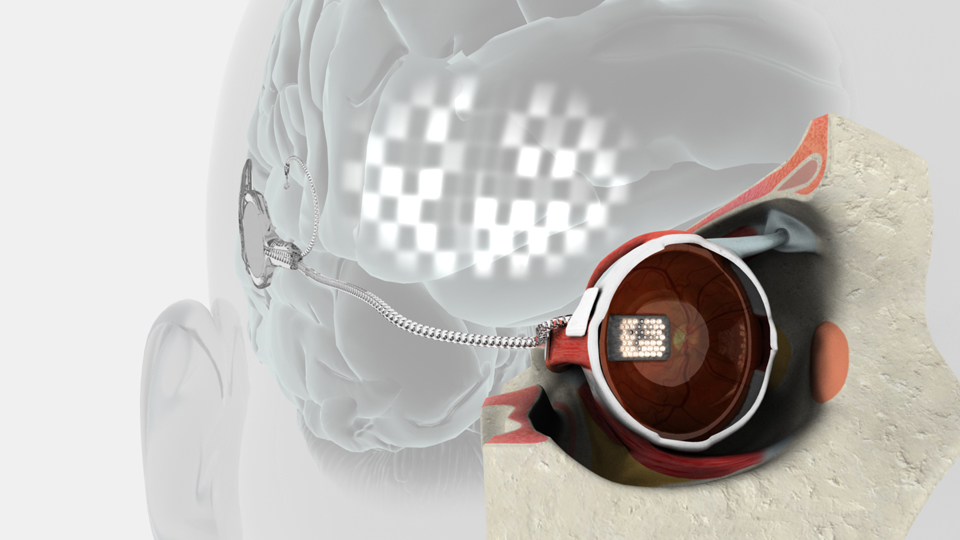
All of a sudden I could see a little flash of light. It was amazing.

Bionic Vision Australia researchers have successfully performed the first implantation of an early prototype bionic eye with 24 electrodes.
Dianne Ashworth has profound vision loss due to retinitis pigmentosa, an inherited condition. She has now received what she calls a “pre-bionic eye” implant that enables her to experience some vision.