Take a look a MIT's view on this years most innovative companies. Click on each square to review.
Friday, 18 May 2012


Tuesday, 15 May 2012

Saudi Arabia-based Kingdom Holding Company, headed by Prince Al Waleed Bin Talal, has given the green light to build a 1 mile high tower in the Red Sea port city of Jeddah.
Designed by Adrian Smith of Adrian Smith + Gordon Gill Architecture, the “Kingdom Tower” will be twice as tall as the Burj Khalifa, include 12 million cubic feet of space and it will take 12 minutes for a regular elevator to reach the top! Flabbergasted?
Friday, 11 May 2012

'This is an impressive book by any standards and I for one
have very much appreciated that Harris has chosen to share his
methodologies...I have read the book three times, such is the level of richness
and guidance provided, and each time I pick it up I get new insights. I
strongly recommend Building Innovative Teams.'
- Robin Campbell, Journal of Management
Development.
'Chris Harris's new book fills an important gap in the
library of creativity and innovation. Some books focus on the individual, and
provide guidance on how individuals can enhance their personal, creative
skills; others focus on the organisation, and relate how you have to get the
reward structure, role models, the resource allocation system and all the rest
in harmony with the corporate goal of innovation. Building Innovative Teams looks at that
oh-so-important and practical middle ground - how groups of individuals can be
moulded into high performing teams, with innovation as their key agenda.
Written in a highly readable, pacy style, Building Innovative Teams offers great insights into
something we all strive to do, and provides much pragmatic advice as to how to
do it.'
- Dennis Sherwood, former Vice President of SIR Consulting;
distinguished fellow of the Sloan Management School at MIT; CEO of SilverBullet
Machine Manufacturing Ltd; and author of Smart Things to Know about
Innovation and Creativity and Seeing the Forest for the
Trees: A Manager's Guide to Applying Systems Thinking.
Click here to review.
Saturday, 5 May 2012
Life-size, 3D hologram-like telepods may revolutionize videoconferencing
[+]
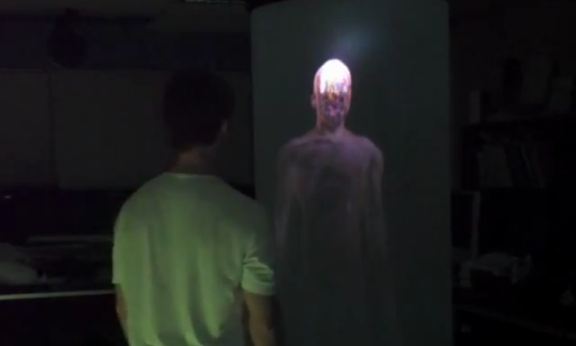
TeleHuman (credit: Queen's University)
A Queen’s University researcher has created a Star Trek-like human-scale 3D videoconferencing pod that allows people in different locations to video conference as if they are standing in front of each other.
“Why Skype when you can talk to a life-size 3D holographic image of another person?” says professor Roel Vertegaal, director of the Human Media Lab.
The technology Dr. Vertegaal and researchers at the Queen’s Human Media Lab have developed is called “TeleHuman” and looks like something from the Star Trek holodeck.
Two people simply stand infront of their own life-size cylindrical pods and talk to a 3D hologram-like images of each other. Kinect cameras capture and track 3D video and convert into the life-size image.
Since the 3D video image is visible 360 degrees around the Pod, the person can walk around it to see the other person’s side or back.
While the technology may seem like it comes from a galaxy far, far away, it’s not as complicated as it sounds. Dr. Vertegaal and his team used mostly existing hardware — including a 3D projector, a 1.8 metre-tall translucent acrylic cylinder and a convex mirror.
[+]
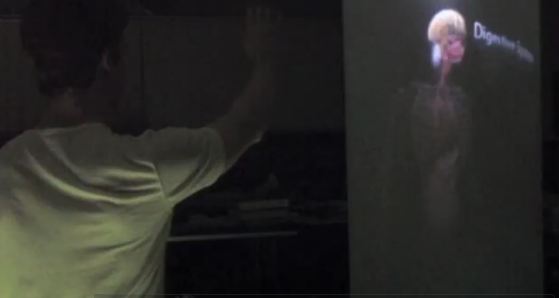
BodiPod, an interactive 3D anatomy model of the human body (credit: Queen's University)
BodiPod
The researchers used the same Pod to create another application called BodiPod, which presents an interactive 3D anatomy model of the human body. The model can be explored 360 degrees around the model through gestures and speech interactions.
When people approach the BodiPod, they can wave in thin air to peel off layers of tissue. In X-ray mode, as users get closer to the pod they can see deeper into the anatomy, revealing the model’s muscles, organs and bone structure. Voice commands such as “show brain” or “show heart” will automatically zoom into a 3D model of a brain or heart.
Dr. Vertegaal will unveil TeleHuman and BodiPod at CHI 2012, the premier international conference on human-computer interaction, in Austin, Texas May 5-10.
Thursday, 3 May 2012
Singularity University: meet the people who are building our future
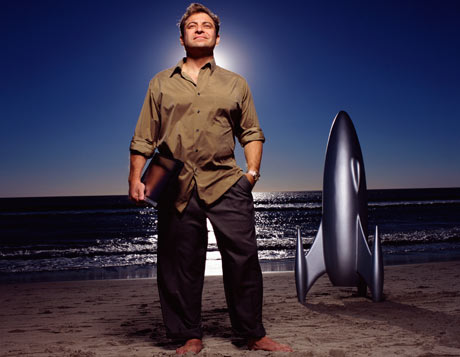
Space cadet? Peter Diamandis, co-founder of the Singularity University. Photograph: Andrew Brusso/ Andrew Brusso/Corbis
It's day one at the Singularity University: the opening address has just been delivered by a hologram. Craig Venter, who was one of the first scientists to sequence the human genome and created the first synthetic life form, is up next. And later, we will see two people, paralysed from the waist down, use robotic exoskeletons to rise up and walk.
But first, the co-founder of the Singularity University, Peter Diamandis, gives us our instructions for the day. Your task, he says, is to pick one of the "grand challenges of humanity" – the lack of clean drinking water, say. And then come up with an idea that "can positively impact the lives of a billion people".
It's 9.30 in the morning. Some of us haven't even had coffee yet. There's about 50 of us present and the room has been divided up into tables, one for education, another for poverty, another for water, and I'm not sure where I should sit. Diane Murphy, the university's PR executive, hesitates for a moment and then directs me over to the table marked "food". "Tell you what," she says. "Why don't you take Ashton Kutcher's chair over there. He's not coming until later." (When he does arrive, he pulls up a chair at the next table over. What can I say? If Ashton Kutcher fails to solve global hunger, it will be my fault.)
The Singularity University is really not much like a regular university. And not just because it's a place that manages to accommodate the likes of both Venter and Kutcher (and where, during a Q&A session, somebody asks a question about taking the Singularity University into the ghetto, and it turns out to be from the musician will.i.am).
Its courses aren't accredited, and it has no undergraduates. Stanford University might have been the cradle for a hundred Silicon Valley startups and the hothouse for some of its greatest technical innovations, but the Singularity University is an institution that has been made in the valley's own image: highly networked, fuelled by a cocktail of philanthro-capitalism and endowed with an almost mystical sense of its own destiny.
It is both Silicon Valley's elite future thinktank and its global outreach arm: Google and Microsoft both came to the founding conference and gave money, Nasa provided the campus space, and emblazoned across the website is a quote from Google's co-founder, Larry Page: "If I was a student," he says, "this is where I'd want to be." Its aim is "to assemble, educate and inspire a new generation of leaders who strive to understand and utilise exponentially advancing technologies to address humanity's grand challenges".
So, no pressure then. Although, of course, the easiest thing would simply to be British about all this and scoff. Ashton Kutcher! (I read later that he's been cast to play Steve Jobs in a forthcoming film and slightly suspect that he thinks he might actually be Steve Jobs.) A billion people! It's the kind of thing you can imagine someone in a white coat writing down as evidence just before they decide to commit you. What's more, Diamandis is the kind of can-do entrepreneur that, as a nation, we're inclined to lampoon and shun. (He's good friends with Richard Branson.)
The only problem with this as a strategy is that half the people in the room actually have done things which have had a positive impact on a billion people. Or, in some cases, more. Not just Venter, who has flown in on his private jet; there's also Vint Cerf, who is considered one of the fathers of the internet – he worked on Arpanet, the internet's predecessor – and is now "chief internet evangelist" at Google. AndSebastian Thrun, the man behind one of Google's latest and potentially most disruptive technologies yet, the self-driving car. He's also the head of the top-secret Google X lab, part of the firm that most employees didn't even know existed until the New York Times ran a piece on it last November.
Abundance: The Future is Better than You Think.

Peter H. Diamandis, co-author of Abundance and co-founder of Singularity University, thinks that our brains are not wired to understand exponential change. We have evolved to think arithmetically rather than exponentially, and therefore have a hard time wrapping our heads around the implications of Moore's law type performance/cost improvements of digital technologies.
We should not limit our thinking about exponential performance-to-cost improvements to transistors. Exponential improvements have characterized network bandwidth (Butters' law), and computer storage / per dollar (Kryder's law). A computer of 1982 is 100 times heavier, 500 times larger, 10 times as expensive and 1/100th as powerful as the smart phone in your pocket.
The authors of Abundance ask if exponential technological improvements will translate into a commensurate exponential increase in our standards of living? Can the story of the computer be replicated in medicine, agriculture, and perhaps even education? The answer depends on the extent to which these economic activities take on the characteristics and designs of digital technologies.
It is hard not to finish Abundance with the belief that our children will enjoy abundant energy (as renewable power technology follows the exponential performance/cost curve) and dramatic improvements in health and lifespan (as medical technologies miniaturize and become implanted in our bodies).
You and I may have plenty of arguments with Kotler and Diamandis. The power of digital technologies may be impressive, but digital technologies do not address the fundamental problems of environmental degradation, political repression, or structural inequality. An iPhone will not solve water shortages, endemic infectious diseases, or the absence of the rule of law.
None of these complaints, however, should stop you from reading and enjoying Abundance.
Our day-to-day work and personal lives are characterized by resource constraints. We live without the time to do everything we need to do, and the dollars to invest properly for what is next. A book like Abundance gets us out of what is immediately before our eyes, and gives us a framework to think about where we may go in the future.
If we can figure out how to align our work with those of digital goods, and therefore reap the benefits of exponential cost and performance improvements, we might just figure out how to move our industries (even higher ed) from scarcity to abundance.
Read more: http://www.abundancethebook.com/wp-content/uploads/2012/01/Abundance_Chapter_1_Sneak_Preview2.pdf?139d23
Tuesday, 1 May 2012

Billionaire to Build New Titanic for 2016
Australian real estate billionaire Clive Palmer announced that he's planning to build a replica of the Titanic and have it ready for its maiden voyage in late 2016. It will sail from England to New York, the same path the first Titanic was taking.
"It will be every bit as luxurious as the original Titanic, but will have state-of-the-art 21st-century technology and the latest navigation and safety systems," Palmer said in a statement. He called the project "a tribute to the spirit of the men and women who worked on the original Titanic."
Palmer is to include all modern technology, but will still make it look like the original design. For example: Despite being diesel-powered, the new ship will still have four smoke stacks, like the coal-powered original, but they will be purely decorative.
Saturday, 28 April 2012
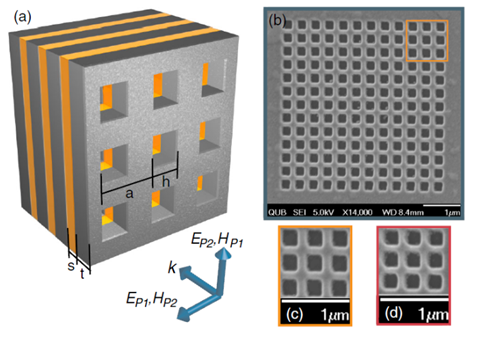
Scientists in England and Valencia, Spain, have constructed what may be the first practicalmetamaterial that manipulates visible light.
The researchers predict it could be used for subpicosecond (less than a trillionth of a second) optical switches and finely controlled laser pulses. The layered structure, in contrast to the makeup of earlier… [ IEEE Spectrum ]
Transparent graphene-based material could revolutionize wearable electronics, solar panels
April 28, 2012

GraphExeter, the most transparent, lightweight and flexible material ever for conducting electricity, has been invented by a team from the University of Exeter.
Liquid solar cells that can be printed onto surfaces
April 27, 2012
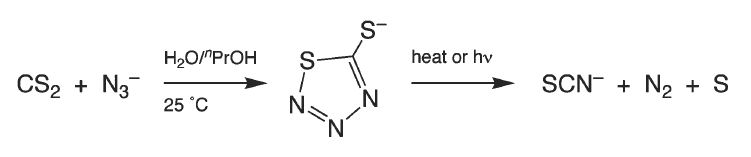
USC scientists have developed a potential pathway to cheap, stable solar cells made from nanocrystals so small they can exist as a liquid ink and can be painted or printed onto clear surfaces.
New harvesting approach boosts energy output from bacteria
April 27, 2012

A novel energy system that increases the amount of energy harvested from microbial fuel cells (MFCs) by more than 70 times has been developed by University of Colorado Denver (CU Denver) scientists.
Tuesday, 3 April 2012
How to create multiple frequencies of light simultaneously
[+]
By aiming high- and low-frequency laser beams at a semiconductor, physicists at UC Santa Barbara have produced multiple frequencies of light simultaneously, with the potential to significantly increase the speed of data communication.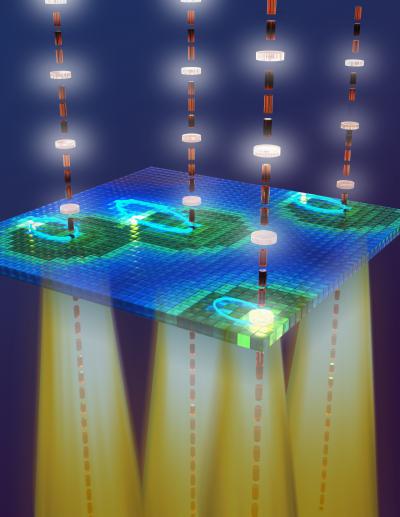
An artist's rendition of electron-hole recollision. Near-infrared (amber rods) and terahertz (yellow cones) radiation interact with a semiconductor quantum well (tiles). The near-IR radiation creates excitons (green tiles) consisting of a negative electron and a positive hole (dark blue tile at center of green tiles) bound in an atom-like state. Intense terahertz fields pull the electrons (white tiles) first away from the hole and then back towards it (electron paths represented by blue ellipses). Electrons periodically recollide with holes, creating periodic flashes of light (white disks between amber rods) that are emitted and detected as sidebands. (Credit: Peter Allen, UCSB)
They did that by causing electrons to be ripped from their cores, accelerated, and then smashed back into the cores they left behind.
When the high-frequency optical laser beam hits the semiconductor material — in this case, gallium arsenide nanostructures — it creates an electron-hole pair called an exciton. The electron is negatively charged, and the hole is positively charged, and the two are bound together by their mutual attraction.
“The very strong, low-frequency free electron laser beam rips the electron away from the hole and accelerates it,” explained Mark Sherwin, whose research group made the groundbreaking discovery. Sherwin is a professor of physics at UCSB and a co-author of the paper. He is also director of the campus’s Institute for Terahertz Science and Technology.
“As the low-frequency field oscillates, it causes the electron to come careening back to the hole.” The electron has excess energy because it has been accelerated, and when it slams back into the hole, the recombined electron-hole pair emits photons at new frequencies — up to 11 in their experiment.
The electron-hole recollision phenomenon has the potential to significantly increase the speed of data transfer and communication processes. One possible application involves multiplexing — the ability to send data down multiple channels. Another is high-speed modulation.
The researchers utilize a free electron laser to produce the electron-hole recollisions, which they note is not practical for real-world applications.
Theoretically, however, a transistor could be used in place of the free electron laser to produce the strong terahertz fields.
Tuesday, 6 March 2012
The Future of Manufacturing

Manufacturing has a key role to play in economic growth, particularly in driving exports and productivity, and in rebalancing the UK economy. It also brings a number of other benefits to the UK in terms of societal value and contribution to national resilience.
The nature of manufacturing and its role in the UK and global economies is going through a period of change.
As with a number of developed economies, the manufacturing share of the UK economy has declined, from 22% of GDP in 1990 to around 10% today. New industries and technologies are emerging. There is increased competition and changing demand for products and services.
The Future of Manufacturing project will provide a timely and fresh look at the long-term picture for the manufacturing sector out to 2050, investigating global trends and drivers of change.
Leading experts
The project calls on industry and academic expertise from the UK and abroad to explore how the UK can maximise key opportunities and mitigate risks. In doing so, it will provide a robust evidence base to help ensure that policy decisions taken today are resilient in an uncertain future.
The Government Office for Science Foresight programme leads the project, under the direction of the Government Chief Scientific Adviser, Professor Sir John Beddington. Vince Cable, Secretary of State for Business, Innovation and Skills, is the project sponsor Minister.
A Lead Expert Group (LEG) of eminent academic and private sector experts from a range of disciplines works alongside the Foresight team to help guide the project and secure a strong evidence base. A High Level Stakeholder Group (HLSG), chaired by Vince Cable, will advise on the strategic direction and impact. Find out more about the LEG. Members of the HLSG will be announced in early 2012.
The project’s fresh thinking, innovative evidence base and futures analysis will help inform policy makers in the Department for Business, Innovation and Skills and a range of other relevant departments throughout the project and beyond.
Subscribe to:
Posts (Atom)