Author, Speaker, and Consultant on Hyperinnovation, Future Studies, GigaMarket$, The New Industrial Revolution, and Advanced Robotics and (iRev) Intelligence Revolution.
Thursday, 3 May 2012
Abundance: The Future is Better than You Think.
We should not limit our thinking about exponential performance-to-cost improvements to transistors. Exponential improvements have characterized network bandwidth (Butters' law), and computer storage / per dollar (Kryder's law). A computer of 1982 is 100 times heavier, 500 times larger, 10 times as expensive and 1/100th as powerful as the smart phone in your pocket.
The authors of Abundance ask if exponential technological improvements will translate into a commensurate exponential increase in our standards of living? Can the story of the computer be replicated in medicine, agriculture, and perhaps even education? The answer depends on the extent to which these economic activities take on the characteristics and designs of digital technologies.
It is hard not to finish Abundance with the belief that our children will enjoy abundant energy (as renewable power technology follows the exponential performance/cost curve) and dramatic improvements in health and lifespan (as medical technologies miniaturize and become implanted in our bodies).
You and I may have plenty of arguments with Kotler and Diamandis. The power of digital technologies may be impressive, but digital technologies do not address the fundamental problems of environmental degradation, political repression, or structural inequality. An iPhone will not solve water shortages, endemic infectious diseases, or the absence of the rule of law.
None of these complaints, however, should stop you from reading and enjoying Abundance.
Read more: http://www.abundancethebook.com/wp-content/uploads/2012/01/Abundance_Chapter_1_Sneak_Preview2.pdf?139d23
Tuesday, 1 May 2012

Billionaire to Build New Titanic for 2016
Australian real estate billionaire Clive Palmer announced that he's planning to build a replica of the Titanic and have it ready for its maiden voyage in late 2016. It will sail from England to New York, the same path the first Titanic was taking.
"It will be every bit as luxurious as the original Titanic, but will have state-of-the-art 21st-century technology and the latest navigation and safety systems," Palmer said in a statement. He called the project "a tribute to the spirit of the men and women who worked on the original Titanic."
Palmer is to include all modern technology, but will still make it look like the original design. For example: Despite being diesel-powered, the new ship will still have four smoke stacks, like the coal-powered original, but they will be purely decorative.
Saturday, 28 April 2012
Transparent graphene-based material could revolutionize wearable electronics, solar panels
April 28, 2012
Liquid solar cells that can be printed onto surfaces
April 27, 2012
New harvesting approach boosts energy output from bacteria
April 27, 2012
Tuesday, 3 April 2012
How to create multiple frequencies of light simultaneously
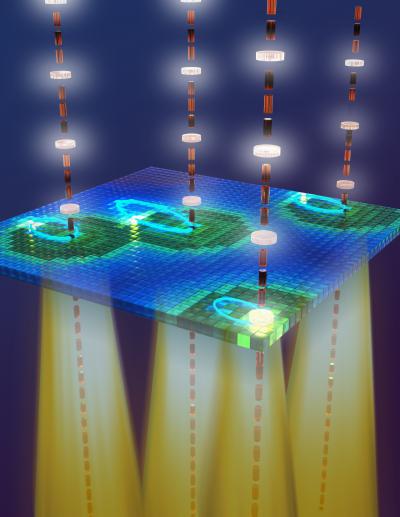
An artist's rendition of electron-hole recollision. Near-infrared (amber rods) and terahertz (yellow cones) radiation interact with a semiconductor quantum well (tiles). The near-IR radiation creates excitons (green tiles) consisting of a negative electron and a positive hole (dark blue tile at center of green tiles) bound in an atom-like state. Intense terahertz fields pull the electrons (white tiles) first away from the hole and then back towards it (electron paths represented by blue ellipses). Electrons periodically recollide with holes, creating periodic flashes of light (white disks between amber rods) that are emitted and detected as sidebands. (Credit: Peter Allen, UCSB)
They did that by causing electrons to be ripped from their cores, accelerated, and then smashed back into the cores they left behind.
When the high-frequency optical laser beam hits the semiconductor material — in this case, gallium arsenide nanostructures — it creates an electron-hole pair called an exciton. The electron is negatively charged, and the hole is positively charged, and the two are bound together by their mutual attraction.
“The very strong, low-frequency free electron laser beam rips the electron away from the hole and accelerates it,” explained Mark Sherwin, whose research group made the groundbreaking discovery. Sherwin is a professor of physics at UCSB and a co-author of the paper. He is also director of the campus’s Institute for Terahertz Science and Technology.
“As the low-frequency field oscillates, it causes the electron to come careening back to the hole.” The electron has excess energy because it has been accelerated, and when it slams back into the hole, the recombined electron-hole pair emits photons at new frequencies — up to 11 in their experiment.
The electron-hole recollision phenomenon has the potential to significantly increase the speed of data transfer and communication processes. One possible application involves multiplexing — the ability to send data down multiple channels. Another is high-speed modulation.
The researchers utilize a free electron laser to produce the electron-hole recollisions, which they note is not practical for real-world applications.
Theoretically, however, a transistor could be used in place of the free electron laser to produce the strong terahertz fields.
Tuesday, 6 March 2012
Manufacturing has a key role to play in economic growth, particularly in driving exports and productivity, and in rebalancing the UK economy. It also brings a number of other benefits to the UK in terms of societal value and contribution to national resilience.
The nature of manufacturing and its role in the UK and global economies is going through a period of change.
As with a number of developed economies, the manufacturing share of the UK economy has declined, from 22% of GDP in 1990 to around 10% today. New industries and technologies are emerging. There is increased competition and changing demand for products and services.
The Future of Manufacturing project will provide a timely and fresh look at the long-term picture for the manufacturing sector out to 2050, investigating global trends and drivers of change.
Leading experts
The project calls on industry and academic expertise from the UK and abroad to explore how the UK can maximise key opportunities and mitigate risks. In doing so, it will provide a robust evidence base to help ensure that policy decisions taken today are resilient in an uncertain future.
The Government Office for Science Foresight programme leads the project, under the direction of the Government Chief Scientific Adviser, Professor Sir John Beddington. Vince Cable, Secretary of State for Business, Innovation and Skills, is the project sponsor Minister.
A Lead Expert Group (LEG) of eminent academic and private sector experts from a range of disciplines works alongside the Foresight team to help guide the project and secure a strong evidence base. A High Level Stakeholder Group (HLSG), chaired by Vince Cable, will advise on the strategic direction and impact. Find out more about the LEG. Members of the HLSG will be announced in early 2012.
The project’s fresh thinking, innovative evidence base and futures analysis will help inform policy makers in the Department for Business, Innovation and Skills and a range of other relevant departments throughout the project and beyond.
Sunday, 4 March 2012
Boeing announced that it has, for the first time in aviation history, flown a manned airplane powered by hydrogen fuel cells.
The recent milestone is the work of an engineering team at Boeing Research & Technology Europe (BR&TE) in Madrid, with assistance from industry partners in Austria, France, Germany, Spain, the United Kingdom and the United States.
"Boeing is actively working to develop new technologies for environmentally progressive aerospace products," said Francisco Escarti, BR&TE's managing director. "We are proud of our pioneering work during the past five years on the Fuel Cell Demonstrator Airplane project. It is a tangible example of how we are exploring future leaps in environmental performance, as well as a credit to the talents and innovative spirit of our team."
A fuel cell is an electrochemical device that converts hydrogen directly into electricity and heat with none of the products of combustion such as carbon dioxide. Other than heat, water is its only exhaust.
A two-seat Dimona motor-glider with a 16.3 meter (53.5 foot) wingspan was used as the airframe. Built by Diamond Aircraft Industries of Austria, it was modified by BR&TE to include a Proton Exchange Membrane (PEM) fuel cell/lithium-ion battery hybrid system to power an electric motor coupled to a conventional propeller.
Three test flights took place in February and March at the airfield in Ocaña, south of Madrid, operated by the Spanish company SENASA.
During the flights, the pilot of the experimental airplane climbed to an altitude of 1,000 meters (3,300 feet) above sea level using a combination of battery power and power generated by hydrogen fuel cells. Then, after reaching the cruise altitude and disconnecting the batteries, the pilot flew straight and level at a cruising speed of 100 kilometers per hour (62 miles per hour) for approximately 20 minutes on power solely generated by the fuel cells.
According to Boeing researchers, PEM fuel cell technology potentially could power small manned and unmanned air vehicles. Over the longer term, solid oxide fuel cells could be applied to secondary power-generating systems, such as auxiliary power units for large commercial airplanes. Boeing does not envision that fuel cells will ever provide primary power for large passenger airplanes, but the company will continue to investigate their potential, as well as other sustainable alternative fuel and energy sources that improve environmental performance.
BR&TE, part of the Boeing Phantom Works advanced R&D unit, has worked closely with Boeing Commercial Airplanes and a network of partners since 2003 to design, assemble and fly the experimental craft.
The group of companies, universities and institutions participating in this project includes:
- Austria -- Diamond Aircraft Industries
- France -- SAFT France
- Germany -- Gore and MT Propeller
- Spain -- Adventia, Aerlyper, Air Liquide Spain, Indra, IngenierÃa de Instrumentación y Control (IIC), Inventia, SENASA, Swagelok, Técnicas Aeronauticas de Madrid (TAM), Tecnobit, Universidad Politécnica de Madrid, and the Regional Government of Madrid
- United Kingdom -- Intelligent Energy
- United States -- UQM Technologies.