Author, Speaker, and Consultant on Hyperinnovation, Future Studies, GigaMarket$, The New Industrial Revolution, and Advanced Robotics and (iRev) Intelligence Revolution.
Tuesday, 1 March 2011
Pop-Up Hyperinnovative Skateparks!
.
This innovative concept sees art, design and extreme sports collide creatively in an awe-inspiring, customised Skatepark entirely unique in the skating world.
.
Using pop-culture icons and the latest trends, the Pop-Up Skatpark creates ultra-cool skating environments, designed to garner the ultimate media exposure through their incredible appeal and popularity.
.
Currently I know of two Pop-Up Skate Park themes in production – Transformers and Space Invaders — both ideal promotional media for high-energy brands that want to attract serious attention.
.
This is a fully customizable skating environment, designed for each specific location’s surroundings, and incorporating a range of innovative ramps, bowls, half-pipes and landings.
. Two oversized Autobot Transformer robots, impressively positioned at either end of the skate park, signify guardianship of the ramp and those who use it, echoing seamlessly the Transformers film concept of robots protecting humans.
.
An all-encompassing landscape of illumination and light-projected designs enhance the skating environment. There is also the option of showcasing a range of rotating art works to further emphasize this hyper- real environment.
.
Space Invaders, in turn, are arguably the biggest pop-cultural icons of the 1970s!
.
The original characters that introduced the world to the realm of video gaming through their pixilated aesthetics, enjoy the unique advantage of multi-generational appeal.
.
Globally, from children of the 70s through to Generation Y, the public has recognized and appreciated these characters for their cool simplicity. .
Alien invaders and super-sizing them for their unique Skatepark. A pair of larger-than-life Space Invader characters frame the two ends of the skating environment. Made from translucent Perspex, these illuminated figures create the visual masthead for the Skate Invaders Park.
.
The Continued Growth of the Multifuctional Complex.
The main idea of this project is architectonics and aesthetics of the new environment, which it creates. Also it has a purpose to be an alternative model for the architecture of the future.
This complex is designed to be in Armenia - Yerevan, (in the canyon of Hrazdan) which is situated not far from the historical center of the city. The whole complex is located in such a place, which can be considered as an entrance to the center of the city.
By making some major changes with the environment where it is situated it also recreates the perception of an urban environment in Yerevan.
Here the idea of skyscraper is analyzed and designed in alternative way, with taking into consideration a human development, connection between human and nature, human scale.
I have analyzed the concept of a skyscraper in several ways; the most important thing is to understand a skyscraper as a vertical growth of urban environment (especially urban environment of central business district).
This proposal suggests the idea of 'continual growth' of skyscrapers, which can be the next stage of development.
Friday, 28 January 2011
‘1 in 5 Graduates are Unemployed in UK,’ reports the BBC 6 'O’Clock News!
Why?
Is it the Recession?....Is it a case of wrong Degree, wrong time?....Has the Value of the Degree Commoditized (as a result of the fact that a great many British young adults are now graduates)?
All three hold water, I suspect!
But wot beats me, is the fact that throughout history, so many-many people have achieved mega-achievements without so much as a University degree, and sometimes without much education at all.
Can you think of any???....There are loads.
Here’s a short roll of people out of a non-exhaustive catalog.
For starters, the obvious protagonists: Richard Branson (who left school with very little credentials, got himself a criminal record for tax evasion at age 17) and now founder/owner of Virgin Group, with a capital worth of $25-Billion. Then there’s Lord Alan Sugar (who left school to sell TV Aerials and Yo-Yos), he’s now 800-million quid better off. And of course Bill Gates (who flunked out of Uni) founded M.S and became one of the wealthiest men on the planet.
What about the 2 boys who went to a rough secondary comprehensive school in Liverpool, who were often chucked out the Music class for being disruptive, and dismally failed their ‘O’ Level Music exam? Well, Paul McCartney and George Harrison have done fairly well, haven’t they?
There was a small girl who had very hard time at school. Daughter to a tough market stallholder and laundrywoman, who died quite young. She then spent years in a deprived orphanage.Only, she went on to become a pioneering designer and icon in world fashion. Gabrielle Bonheur ‘Coco’ Chanel, founder of the famous fashion brand Chanel, had extraordinary influence on fashion world.
Son, of wool merchant, and born into desperate poverty. Soon after his father lost his business. But this did not stop this eventual preeminent man. Sigmund Freud went on to invent and found the bedrock of psychoanalytic and psychiatry.
He started in a mailroom for a music publishing company. He has since become an Artist and Repertoire (A&R) executive for Sony BMG in the UK, and a television producer and judge for major television talent contests including American Idol. Simon Cowell is close to beoming a Billionaire!
With $1,000, dedication and desire, he dropped out of college at age 19 to start PC’s Limited, later named Dell, Inc. Dell became the most profitable PC manufacturer in the world. In 1996, The Michael and Susan Dell Foundation offered a $50 million grant to The University of Texas at Austin to be used for children’s health and education in the city.
Having dropped out of high school at 16, his s career and accomplishments are astounding. The most influential animator,Walt Disney holds the record for the most awards and nominations. Disney’s imagination included cartoons and theme parks. The Walt Disney Company now has annual revenue of $30 billion.
As a young, 20 year old housewife with no business experience, Debbi Fields started Mrs. Fields Chocolate Chippery. With a recipe for chocolate chip cookies, this young woman became the most successful cookie company owner. She later renamed, franchised, then sold Mrs. Field’s Cookies.
At 16, he left home to apprentice as a machinist. He later started a Small Motor Company to manufacture cars. HenryFord’s first major success, the Model T, allowed Ford to open a large factory and later start the assembly line production, revolutionalizing the auto-making industry.
With only a fourth grade education, this man started his own chocolate company. Hershey’s Milk Chocolate, which became the first US nationally marketed chocolate. Hershey also focused on building a wonderful community for his workers, known as Hershey, Pennsylvania.
After attending one semester of college, he worked for Atari before co-founding Apple Computers. Now without the “Computers” in their name, Apple includes iPod, iTunes, and most recently the iPhone. Steve Jobs was also the CEO and co-founder of Pixar before it merged with Walt Disney.
Sole owner, CEO, and Chairman of Ty, Inc., Ty Warner is a savvy, yet private business man. Ty, Inc., made $700 million in a single year with the Beanie Babies craze without spending money on advertising! He has since expanded to include Ty Girlz dolls, directly competing with Bratz dolls.
Having never attended high school, Frank Lloyd Wright surpassed all odds when he became the most influential architect of the twentieth century. Frank Wright designed more than 1,100 projects with about half actually being built. His designs have inspired numerous architects to look at the beauty around them and add to it.
Please understand. It's not that education is unimportant, because it is. If you have the resources and time to get one, get it. But education today - especially today - is not enougth. However, learning on a continuous basis is!
Education these days is expansive (we know that). Fees have gone through the roof. But learning is relatively free.
Education means knowledge that is emparted to you: done to you. Learning, on the other hand - is self-motivated and self-directed. You own it!
So build your Imagination, Creativity and Innovation quotient. Get ambitious. Get Determined. Think ‘Co Co.’ Think ‘Branson.’ And things will change for the positive.
The message: education will only get you so far thesedays. Human Resources will continue to demand credentials and will continue to put huddles in your way.
The answer is 'get real.' Learn, learn, learn. Be Entrepreneurial!
Wednesday, 26 January 2011
Noisy Radical Ideas in the Class-room, Team Building Workshop and Seminar, is good!
.
If you understand both the concept and significance of 'Disruptive Innovation' in the context of Education and Organisational Learning, then this is for you.
.
Disrupting Class was named the best human capital book of the year in the Strategy + Business ‘Best Book.’ They say: ‘…a must-read for anyone considering how to develop and profit from human capital.’ .
What I like about it, is that it's a rare 'Strategy' book on modernising (revolutionising!) Education, that's both 'Prescriptive' and full of 'Real-World' examples!
Well researchers at BAE systems in Bristol combined a "shear-thickening" liquid with the existing material used in bullet-proof vests - called Kevlar - to create the new armour.
The chemical formula of the new liquid is being kept secret but scientists say it works by thickening and becoming sticky on impact with a bullet.
BAE describe the new material as "bullet-proof custard". "It's very similar to custard in the sense that the molecules lock together when it's struck."
To test the new armour, scientists used a large gas gun to fire spherical-shaped bullets at more than 300 metres per second. They fired one set of bullets at 31 layers of untreated Kevlar and another set at 10 layers of Kevlar combined with the new "shear-thickening" liquid. The results showed that the Kevlar and liquid mix was more effective, as the Kevlar with the liquid works much faster and the impact isn't anything like as deep.
The new light-weight material could eventually replace the thick, heavy-layered plates of Kevlar used in existing bullet-proof vests for soldiers, in turn reducing soldier fatigue and would be more effective against bullets, shrapnel and in-coming custard pies.
Tuesday, 25 January 2011
HOLO4OD: Touch the Unreal!
Recently showcased at Tokyo Pack 2010, the DNP and ZeroUnit’s series of AirZero digital signage units make use of 3D projection to create displays that float in the air.
The viewer does not need to wear any special glasses, nor do their eyes get tired after watching the footage for a long time. Further, even in brightly lit locations the 3D display is still very visible and the footage itself does not require special editing to be projected. The Holo screens are 40-inches and 17-inches, projecting 3D imagery 90cm (35.4 inches) and 30cm (11.8 inches) respectively.
Also in development are the AERAS units, which allow you to touch and manipulate 3D and augmented reality footage floating in front of you, as if they were a regular touchpanel. These have already been installed at a museum in Japan since summer 2010.
The hype over 3D is currently at a peak, leading to a plethora of phones, TVs and other consumer electronics that feature the technology.
However, actually practical signage incorporating 3D is still lacking and this new series allows interactivity so that the content is not merely an expensive mini advertisement. The uses include actual menus and information screens, as if it were a regular touchscreen display.
I was talking to a friend the other day, and the question of progress came up.
The conversion went on: '.... It looks as though change - in technology, social structure, standards of living, life span, life opportunities, etc, etc - within our life time has only become discernible within our life time.....'
Only, her retort was unsympathetic: 'I don't know how that works? As, even though we can see things are changing and even improving right now, no one can know the future, let alone study it. Hell, no one can know where all this change is heading....'
I said, we can 'project' in a great many instance, many kind of futures.
'No, no!' she screeched!
So I simply asked her whether the 'Sun' would come up over the Horizon in the morning.
She replied 'Yes, silly.' 'Well that's in the future,' I said.
Point is, there are a great many things about the future that are highly predictable or forecastable (although some much less so).
But further, there are methods, tools and techniques that can help us see over the Horizon.
Structured ways of thinking and analysing that dramatically increase our understanding of the future.
Below is list of links to ‘wiki-sites’ that give a 101 intro to studying the future!
i am hobby illustrator, is there a chance you'd like to publish some of my pics? i think it would be fun and fit on your cms :-) absolutely admire your design! write me a mail please in case you want to see my artwork
Would you like to send me you eamil to: chrisharrisfutures@hotmail.co.uk
Saturday, 4 December 2010
As I said 8 years ago in my book Hyperinnovation:
'As the big broadband telesatelites go up, so the borders of product, service and nation-states alike, collapse. Integrated portable videophones with hip-hop stereo sub-bass conferencing one-to-one, one-to-all, all-to-all and all-to-one emerge on every street corner from Iceland to Ice-Tea'
Well, the first satellite dedicated to delivering broadband services to Europe has launched on an Ariane 5 rocket.
The Hylas spacecraft is designed to fill so-called "notspots" - remote locations such as rural villages where it is currently not possible to get a fast internet connection.
Controllers will now take a number of weeks to position the spacecraft properly in the sky some 36,000km above the equator, and to check out onboard systems.
Hylas (Highly Adaptable Satellite) is a commercial venture operated by start-up Avanti Communications of London, but the spacecraft itself incorporates technology developed with public funding through the European Space Agency (Esa).
The payload has flexibility to reallocate bandwidth and power in each of the eight spot beams that cover key market areas selected by Avanti. On Hylas, this can be done at any moment in time from the control centre. This agility is important because it will allow Avanti to keep up with market evolution.
It has a commitment that everyone in Britain should have access to a decent net connection by 2015. That means a minimum of two megabits per second (Mbps).
Some three million UK homes currently fall below this standard; and across Europe, there are many millions more who cannot currently get an adequate connection through terrestrial technology.
Hylas will be offering up to 10Mbps to its users. There'll be farmers, hotels, houses in the Lake District, in Scotland and parts of Cornwall that haven't been able to get broadband before; but now this satellite will deliver it. That brings them all online and that's something the coalition government is really committed to," he told BBC News.
Thursday, 2 December 2010
From blog blow:
'Not so long ago, you didn't even know the sex of your baby until the day of birth.
Today, we can know not only the genda of our new baby before its birth, we can know - in much detail - its physiology, facial features, and internal health.'
In a world where people appreciate good design everywhere, cool mini hotel rooms are the latest ‘it’ trend.
In Tokyo, the Capsule Inn exemplifies the bare-essentials hotel rooms for brief use, and similar concepts are popping up at airports, train stations and downtowns around the world, replacing and mimicking the “day rooms” already existing at many airports.
Unlike Tokyo’s bed-only cabins where customers climb into a human equivalent of a honeycomb for a night’s rest, Yotel pods at Gatwick and Heathrow airports in London and Schiphol Airport in Amsterdam come in larger and more comfortable formats. These self-contained mini hotel rooms are equipped with a bed, table, HD TV and Wi-Fi.
The fourth Yotel is set to arrive in New York in 2011 with a location opening on 42nd and 10th street boasting 669 luxury rooms and the largest outside terrace in any hotel in New York
Also in Amsterdam, Citizen M has a hotel with 230 mini rooms at Schiphol Airport and a 215-room hotel in Amsterdam City. Citizen M plans to open similar hotels across Europe.
Qbic Hotels has opened two “cheap chic” hotels with mini rooms in the Netherlands: Qbic World Trade Centre Amsterdam and Qbic Maastricht, plus one in Antwerp, Belgium.
Taking the next step in rest and space efficiency, Russia’s Arch Group designed the SleepBox.
Along with an airport version of the rest pod, equipped with the usual, high-tech necessities offered by other companies, Arch Group has also designed an easy-to-relocate version fit for hostels. A small, mobile compartment, 2m (l) x 1.4m (w) x 2.3m (h), SleepBox is made of wood and MDF. SleepBox is meant to “allow very efficient use of available space and, if necessary, a quick change of layout”, making it perfect for hostels where demand and space available often come in conflict with each other. The hostel-specific SleepBox features bunk beds, flip-out tables and sockets for computers or phone chargers and not much else.
Monday, 29 November 2010
A Brief History of Time-Based Strategy.
The ‘speed thing’ - whether time-to-market, production cycle-times, or delivery lead-times, et al - isn’t new. It goes way back before it became vogue in late 20th century business strategy. Competition through swiftness goes back millennia in fact.
The Great Wall of China and Rome’s straight cobbled roads where constructed to deploy troops and ordnance at pace. Empires would fallen like dominos if it were not for these engineering super-highways.
When the first prototype of the K5054 (Type 300) Spitfire was assembled in 1936 it took almost 28 days of 24 hour shifts. By the end of the Battle of Britain in October 1940 it took a mere 9 hours to put the Mark-V (type 331) Spitfire together…. And hay, who said the Japanese pioneered Kaizen type continuous improvement?
Lockheed (now merged as Lockheed-Martin) also as far back a the World-War-II and through the 1970s continued to amaze the Pentagon by the speed at which they designed and built advanced tactical jet aircraft. In fact, one-tenth of the time compared to the competition. The driving force behind this stupendous rate of productivity was one Clarence ‘Kelly’ Johnson. He set up an organisation with all the processes in one giant hanger to cut across red-tape to get things done without fuss. Two of his most celebrated projects was the U-2 and SR-71 (Blackbird) spy plans. They went from rough sketch to airborne prototype in under 21 weeks (that’s 144 days).
In 1979 a client of the Boston Consulting Group revealed the conclusions of a benchmarking programme he carried out between his US factories against his Japanese affiliate’s factories. The findings were stark. The Japanese plants had substantially higher productivity, better quality, less inventory, less space and much faster throughput times. However, they were baffled as to how they achieved such competitive advantages? And after the best part of a 4 year study the cause of these effects were delineated. ‘Time’ was at the essence.
During these investigations many closely held assumptions as to how costs and customers behave were altered. Instead of costs going up as run-lengths are reduced; instead of costs going up as greater investment in quality; instead of costs going up with increasing variety and quicker response times; costs came down. Further, instead of customer demand being only marginally affected by expanded choice and better responsiveness, it proved astoundingly sensitive to better service.
After these conclusions were drawn, they began to leak out into the technical media, and so time-based strategy began to take off. Throughout the 1980s and ‘90s speed became a big issue. In Japan Sony, Casio and Sharp adopted the temporal approach to new products. Six months for new platform digital watch, camera, phone, PDA, or forget it! State-side, the likes of Xerox, AT&T, H-P, Intel, and Motorola begun to see the benefit and implement time-based strategies and organisations. Eventually, in some cases, new product introduction went from many tardy years to months.
And so it was set. Manufacturing, and many a service industry was ablaze with buzz terms like ‘Simultaneous Engineering, ‘Integrated Design and Manufacturing,’ ‘Process Reengineering,‘ and ‘Time-to-Market.’
Today, arguable, Formular-1 racing hold the batten of speed across new product introduction and production cycle-times. Making use of ultra-fast design and manufacturing technologies, and highly talented, skilled and integrated teams of engineers and designers. Racecraft s go through significant adaptations week-to-week during race season.
A Brief History of Time-Based Strategy.
The ‘speed thing’ - whether time-to-market, production cycle-times, or delivery lead-times, et al - isn’t new. It goes way back before it became vogue in late 20th century business strategy. Competition through swiftness goes back millennia in fact.
The Great Wall of China and Rome’s straight cobbled roads where constructed to deploy troops and ordnance at pace. Empires would fallen like dominos if it were not for these engineering super-highways.
When the first prototype model of the K5054 (Type 300) Spitfire was assembled in 1936 it took almost 28 days of 24 hour shifts. By the end of the Battle of Britain in October 1940 it took a mere 9 hours to put the Mark-V (type 331) Spitfire together…. And hay, who said the Japanese pioneered Kaizen type continuous improvement?
Lockheed (now merged as Lockheed-Martin) also as far back a the World-War-II and through the 1970s continued to amaze the Pentagon by the speed at which they designed and built advanced tactical jet aircraft. In fact, one-tenth of the time compared to the competition. The driving force behind this stupendous rate of productivity was one Clarence ‘Kelly’ Johnson. He set up an organisation with all the processes in one giant hanger to cut across red-tape to get things done without fuss. Two of his most celebrated projects was the U-2 and SR-71 (Blackbird) spy plans. They went from rough sketch to airborne prototype in under 21 weeks (that’s 144 days).
In 1979 a client of the Boston Consulting Group revealed the conclusions of a benchmarking programme he carried out between his US factories against his Japanese affiliate’s factories. The findings were stark. The Japanese plants had substantially higher productivity, better quality, less inventory, less space and much faster throughput times. However, they were baffled as to how they achieved such competitive advantages? And after the best part of a 4 year study the cause of these effects were delineated. ‘Time’ was at the essence.
During these investigations many closely held assumptions as to how costs and customers behave were altered. Instead of costs going up as run-lengths are reduced; instead of costs going up as greater investment in quality; instead of costs going up with increasing variety and quicker response times; costs came down. Further, instead of customer demand being only marginally affected by expanded choice and better responsiveness, it proved astoundingly sensitive to better service.
After these conclusions were drawn, they began to leak out into the technical media, and so time-based strategy began to take off. Throughout the 1980s and ‘90s speed became a big issue. In Japan Sony, Casio and Sharp adopted the temporal approach to new products. Six months for new platform digital watch, camera, phone, PDA, or forget it! State-side, the likes of Xerox, AT&T, H-P, Intel, and Motorola begun to see the benefit and implement time-based strategies and organisations. Eventually, in some cases, new product introduction went from many tardy years to months.
And so it was set. Manufacturing, and many a service industry was ablaze with buzz terms like ‘Simultaneous Engineering, ‘Integrated Design and Manufacturing,’ ‘Process Reengineering,‘ and ‘Time-to-Market.’
Today, arguable, Formular-1 racing hold the batten of speed across new product introduction and production cycle-times. Making use of ultra-fast design and manufacturing technologies, and highly talented, skilled and integrated teams of engineers and designers. Racecraft models go through significant adaptations week-to-week during race season.
Wednesday, 3 November 2010
First 3D Printed Car to Hit Road.
The 'Urbee' is an Automotive X Prize candidate, designed by Kor Ecologic of Winnipeg, Canada. it's an electric/liquid-fuel hybrid that will get the equivalent of over 200 mpg on the highway and 100 MPG in the city.
But it is also the first car ever to have its entire body printed out on a giant 3D printer.
'Urbee is the first prototype car ever to have its entire body 3D printed with an additive process. All exterior components - including the glass panel prototypes - were created using Dimension 3D Printers and Fortus 3D Production Systems at Stratasys' digital manufacturing service: RedEye on Demand.'
The designers at 'Kor' point out the benefits of so-called 'Fused Deposition ling (FDM)':
'Our goal in designing it was to be as 'green' as possible throughout the design and manufacturing processes. FDM technology from Stratasys has been central to meeting that objective. FDM lets us eliminate tooling, machining, and handwork, and it brings incredible efficiency when a design change is needed. If you can get to a pilot run without any tooling, you have advantages.'
The implications for building prototypes are obvious; you go straight from computer to finished part in a lot less time. But imagine a few years down the road, when everyone might order up the car body of their choice from a catalogue and just bolt it on a standard chassis. Ding the side? Just print up a replacement.
Google on Thursday introduced the next generation of interaction with its Android operating system: voice-driven actions.
Google executives outlined 12 new "Voice Actions for Android," including phone calls, reminder e-mails, direction search, and music search. (Searching for generic links, a traditional function of Android, is number 13.) The app is called "Voice Search," requires Android 2.2, and is available in the Android Market now, Google executives said.
A second improvement, dubbed "Chrome to Phone," allows users to click on a new "mobile phone" icon to send links, YouTube videos, even directions, to the phone.
So far, the features are exclusive to Android phones and U.S. English, although the capabilities will be moved to other languages and other operating systems (including the iPhone) in the future, executives said. "It's probably, on Android, the easiest," said Hugo Barra, director of product management for Google.
Voice actions can be triggered by clicking the "microphone" icon on the screen. Saying "call John Smith at home" will trigger the contacts list and voice dialer, "find art museums in Amsterdam" would launch a Google Maps application, and "listen to Ace of Base" will search for music from the artist on Pandora, Last.fm, or another music application. A "note to self" command, meanwhile, will send an automated e-mail to a default e-mail address. If Android is confused about which application to use, or a location, it will present a list of choices.
Within the phone, the microprocessor can power just hundreds or thousands of MIPS, a measure of processing power. But connecting the phone to the cloud allows the phone to basically put a supercomputer in your pocket, Barra said.
Voice actions allow the user to essentially command the phone's actions, where previous iterations have focused on looking for links. Google has no plans to add sponsored search listing, and the company will use your location if you provide it. Barra said that there is a roadmap to increasing the capabilities of the voice actions, including the possibility for adding a scripting language.
"There's a place where you want to type, and there's a time and place where you want to use voice," said Dave Burke, an engineering manager at Google and the author of the "Chrome to Phone" function. About 25 percent of the data Google processes via Android is search data, Barra said.
"Chrome to Phone" is as described: within Chrome, clicking the "phone" icon sends a search result, a YouTube link, or directions directly to an Android 2.2 phone. The Chrome to Phone capability is a Chrome extension, and is available on the App Market, Burke said.
For now, the transfer is one-way; data can not be sent from the phone to the PC, Barra said. The phone-to-PC capability may be added in the future, Barra said.
NASA DARPA-funded ‘Hundred Year Starship’ Program.
NASA Ames Director Simon Pete Worden revealed Saturday that NASA Ames has “just started a project with DARPA called the Hundred Year Starship,” with $1 million funding from DARPA and $100K from NASA.
“You heard it here,” said Worden at “Long Conversation,” a Long Now Foundation event in San Francisco. “We also hope to inveigle some billionaires to form a Hundred Year Starship fund,” Dr. Worden added. “I absolutely will be on board.” (No further details on this are available from NASA at this time.)
“The human space program is now really aimed at settling other worlds,” he explained. “Twenty years ago you had to whisper that in dark bars and get fired.” (Worden was in fact fired by President George W. Bush, he also revealed.)
New propulsion ideas
Worden also mentioned some nearer-term ideas that NASA is exploring (and that are not necessarily related to the Starship program). One new propulsion concept is electric propulsion, said Worden. “Anybody that watches the [Star Trek] Enterprise, you know you don’t see huge plumes of fire. Within a few years we will see the first true prototype of a spaceship that will take us between worlds.”
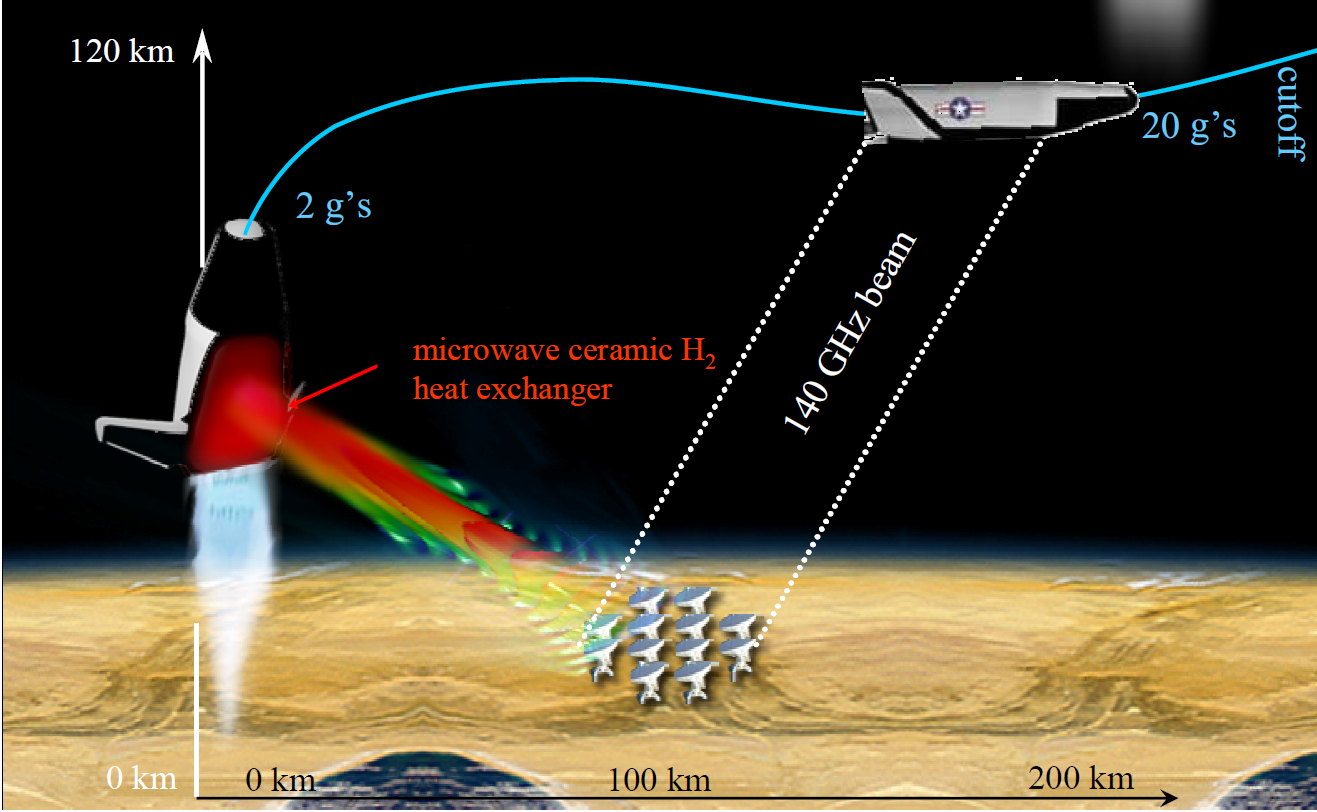
Worden said NASA is also funding a new program to develop microwave thermal propulsion for getting to orbit. “The idea is if you can beam power to the spaceship, so you don’t have to carry all the fuel; and then you use that energy from a laser or microwave power to heat a propellant; it gets you a pretty big factor of improvement. I think that’s one way of getting off the world.”
The principal investigator of this program is Dr. Kevin L.G. Parkin, who invented the technology and described it in his PhD thesis. He is assisted by Creon Levit and David Murakami. Caltech grad student Dmitriy Tseliakhovich has also formed a company called Escape Dynamics LLC to commercialize the microwave thermal propulsion project. (Tseliakhovich’s team project at Singularity University this past summer grew out of Parkin’s work.)
“The microwave thermal thruster using beamed propulsion is an excellent idea,” said Dr. Narayanan M. Komerath, a professor at Georgia Tech College of Engineering and a NASA Institute of Advanced Concepts Fellow. “[Kevin Parkin] picks the 140 GHz window, which apparently offers strong advantages in absorption by the materials that he uses in the propulsion system.”
Space settlements and electric planes
But Worden warned that in settling on other worlds, we need to be cautious. “How do you live in another world? I don’t have the slightest idea,” he said. “If you’re a conservative, you worry about it us; if you’re a liberal, you worry about us it. I think things like synthetic biology have lot of potential for that. I think rather than make an environment on Mars like Earth, why don’t we modify life … including the human genome … so it’s better suited to [Mars]?”
Worden also thinks we should go to the moons of Mars first, where we can do extensive telerobotics exploration of the planet. “I think we’ll be on the moons of Mars by 2030 or so. Larry [Page] asked me a couple weeks ago how much it would cost to send people one way to Mars and I told him $10 billion, and his response was, ‘Can you get it down to 1 or 2 billion?’ So now we’re starting to get a little argument over the price.”
Meanwhile, back on Earth, Worden says NASA Ames is exploring another radical new concept: a heavy-lift airship that could carry hundreds of tons. “I think that could revolutionize air transport, because it becomes very cheap and still goes 100 knots. The idea is that you could easily go to Hawaii overnight, for example… with a lot less fuel.
“The long-term answer [to the rapidly accelerating growth of travel in the developing world and the increase in greenhouse gas] is a “Tesla in the air” — using high-density batteries powered off ground-based solar grids, so your airliner stays plugged in overnight, and it’s got an electrical engine rather than a chemical engine. I think within ten years we’ll have small-scale business-level ones, and within 20, they’ll be the airliners.
Sunday, 24 October 2010
Body Organs with IP Address!
For cardiac patients too much excitement can be a shocking experience. If their heart rate gets too high an implanted defibrillator in their chest can think their having a heart attack and give them a friendly remedial shock. But such nasty surprises could soon become less of a concern for people like me – by giving our hearts their very own IP addresses.
Dutch research organisation IMEC, based in Eindhoven, this week demonstrated a new type of wireless body area network (BAN). Dubbed the Human++ BAN platform, the system converts IMEC's ultra-low-power electrocardiogram sensors into wireless nodes in a short-range network, transmitting physiological data to a hub – the patient's cellphone.
From there, the readings can be forwarded to doctors via a Wi-Fi or 3G connection. They can also be displayed on the phone or sound an alarm when things are about to go wrong, giving patients like me a chance to try to slow our heart rates and avoid an unnecessary shock.
Besides helping those already diagnosed with chronic conditions, BANs could be used by people at risk of developing medical problems – the so-called "worried well" – or by fitness enthusiasts and athletes who want to keep tabs on their physiological processes during training.
In the current design, the ECG electrodes are connected to a small necklace that contains the transmitter and battery. The next step will be to use an ultra-low-power radio transmitter, still in development at IMEC, to improve the stamina and portability of the sensors.
With around 18 million people in the UK living with chronic disease, ‘Telehealth' monitoring like this is the way things are going. Devices already exist that allow people with pacemakers and defibrillators to send telemetry from their implants via a landline to doctors. But using mobile phones would be the next step.
Wednesday, 22 September 2010
Leon Trotsky once said: ‘You may not be interested in technology, but technology is most certainly interested in you.’ Thus, does technology have it’s own agenda?
Well Kevin Kelly's new book 'What Technology Wants' makes clear technos has a path with a teleological force (are you listening Trotsky!).
Clearly, technology not only give us evermore choice, it gives us more time, and increased productivity to invent more technology. In fact, a major milestone in human cultural evolution - and a consequence of Kelly’s hypothesis - is (was) the very moment we invented the first ‘Toy!’
Perhaps human civilisation didn’t begin with the struggle with ‘Tools’, but begun with the pleasure of ‘Toys!’
In fact we humans have only ever produced 2 technological archetypes: the ‘Tool’ and the ‘Toy‘.
1) Tools: language, the controlled production of fire, flint knife, clothing, shelter, mega-dumper trucks.
2) Toys: rhythmical chants, fire walking, fashioned stones on string, iPODs.
It was only when man had a little time on his hands that he could 'chose' to play; suddenly entertainment arrived. And that only happened through the evolution of more productive tools.
Kelly's provocative book introduces a brand-new view of technology. It suggests that technology as a whole is not a jumble of wires and metal but a living, evolving organism that has its own unconscious needs and tendencies.
Kevin Kelly looks out through the eyes of this global technological system to discover "what it wants." He uses vivid examples from the past to trace technology's long course and then follows a dozen trajectories of technology into the near future to project where technology is headed.
This new concept of technology offers three practical lessons:
1) By listening to what technology wants we can better prepare ourselves and our children for the inevitable technologies to come.
2) By adopting the principles of pro-action and engagement, we can steer technologies into their best roles.
3) And by aligning ourselves with the long-term imperatives of this near-living system, we can capture its full gifts.
Written in intelligent and accessible language, this is a fascinating, innovative, and optimistic look at how humanity and technology join to produce increasing opportunities in the world and how technology can give our lives greater meaning.
"Institutions will try to preserve the problem to which they are the solution." -- Clay Shirky
I think this observation is brilliant. It reminds me of the clarity of the Peter Principle, which says that a person in an organization will be promoted to the level of their incompetence. At which point their past achievements will prevent them from being fired, but their incompetence at this new level will prevent them from being promoted again, so they stagnate in their incompetence.
The Shirky Principle declares that complex solutions (like a company, or an industry) can become so dedicated to the problem they are the solution to, that often they inadvertently perpetuate the problem.
Unions, or example. Unions were a brilliant solution to the problem of capital management which tended to exploit uncapitalized workers. But over time as capital increased in complexity, unions complexified as well, until unions needed management. The two became one system -- union/management. So now the problem with unions is that they are locked into the old framework, the old system. They inadvertently perpetuate the continuation of the problem (management) they are the solution to because as long as unions exists, companies feel they need management to offset them, and so the two became co-dependent. In effect problems and solutions tend become a single system.
In his brilliant, classic book The Innovator's Dilemma, Clay Christensen demonstrates how disruptive technologies almost always arise from the margins of an industry, where they start out as insignificant, or toy, solutions. Honda's hobbyist electric bicycles were no threat to the big four automobile companies, until electric bikes become motorcycles and motorcycles became small efficient cars. Cheap crumby dot matrix printers were no threat to big offset printing companies until dot matrix became injet printers and injects became the HP Indigo 5000 on-demand printers. In each case, the solutions were marginal, barely working, at first, and therefore ignored. I think what Clay Shirky is pointing out is that many problems, too, are marginal at first, and therefore ignored. Established industries like to focus on established problems.
Shirky made his quote in a recent talk, a bit from his upcoming book Cognitive Surplus. Shirky also referred to a similar idea in a recent blog posting about the ways in which media companies and the media industry are often constitutionally incapable of changing because they are still solving the last problem.
In a strong sense we are defined by the problems we are solving. Yin/Yang, problem/solution, both sides form one unit. Because of the Shirky Principle, which says that every entity tends to prolong the problem it is solving, progress sometimes demands that we let go of problems. We can then look to marginal solutions and ask ourselves, what marginal problem is this solving that might be a more appreciated problem later on?
Friday, 30 July 2010
Brit Tech Genius: 10 Innovators Changing Your World.
Think all your gadgets are dreamt up across the pond or in secret Far East bunkers owned by the world’s biggest tech titans? Think again. Britain is at the forefront when it comes to bleeding edge gadgetry, whether it’s the latest shiny must-have from Apple, or a motor that’s all set to break the land speed record. It’s easy to forget British boffins are behind some of the world’s greatest gadgets so, without further ado, here are my top 10 British innovators you need to know.
Jonny Ive, Senior Vice President of Industrial Design at Apple: Every modern day Apple gadget owes its existence to one man. Not Steve Jobs, but Jonny Ive, the Chingford (UK) born designer who’s been in charge of Cupertino’s industrial design since 1997. In that time he’s created the classic iMac, turned the MP3 player from niche plaything to global phenomenon with the iPod, and made touchscreens work seamlessly on the iPhone. .
Ive’s a shy genius, rarely speaking about his work and showing his face in public even less often. He’s most frequently found toeing the company line in official Apple videos, but the clip below from American TV show Objectified shows him more relaxed, working in his studio, and explaining the thought processes which keeps him at the top of the tech design pile.
James Dyson, inventor the Dyson Dual Cyclone: Dyson’s first vacuum cleaner, the G-Force, was sidelined when it was first unleashed in the 80s. Yet it’s follow-ups have set the tone for household gadgets all over the world. With the Dyson Dual Cyclone now found in the home of every self-respecting cleanliness freak Dyson has set his sights further afield.
Not content with fighting dust, Dyson’s Airblade hand drier has called time on weak-willed air blowers in loos across the globe, and earlier this year he set out to change desktop fans forever with his Dyson Air Multiplier.
Tim Berners Lee, inventor of the World Wide Web Without Tim Berners Lee, what you’re doing right now might not be possible. The British engineer developed the www back in 1989, going on to build the first ever web browser and web server.
After the first website was built in 1991, Berners Lee’s creation went from niche networking to global colossus in ten short years. Tell me you could live without the world wide web now and you’d be lying.
John Piper, Chief Designer, Hound: You might not have heard of John Piper, but pay attention: Piper’s car, Hound, isn’t like other motors. That’s because it’s being primed to top 1,000mph in 2011, smashing the world land speed record in the process.
Whizzing by in a faster-than-sound blur, it’ll be driven by current record holder, Wing Commander Andy Green. Piper recently finished the design of Hound, positioning a small rocket underneath the engine of a Eurofighter jet. He reckons it’ll be enough to bring him success with the landspeed record, and cements him a place on my list of British tech giants.
Gordon Murray, McLaren F1 designer turned eco car maker: Murray is known as the man behind the McLaren F1 sports car. But he’s all set to make a name for himself at the bleeding edge of eco motoring with the T.27, a brand new type of electric car that’ll be ready to roll on British streets in just under two years.
A completely new concept, Murray is hoping to have s built and on sale by 2011. It’ll have a top seed of 60mph when it hits the tarmac in 18 months time, weighing around half the mass of today’s ‘leccy motors at 600Kg. At the moment, Murray’s prototypes look like he’s hammered them together in a shed, but he’s got form for creating fantastic cars in the past, and could be about to start a Prius-style revolution right here in the UK.
Trevor Baylis, inventor of the clockwork radio: Baylis is best known for inventing the clockwork radio, letting people snaffle signals without relying on batteries or the mains for their breakfast banter. His Freeplay radio, as it became known, was first unleashed in Africa, before a smaller hit the UK.
Since then Baylis has become a champion of British inventors, helping young bucks bring their high tech dreams to reality with the Trevor Baylis Foundation.
Kane Kramer, inventor of the Digital Audio Player: While Jonny Ive may have brought the MP3 player to the masses, it’s possible the iPod would never have happened without Kane Kramer. The British inventor first conceived a Digital Audio Player (DAP) back in 1979, also touting the idea of downloading music of your phone line and something that looks very much like an Apple store. It may have seemed mad back then, but he was bang on the money.
Kramer’s original drawings of a DAP clearly show a slab like device that many of us would recognise as an iPod today. In 1979 though, his ideas were seen as marginal. Apple was even moved to recognise Kane’s idea in 2007, although it won’t be stumping up any cash in return for making it popular.
Peter Molyneux, creator of Fable, Theme Park and Milo: Britain’s gaming industry is teeming with successful developers that are the envy of the world. But Molyneux has been a leading light in the world of video games since the 80s. Classics such as Theme Park, Populous and Fable all bear his hallmark. And he’s not shuffling off into retirement yet.
Molyneux is one of the driving forces behind the Xbox 360’s Project Natal. At its launch, he showed off a project dubbed Milo and the forthcoming Fable 3. If a gaming technology has Molyneux behind it, you’re guaranteed big crowds, and with his vote firmly in Natal’s ballot box he’s already making sure British games studios are taking Microsoft’s system seriously.
Richard Palmer, founder D3O: My home town 'Brighton and Hove' based 'D3O' is about to revolutionise gadgets. You might not know its name, but it’s one of the world’s first smart materials, and it was invented by a Brit!
Sussex University graduate Chemical engineer Richard Palmerset up his own business to create the substance, which acts like silly putty in your hands, but stiffens up to absorb shocks and bumps whenever it’s hit.
It’s a silicon polymer that has the look and feel of playdoh, and is already in laptop and iPod cases from Tech 21, saving your precious tech from taking a battering. Palmer also says it could go into body armour too. Think futuristic football shin pads that mould to your legs but harden up when you’re hit by a crunching tackle. Smart materials are the future, and Palmer proves you needn’t be a mega multinational to make your mark.
Sir Howard Stringer, CEO Sony: Stringer hasn’t had it easy heading up one of the planet’s biggest tech giants. But his Sony United plan has made the gadget colossus more lean, better focused and able to make the most of its assets.
His first triumph was with the robotic Rolly. The device itself was never going to be a huge seller, but it let Stringer pull together Sony’s Walkman, Aibo and mobile teams to create a single product that was more than the sum of its parts. It was niche and bizarre, and stole headlines while proving that Sony’s sprawling divisions could work together effectively. And he hasn’t stopped there.
With the likes of the PlayStation 3’s XMB interface heading to Sony Ericsson phones and onto Blu-ray players, he’s helped Sony’s products have one core interface. The impending Sony Online Service, flogging eBooks, music and video will also be a huge match for iTunes, finally turning Sony’s ragtag army of products into a unified fighting force ready to stomp all over tech rivals.
Tuesday, 27 July 2010
U.S. health officials have approved a first-of-its-kind technology to counter a leading cause of blindness in older adults - a tiny telescope implanted inside the eye.
The Implantable Miniature Telescope aims to help in the end stages of incurable age-related macular degeneration, a creeping loss of central vision that blocks reading, watching TV, eventually even recognizing faces.
The idea: Surgically insert the Implantable Miniature Telescope into one eye for better central vision, while leaving the other eye alone to provide peripheral vision. The brain must fuse two views into a single image, and the Food and Drug Administration warned Tuesday that patients need post-surgery rehabilitation to make it work.
There's little to help such advanced patients today aside from difficult-to-use handheld or glasses-mounted telescopes, while the new implanted telescope - smaller than a pea - can improve quality of life for the right candidate, said Dr. Malvina Eydelman, FDA's ophthalmic devices chief.
But it's only for a subset of the nearly 2 million Americans with advanced macular degeneration, Eydelman warned: Those 75 and older, with a certain degree of vision loss, who also need a cataract removed. In fact, the FDA took the highly unusual step of requiring that patients and their surgeons sign a detailed "acceptance of risk agreement" before surgery, acknowledging potential side effects - including corneal damage and worsened vision - and the need for lots of testing to determine who's a candidate.
"We're not giving people back 20-year-old eyes," cautioned ophthalmic surgeon Dr. Kathryn Colby of Harvard and the Massachusetts Eye and Ear Infirmary in Boston. She helped lead manufacturer VisionCare Ophthalmic Technologies' study of the implant.
But by magnifying images onto more of the retina than its diseased center, someone who before couldn't see an entire face might now miss only the nose, Colby said.
In a 219-patient study, the FDA said 90 percent of telescope recipients had their vision improve by at least two lines on an eye chart, and three-quarters went from severe to moderate vision impairment.
Concern about damage to the inside lining of the cornea, the eye's clear front covering that helps focus light, held up FDA approval for several years. In that study, 10 eyes had serious corneal swelling, five that required corneal transplants. FDA's Eydelman said the company proposed candidate restrictions to minimize that risk, and will study how an additional 770 recipients fare after sales begin.
VisionCare, of Saratoga, Calif., is seeking Medicare coverage for the surgery and rehab costs, a package that it calls CentraSight. The company wouldn't estimate total costs but said the device itself costs $15,000.
WorkDetecon is a consulting company which unites classic management consulting with a high level of technology expertise.
Recentley they've had a further take on my thesis Hyperinnovation.
The artical reads:
'Hyperinnovation for Telcos... How to Get in the Game - Fast.
....Almost a decade has passed since Chris Harris elaborated on what he described as “the multidimensional interconnection of ideas” that challenges organizations to rethink the way they innovate in terms of strategy, culture, organization and methodology.
The basics have not changed, but Hyperinnovation for telcos now has a new spin, through technology that encourages and enables infinite and rapid communication and collaboration in a global economy....'
I find it interesting that my thsis is still being augmented!
 Pop-Up Hyperinnovative Skateparks!