Author, Speaker, and Consultant on Hyperinnovation, Future Studies, GigaMarket$, The New Industrial Revolution, and Advanced Robotics and (iRev) Intelligence Revolution.
Wednesday, 3 November 2010
First 3D Printed Car to Hit Road.
The 'Urbee' is an Automotive X Prize candidate, designed by Kor Ecologic of Winnipeg, Canada. it's an electric/liquid-fuel hybrid that will get the equivalent of over 200 mpg on the highway and 100 MPG in the city.
But it is also the first car ever to have its entire body printed out on a giant 3D printer.
'Urbee is the first prototype car ever to have its entire body 3D printed with an additive process. All exterior components - including the glass panel prototypes - were created using Dimension 3D Printers and Fortus 3D Production Systems at Stratasys' digital manufacturing service: RedEye on Demand.'
The designers at 'Kor' point out the benefits of so-called 'Fused Deposition ling (FDM)':
'Our goal in designing it was to be as 'green' as possible throughout the design and manufacturing processes. FDM technology from Stratasys has been central to meeting that objective. FDM lets us eliminate tooling, machining, and handwork, and it brings incredible efficiency when a design change is needed. If you can get to a pilot run without any tooling, you have advantages.'
The implications for building prototypes are obvious; you go straight from computer to finished part in a lot less time. But imagine a few years down the road, when everyone might order up the car body of their choice from a catalogue and just bolt it on a standard chassis. Ding the side? Just print up a replacement.
Google on Thursday introduced the next generation of interaction with its Android operating system: voice-driven actions.
Google executives outlined 12 new "Voice Actions for Android," including phone calls, reminder e-mails, direction search, and music search. (Searching for generic links, a traditional function of Android, is number 13.) The app is called "Voice Search," requires Android 2.2, and is available in the Android Market now, Google executives said.
A second improvement, dubbed "Chrome to Phone," allows users to click on a new "mobile phone" icon to send links, YouTube videos, even directions, to the phone.
So far, the features are exclusive to Android phones and U.S. English, although the capabilities will be moved to other languages and other operating systems (including the iPhone) in the future, executives said. "It's probably, on Android, the easiest," said Hugo Barra, director of product management for Google.
Voice actions can be triggered by clicking the "microphone" icon on the screen. Saying "call John Smith at home" will trigger the contacts list and voice dialer, "find art museums in Amsterdam" would launch a Google Maps application, and "listen to Ace of Base" will search for music from the artist on Pandora, Last.fm, or another music application. A "note to self" command, meanwhile, will send an automated e-mail to a default e-mail address. If Android is confused about which application to use, or a location, it will present a list of choices.
Within the phone, the microprocessor can power just hundreds or thousands of MIPS, a measure of processing power. But connecting the phone to the cloud allows the phone to basically put a supercomputer in your pocket, Barra said.
Voice actions allow the user to essentially command the phone's actions, where previous iterations have focused on looking for links. Google has no plans to add sponsored search listing, and the company will use your location if you provide it. Barra said that there is a roadmap to increasing the capabilities of the voice actions, including the possibility for adding a scripting language.
"There's a place where you want to type, and there's a time and place where you want to use voice," said Dave Burke, an engineering manager at Google and the author of the "Chrome to Phone" function. About 25 percent of the data Google processes via Android is search data, Barra said.
"Chrome to Phone" is as described: within Chrome, clicking the "phone" icon sends a search result, a YouTube link, or directions directly to an Android 2.2 phone. The Chrome to Phone capability is a Chrome extension, and is available on the App Market, Burke said.
For now, the transfer is one-way; data can not be sent from the phone to the PC, Barra said. The phone-to-PC capability may be added in the future, Barra said.
NASA DARPA-funded ‘Hundred Year Starship’ Program.
NASA Ames Director Simon Pete Worden revealed Saturday that NASA Ames has “just started a project with DARPA called the Hundred Year Starship,” with $1 million funding from DARPA and $100K from NASA.
“You heard it here,” said Worden at “Long Conversation,” a Long Now Foundation event in San Francisco. “We also hope to inveigle some billionaires to form a Hundred Year Starship fund,” Dr. Worden added. “I absolutely will be on board.” (No further details on this are available from NASA at this time.)
“The human space program is now really aimed at settling other worlds,” he explained. “Twenty years ago you had to whisper that in dark bars and get fired.” (Worden was in fact fired by President George W. Bush, he also revealed.)
New propulsion ideas
Worden also mentioned some nearer-term ideas that NASA is exploring (and that are not necessarily related to the Starship program). One new propulsion concept is electric propulsion, said Worden. “Anybody that watches the [Star Trek] Enterprise, you know you don’t see huge plumes of fire. Within a few years we will see the first true prototype of a spaceship that will take us between worlds.”
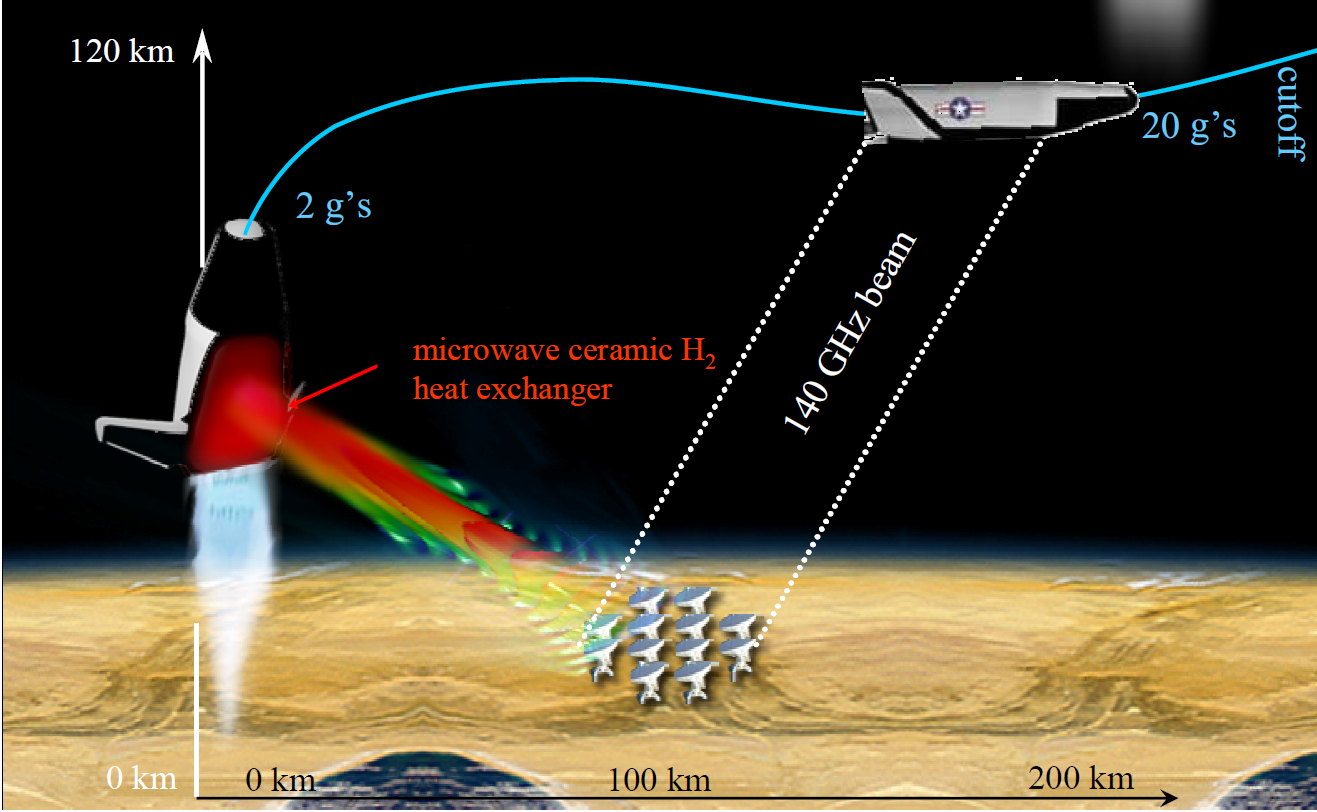
Worden said NASA is also funding a new program to develop microwave thermal propulsion for getting to orbit. “The idea is if you can beam power to the spaceship, so you don’t have to carry all the fuel; and then you use that energy from a laser or microwave power to heat a propellant; it gets you a pretty big factor of improvement. I think that’s one way of getting off the world.”
The principal investigator of this program is Dr. Kevin L.G. Parkin, who invented the technology and described it in his PhD thesis. He is assisted by Creon Levit and David Murakami. Caltech grad student Dmitriy Tseliakhovich has also formed a company called Escape Dynamics LLC to commercialize the microwave thermal propulsion project. (Tseliakhovich’s team project at Singularity University this past summer grew out of Parkin’s work.)
“The microwave thermal thruster using beamed propulsion is an excellent idea,” said Dr. Narayanan M. Komerath, a professor at Georgia Tech College of Engineering and a NASA Institute of Advanced Concepts Fellow. “[Kevin Parkin] picks the 140 GHz window, which apparently offers strong advantages in absorption by the materials that he uses in the propulsion system.”
Space settlements and electric planes
But Worden warned that in settling on other worlds, we need to be cautious. “How do you live in another world? I don’t have the slightest idea,” he said. “If you’re a conservative, you worry about it us; if you’re a liberal, you worry about us it. I think things like synthetic biology have lot of potential for that. I think rather than make an environment on Mars like Earth, why don’t we modify life … including the human genome … so it’s better suited to [Mars]?”
Worden also thinks we should go to the moons of Mars first, where we can do extensive telerobotics exploration of the planet. “I think we’ll be on the moons of Mars by 2030 or so. Larry [Page] asked me a couple weeks ago how much it would cost to send people one way to Mars and I told him $10 billion, and his response was, ‘Can you get it down to 1 or 2 billion?’ So now we’re starting to get a little argument over the price.”
Meanwhile, back on Earth, Worden says NASA Ames is exploring another radical new concept: a heavy-lift airship that could carry hundreds of tons. “I think that could revolutionize air transport, because it becomes very cheap and still goes 100 knots. The idea is that you could easily go to Hawaii overnight, for example… with a lot less fuel.
“The long-term answer [to the rapidly accelerating growth of travel in the developing world and the increase in greenhouse gas] is a “Tesla in the air” — using high-density batteries powered off ground-based solar grids, so your airliner stays plugged in overnight, and it’s got an electrical engine rather than a chemical engine. I think within ten years we’ll have small-scale business-level ones, and within 20, they’ll be the airliners.
Sunday, 24 October 2010
Body Organs with IP Address!
For cardiac patients too much excitement can be a shocking experience. If their heart rate gets too high an implanted defibrillator in their chest can think their having a heart attack and give them a friendly remedial shock. But such nasty surprises could soon become less of a concern for people like me – by giving our hearts their very own IP addresses.
Dutch research organisation IMEC, based in Eindhoven, this week demonstrated a new type of wireless body area network (BAN). Dubbed the Human++ BAN platform, the system converts IMEC's ultra-low-power electrocardiogram sensors into wireless nodes in a short-range network, transmitting physiological data to a hub – the patient's cellphone.
From there, the readings can be forwarded to doctors via a Wi-Fi or 3G connection. They can also be displayed on the phone or sound an alarm when things are about to go wrong, giving patients like me a chance to try to slow our heart rates and avoid an unnecessary shock.
Besides helping those already diagnosed with chronic conditions, BANs could be used by people at risk of developing medical problems – the so-called "worried well" – or by fitness enthusiasts and athletes who want to keep tabs on their physiological processes during training.
In the current design, the ECG electrodes are connected to a small necklace that contains the transmitter and battery. The next step will be to use an ultra-low-power radio transmitter, still in development at IMEC, to improve the stamina and portability of the sensors.
With around 18 million people in the UK living with chronic disease, ‘Telehealth' monitoring like this is the way things are going. Devices already exist that allow people with pacemakers and defibrillators to send telemetry from their implants via a landline to doctors. But using mobile phones would be the next step.
Wednesday, 22 September 2010
Leon Trotsky once said: ‘You may not be interested in technology, but technology is most certainly interested in you.’ Thus, does technology have it’s own agenda?
Well Kevin Kelly's new book 'What Technology Wants' makes clear technos has a path with a teleological force (are you listening Trotsky!).
Clearly, technology not only give us evermore choice, it gives us more time, and increased productivity to invent more technology. In fact, a major milestone in human cultural evolution - and a consequence of Kelly’s hypothesis - is (was) the very moment we invented the first ‘Toy!’
Perhaps human civilisation didn’t begin with the struggle with ‘Tools’, but begun with the pleasure of ‘Toys!’
In fact we humans have only ever produced 2 technological archetypes: the ‘Tool’ and the ‘Toy‘.
1) Tools: language, the controlled production of fire, flint knife, clothing, shelter, mega-dumper trucks.
2) Toys: rhythmical chants, fire walking, fashioned stones on string, iPODs.
It was only when man had a little time on his hands that he could 'chose' to play; suddenly entertainment arrived. And that only happened through the evolution of more productive tools.
Kelly's provocative book introduces a brand-new view of technology. It suggests that technology as a whole is not a jumble of wires and metal but a living, evolving organism that has its own unconscious needs and tendencies.
Kevin Kelly looks out through the eyes of this global technological system to discover "what it wants." He uses vivid examples from the past to trace technology's long course and then follows a dozen trajectories of technology into the near future to project where technology is headed.
This new concept of technology offers three practical lessons:
1) By listening to what technology wants we can better prepare ourselves and our children for the inevitable technologies to come.
2) By adopting the principles of pro-action and engagement, we can steer technologies into their best roles.
3) And by aligning ourselves with the long-term imperatives of this near-living system, we can capture its full gifts.
Written in intelligent and accessible language, this is a fascinating, innovative, and optimistic look at how humanity and technology join to produce increasing opportunities in the world and how technology can give our lives greater meaning.
"Institutions will try to preserve the problem to which they are the solution." -- Clay Shirky
I think this observation is brilliant. It reminds me of the clarity of the Peter Principle, which says that a person in an organization will be promoted to the level of their incompetence. At which point their past achievements will prevent them from being fired, but their incompetence at this new level will prevent them from being promoted again, so they stagnate in their incompetence.
The Shirky Principle declares that complex solutions (like a company, or an industry) can become so dedicated to the problem they are the solution to, that often they inadvertently perpetuate the problem.
Unions, or example. Unions were a brilliant solution to the problem of capital management which tended to exploit uncapitalized workers. But over time as capital increased in complexity, unions complexified as well, until unions needed management. The two became one system -- union/management. So now the problem with unions is that they are locked into the old framework, the old system. They inadvertently perpetuate the continuation of the problem (management) they are the solution to because as long as unions exists, companies feel they need management to offset them, and so the two became co-dependent. In effect problems and solutions tend become a single system.
In his brilliant, classic book The Innovator's Dilemma, Clay Christensen demonstrates how disruptive technologies almost always arise from the margins of an industry, where they start out as insignificant, or toy, solutions. Honda's hobbyist electric bicycles were no threat to the big four automobile companies, until electric bikes become motorcycles and motorcycles became small efficient cars. Cheap crumby dot matrix printers were no threat to big offset printing companies until dot matrix became injet printers and injects became the HP Indigo 5000 on-demand printers. In each case, the solutions were marginal, barely working, at first, and therefore ignored. I think what Clay Shirky is pointing out is that many problems, too, are marginal at first, and therefore ignored. Established industries like to focus on established problems.
Shirky made his quote in a recent talk, a bit from his upcoming book Cognitive Surplus. Shirky also referred to a similar idea in a recent blog posting about the ways in which media companies and the media industry are often constitutionally incapable of changing because they are still solving the last problem.
In a strong sense we are defined by the problems we are solving. Yin/Yang, problem/solution, both sides form one unit. Because of the Shirky Principle, which says that every entity tends to prolong the problem it is solving, progress sometimes demands that we let go of problems. We can then look to marginal solutions and ask ourselves, what marginal problem is this solving that might be a more appreciated problem later on?
Friday, 30 July 2010
Brit Tech Genius: 10 Innovators Changing Your World.
Think all your gadgets are dreamt up across the pond or in secret Far East bunkers owned by the world’s biggest tech titans? Think again. Britain is at the forefront when it comes to bleeding edge gadgetry, whether it’s the latest shiny must-have from Apple, or a motor that’s all set to break the land speed record. It’s easy to forget British boffins are behind some of the world’s greatest gadgets so, without further ado, here are my top 10 British innovators you need to know.
Jonny Ive, Senior Vice President of Industrial Design at Apple: Every modern day Apple gadget owes its existence to one man. Not Steve Jobs, but Jonny Ive, the Chingford (UK) born designer who’s been in charge of Cupertino’s industrial design since 1997. In that time he’s created the classic iMac, turned the MP3 player from niche plaything to global phenomenon with the iPod, and made touchscreens work seamlessly on the iPhone. .
Ive’s a shy genius, rarely speaking about his work and showing his face in public even less often. He’s most frequently found toeing the company line in official Apple videos, but the clip below from American TV show Objectified shows him more relaxed, working in his studio, and explaining the thought processes which keeps him at the top of the tech design pile.
James Dyson, inventor the Dyson Dual Cyclone: Dyson’s first vacuum cleaner, the G-Force, was sidelined when it was first unleashed in the 80s. Yet it’s follow-ups have set the tone for household gadgets all over the world. With the Dyson Dual Cyclone now found in the home of every self-respecting cleanliness freak Dyson has set his sights further afield.
Not content with fighting dust, Dyson’s Airblade hand drier has called time on weak-willed air blowers in loos across the globe, and earlier this year he set out to change desktop fans forever with his Dyson Air Multiplier.
Tim Berners Lee, inventor of the World Wide Web Without Tim Berners Lee, what you’re doing right now might not be possible. The British engineer developed the www back in 1989, going on to build the first ever web browser and web server.
After the first website was built in 1991, Berners Lee’s creation went from niche networking to global colossus in ten short years. Tell me you could live without the world wide web now and you’d be lying.
John Piper, Chief Designer, Hound: You might not have heard of John Piper, but pay attention: Piper’s car, Hound, isn’t like other motors. That’s because it’s being primed to top 1,000mph in 2011, smashing the world land speed record in the process.
Whizzing by in a faster-than-sound blur, it’ll be driven by current record holder, Wing Commander Andy Green. Piper recently finished the design of Hound, positioning a small rocket underneath the engine of a Eurofighter jet. He reckons it’ll be enough to bring him success with the landspeed record, and cements him a place on my list of British tech giants.
Gordon Murray, McLaren F1 designer turned eco car maker: Murray is known as the man behind the McLaren F1 sports car. But he’s all set to make a name for himself at the bleeding edge of eco motoring with the T.27, a brand new type of electric car that’ll be ready to roll on British streets in just under two years.
A completely new concept, Murray is hoping to have s built and on sale by 2011. It’ll have a top seed of 60mph when it hits the tarmac in 18 months time, weighing around half the mass of today’s ‘leccy motors at 600Kg. At the moment, Murray’s prototypes look like he’s hammered them together in a shed, but he’s got form for creating fantastic cars in the past, and could be about to start a Prius-style revolution right here in the UK.
Trevor Baylis, inventor of the clockwork radio: Baylis is best known for inventing the clockwork radio, letting people snaffle signals without relying on batteries or the mains for their breakfast banter. His Freeplay radio, as it became known, was first unleashed in Africa, before a smaller hit the UK.
Since then Baylis has become a champion of British inventors, helping young bucks bring their high tech dreams to reality with the Trevor Baylis Foundation.
Kane Kramer, inventor of the Digital Audio Player: While Jonny Ive may have brought the MP3 player to the masses, it’s possible the iPod would never have happened without Kane Kramer. The British inventor first conceived a Digital Audio Player (DAP) back in 1979, also touting the idea of downloading music of your phone line and something that looks very much like an Apple store. It may have seemed mad back then, but he was bang on the money.
Kramer’s original drawings of a DAP clearly show a slab like device that many of us would recognise as an iPod today. In 1979 though, his ideas were seen as marginal. Apple was even moved to recognise Kane’s idea in 2007, although it won’t be stumping up any cash in return for making it popular.
Peter Molyneux, creator of Fable, Theme Park and Milo: Britain’s gaming industry is teeming with successful developers that are the envy of the world. But Molyneux has been a leading light in the world of video games since the 80s. Classics such as Theme Park, Populous and Fable all bear his hallmark. And he’s not shuffling off into retirement yet.
Molyneux is one of the driving forces behind the Xbox 360’s Project Natal. At its launch, he showed off a project dubbed Milo and the forthcoming Fable 3. If a gaming technology has Molyneux behind it, you’re guaranteed big crowds, and with his vote firmly in Natal’s ballot box he’s already making sure British games studios are taking Microsoft’s system seriously.
Richard Palmer, founder D3O: My home town 'Brighton and Hove' based 'D3O' is about to revolutionise gadgets. You might not know its name, but it’s one of the world’s first smart materials, and it was invented by a Brit!
Sussex University graduate Chemical engineer Richard Palmerset up his own business to create the substance, which acts like silly putty in your hands, but stiffens up to absorb shocks and bumps whenever it’s hit.
It’s a silicon polymer that has the look and feel of playdoh, and is already in laptop and iPod cases from Tech 21, saving your precious tech from taking a battering. Palmer also says it could go into body armour too. Think futuristic football shin pads that mould to your legs but harden up when you’re hit by a crunching tackle. Smart materials are the future, and Palmer proves you needn’t be a mega multinational to make your mark.
Sir Howard Stringer, CEO Sony: Stringer hasn’t had it easy heading up one of the planet’s biggest tech giants. But his Sony United plan has made the gadget colossus more lean, better focused and able to make the most of its assets.
His first triumph was with the robotic Rolly. The device itself was never going to be a huge seller, but it let Stringer pull together Sony’s Walkman, Aibo and mobile teams to create a single product that was more than the sum of its parts. It was niche and bizarre, and stole headlines while proving that Sony’s sprawling divisions could work together effectively. And he hasn’t stopped there.
With the likes of the PlayStation 3’s XMB interface heading to Sony Ericsson phones and onto Blu-ray players, he’s helped Sony’s products have one core interface. The impending Sony Online Service, flogging eBooks, music and video will also be a huge match for iTunes, finally turning Sony’s ragtag army of products into a unified fighting force ready to stomp all over tech rivals.
Tuesday, 27 July 2010
U.S. health officials have approved a first-of-its-kind technology to counter a leading cause of blindness in older adults - a tiny telescope implanted inside the eye.
The Implantable Miniature Telescope aims to help in the end stages of incurable age-related macular degeneration, a creeping loss of central vision that blocks reading, watching TV, eventually even recognizing faces.
The idea: Surgically insert the Implantable Miniature Telescope into one eye for better central vision, while leaving the other eye alone to provide peripheral vision. The brain must fuse two views into a single image, and the Food and Drug Administration warned Tuesday that patients need post-surgery rehabilitation to make it work.
There's little to help such advanced patients today aside from difficult-to-use handheld or glasses-mounted telescopes, while the new implanted telescope - smaller than a pea - can improve quality of life for the right candidate, said Dr. Malvina Eydelman, FDA's ophthalmic devices chief.
But it's only for a subset of the nearly 2 million Americans with advanced macular degeneration, Eydelman warned: Those 75 and older, with a certain degree of vision loss, who also need a cataract removed. In fact, the FDA took the highly unusual step of requiring that patients and their surgeons sign a detailed "acceptance of risk agreement" before surgery, acknowledging potential side effects - including corneal damage and worsened vision - and the need for lots of testing to determine who's a candidate.
"We're not giving people back 20-year-old eyes," cautioned ophthalmic surgeon Dr. Kathryn Colby of Harvard and the Massachusetts Eye and Ear Infirmary in Boston. She helped lead manufacturer VisionCare Ophthalmic Technologies' study of the implant.
But by magnifying images onto more of the retina than its diseased center, someone who before couldn't see an entire face might now miss only the nose, Colby said.
In a 219-patient study, the FDA said 90 percent of telescope recipients had their vision improve by at least two lines on an eye chart, and three-quarters went from severe to moderate vision impairment.
Concern about damage to the inside lining of the cornea, the eye's clear front covering that helps focus light, held up FDA approval for several years. In that study, 10 eyes had serious corneal swelling, five that required corneal transplants. FDA's Eydelman said the company proposed candidate restrictions to minimize that risk, and will study how an additional 770 recipients fare after sales begin.
VisionCare, of Saratoga, Calif., is seeking Medicare coverage for the surgery and rehab costs, a package that it calls CentraSight. The company wouldn't estimate total costs but said the device itself costs $15,000.
WorkDetecon is a consulting company which unites classic management consulting with a high level of technology expertise.
Recentley they've had a further take on my thesis Hyperinnovation.
The artical reads:
'Hyperinnovation for Telcos... How to Get in the Game - Fast.
....Almost a decade has passed since Chris Harris elaborated on what he described as “the multidimensional interconnection of ideas” that challenges organizations to rethink the way they innovate in terms of strategy, culture, organization and methodology.
The basics have not changed, but Hyperinnovation for telcos now has a new spin, through technology that encourages and enables infinite and rapid communication and collaboration in a global economy....'
I find it interesting that my thsis is still being augmented!
It's useful to understand exactly what is -- and what isn't -- going on here.
Where we are:
Synthetic genome copied from real genome and transplanted into existing cell structure.
This is a moderately big deal, but only that; it's a stepping-stone to a real big deal down the road. What the Venter Institute has done is synthesize a genome that reproduces the genome of an existing organism, then insert that genome into the body of an existing cell, replacing its own DNA. That cell was then able to self-replicate, indicating that the synthetic DNA copy was sufficiently complete.
"Synthetic" here doesn't mean artificial, by the way. The DNA of the synthetic genome comprises the same base pairs and nucleotides as a ral genome, but was synthesized in the lab rather than replicated from an earlier cell. The best analogy I can think of is if, rather than copying the MP3 of your favorite song, you pulled together a really sophisticated music creation application and reproduced the song yourself, exact in every detail. It's the same, but a synthetic version.
If that sounds like a lot of work to get something that is essentially the same as the ral/original version, you're right. But this step was never the real goal -- it's just preparation. The real goal is to create an entirely novel life form, comprising both entirely new DNA and an entirely new cell. That's still to come.
Where we aren't:
Transgenic synthetic genome ( ral genome copy with genetic code from other kinds of organisms).
The synthetic genome created by the Venter Institute is a streamlined version of the original Mycoplasma mycoides bacteria, containing enough of the original code to replicate and function as M. mycoides. Adding transgenic features -- that is, genetic material copied from non-M. mycoides species -- should be fairly straightforward, as it's essentially doing standard bioengineering.
In principle, this should actually be somewhat safer than current transgenic biotech, as they'll have much more precise control over the engineered genomes.
The ultimate goal would be to create an entirely new bacterial species by creating genes that do new things, or by combining diverse known DNA sequences to create a functional, replicating bacteria that doesn't mimic any existing species. This will be hard, but clearly not impossible.
The bonus goal:
De novo creation of cell structure.
The cell in which the synthetic DNA is housed already existed, but with different DNA (it was the cell of a related species of Mycoplasma). One likely future step will be to create an entirely synthetic cell by throwing together the right set of proteins in just the right way. Like the latest breakthrough, that will undoubtedly start out by simply reproducing an existing cell structure. Ultimately, they'll want to create cellular bodies that have novel features, such as (conjecture here) additional mitochondria for added power.
Where we go:
So what does this all mean?
The idea is to turn bacteria into microscopic machines, carrying out designated tasks in massively-parallel operations. Given the extreme range of things that bacteria can do in re, the extent to which bacterial machines might be used is pretty staggering, particularly concerning environmental response. This would be a perfect platform for methanotrophic remediation of melting permafrost, for example; the Venter folks are already talking about building synthetic bacteria to do carbon capture. Biofuels are also high on the agenda.
The big concern about synthetic biology is the potential for the creation of hazardous materials -- aggressive, infectious bacteria, for example. We should also consider, at the same time, its biomedical potential. Are there ways of delivering via synthetic bacteria?
One advantage of the big splash this relatively modest development has made is that it opens up the possibility of laying out the parameters of what ethical, responsible management of this technology would look like before have to confront its fully-developed form.
Should we require a "shut-off" gene in any novogenic organism, one that kills the cell if certain conditions are (or aren't) met? A reproduction-limiting set of genes that only permits replication in the presence of a rare chemical? Public registration of all novogenic genomes?
One suggestion that we know is possible, because a variation appeared in the Venter announcement: all synthetic genomes should be signed. According to Wired:
“They rebuilt a ral sequence and they put in some poetry,” said University of California at San Francisco synthetic biologist Chris Voigt. “They recreated some quotes in the genome sequence as watermarks.”
What Voigt refers to as a "watermark" should instead be thought of as a "DNA sig re." We should require that all synthetic genomes include something like this, unique sequences following a designated pattern, identifying the organization behind the genome, the lab responsible, the date, and any other useful bits of information. Multiple copies should appear throughout the synthetic genome, so it doesn't get mutated away.
That way, if something unexpected happens, we know whom to talk to.
Wednesday, 19 May 2010
Don Ledingha is a teacher and Executive Director of Education and Children's Services for East Lothian Council, Scotland.
What I like about his work, and indeed his philosophy about Education, is that it should (needs to) be about learning.
Re: education does not equal learning. He has been keeping a learning log since 2005. It started off simply as a means recording what he was up to on a day-to-day basis. Since then it’s grown into something which has had, and is having, a profound effect upon professional practice within schools.
As I say: open, self-directed, radical off the hook learning will smash the old worn out paradigm of 'Eduction, Eduction, Eduction.'
Touch screen, built in camera, scanner, WiFi, google map/earth, google search, image search… all in one device. This way, when you can see a building through it, it gives you the image search result right on the spot.
It’s got a scanner built in, so you can use it this way when you want to check the meaning of a word in the newspaper, book, magazine, etc.
It would be much easier to read a real book. You can use the dictionary, wikipedia, thesaurus and anything else available on the web.
And what about the i-phone concept for this technology?
And this would be ultrauseful: holidays, overseas buisness trips, travalers, language students, think on!
This one will be out soon. I'll keep you posted!
Friday, 30 April 2010
Future Laptop.
What does a laptop of the future need to have and be able to make in order to be a revolutionary product? First of all it has to be ecology friendly and more power saving device. LG Electronics has created a laptop that you can really call the laptop of the future. Why?
Fist of all: the power saving features. This gadget laptop's display uses OLED panels. Organic Light – Emitting Diodes are more power safe and they will work longer than any LCD display that we use now days.
More power efficiency means more energy save for the world and in our situation when we are running out of fuel and other energy sources this technology will really help.
It is not the end of the invention. The LG Electronics Company is going to power their gadget laptops with such fuels as methyl alcohol and natural gas. How they do that?
Well the laptop will have the fuels what we call "on board" they will have a special hinge where they will store the fuel and then use it just like a usual car or whatever. I am not sure how it works because you need something to work that fuel into electricity, but obviously they have something like that.
It is a pity that this laptop is not being produced yet. It is a concept of the future and I would really like to see this laptop in the stores. The reason it is note being produced yet is that it is too expensive to produce them. You got to create an energy unit for every laptop so it is really expensive to produce.
This gadget will be the future of the marked of laptops and other portable devices. Using their own energy source like methyl alcohol or natural gas will make their batteries run longer and be more independent from the electricity.
Small is Beautiful.
Ultra small, unique and delicately designed Agent Cam HD Video Recording camera is a useful gadget in many situation when is necessary to have some memories recorded. Any records could be made and saved. Time with family, business meetings, sport events, outdoor activity, evidence collector, security aim - only are few useful clues where Agent Cam HD will be useful. This small high resolution DVR cam allows to record up to 6 hours of video.
Micro Mini DVR cam is a universal miniaturized piece to carry it anywhere. Reliable construction made from metal and glass, with USB port and Led indicator. Plug and play option for Windows or later editions. Micro Mini Cam is compatible with Windows 98SE / ME / 2000 / Vista / XP. Gadget dimension: 50mm x 50mm x 15mm (LxWxD).
Specification:
- name: HS-WDVR01 Watch DVR - Memory: 2 GB MicroSD in included - Format: AVI (640*480), 15ÀÇÑ - MIC: built-in - Power source: integrated battery that is recharged directly via USB port or with charger. - Display mode: Analog 12 hours (hour, minute, second)
This Micro Mini DVR cam is a universal miniaturized piece to carry it anywhere. Reliable construction made from metal and glass, with USB port and Led indicator. Comes with all necessary set of functions to record video.
Environmentally friendly materials for future technologies produced from plants.
To reduce amount of products in stores that are manufactured of unrecyclable or poorly recyclable materials, a lot of world leading companies look at a farmer’s fields to find an appropriate solution today. And they are not only guided by green tendencies.
By using environmentally friendly materials companies can bring down taxes and costs of productions. Five plants that are presented here are essential for the future technology and they can be accessed in any part of the world.
Let's see what prospective gadgets will be made of.
Are you sick and tired of muddy gardening? Here is a very handy gizmo to save the day. NASA researchers have found the way that makes it possible to grow your favorite plants whatever season it is with no soil at all. Christened the Power Plant Growing Machine, this smart gadget operates based on so called “aeroponics” technique thanks to which plants are well grown.
This clever technique uses a state of the art micro jet system positioned inside the box which allows ceaseless roots spraying with super oxygenated nutrient enriched water. Thus, crops are able to grow efficiently so keep your fingers crossed to reap an abundant harvest which is expected to be stronger and larger.
In order to start growing plants, you will need to fill the power plant reservoir base with tap water or distilled water as a better option. Then, you should pour mixed nutrient throughout the sponge. Sow your seeds into the sponge with the card seed cover placed on it. Now, you can simply place it in a sunny place.
Once the sprouts appear, humidadomes are positioned over every sprout to stimulate their growing. Mains-powered, this ingenious Power Plant Growing Machine lets you enjoy indoor gardening. Whether you want to glow flowers for your wife or some scrumptious veggies, be sure your harvest is rich and constant.
This Power Plant Growing Machine can be used many times and is retailed for 49, 87 USD. No more worms or bugs. This gardening kit seems to offer better conditions than soil grown plants. The Power Plant measures about 20 cm in width, 15, 5 cm in length and 7 cm in diameter and includes a growing system, 2 grow sponges, nutrient mix, pump, 3 humidadomes, 12 volt power supply as well as user guide.
Futuristic 48-core design of Intel’s latest processor concept may sound like the company got involved in an arms race with AMD, especially since Intel Xeon 7500 designed for servers has 8 cores versus Opteron 6100’s 12 cores from AMD.
But as it appears, limited edition of 48-core processors has come into this world only as a guinea pig and will most likely be sacrificed in the name of results it will achieve in the hands of lucky researches when they get it in late Q2.
Everyone who is in the know expects a lot form the experimental 48-core architecture. One of the advantages of rich core topology is low power consumption. Even first tests show that processor stays nicely between 25W when idle and 125W under load. These results are achieved at clock speeds similar to current Atom units.
Another advantage is getting round x86 architecture bottlenecks when it comes to data exchange with system memory. Every core has its personal buffer so that it could immediately communicate with the others. This, by the way, frees up some memory as well.
What’s more, cores can be easily shut off with the help of additional software which so far is in development. I have to say I am quite exited by this concept. Especially because Intel promises to bring some of the elements and ideas behind massively multicore server processors to desktop solutions, so I will keep an eye on what’s going on in Intel Labs.
i-skates!
With development of technologies, appear many ideas how to simplify our locomotion. Some are crazy, some - very pricy. As usual, they are just concepts, only ideas, and are not produced. Chairs, even beds – they all become a vehicle when somebody places engine inside them. And sometimes common and usual roller skates can be the source of inspiration for creative people.
Creator of this engine powered roller skates, iShoes (accessory to iPhone, huh?), probably, was very annoyed to just walk. We don't know his intentions, but his invention looks curious. Imagine a four wheeled roller skates, with a small electric-powered engine built in. They can be easily put on about every shoe, making them more practical than Segway – already existing device for personal transportation.
iShoes can go at speeds up to 24 km per hour (15 miles per hour), one charge of the batteries lasts for 9-11 km (5-7 miles) – distance almost triple shorter than Segway offers. Great advantage of these – small size, which means good portability. You can carry them with you in the bag when you arrive to your destination – a good possibility to prevent theft (Just imagine somebody carrying Segway around…). And while riding iShoes, you are not looking strange – they look just like normal and usual four wheeled roller skates.
So, if you like extreme sports – then these roller skates are not for you. They are completely helpless at ramps and it is very difficult to do tricks with them on foot. But if you prefer calm riding and want to amaze and be original – then this invention of Ilja Kaganovich can be the right choice.
Jet engine powered by hydrogen
Pollution represents a perennial problem that can not be solved except by means of the collaboration of all the world's nations. During some last decades a great attention was paid to the air pollution and Green House effect. Many people and scientists are unison in opinions that the airline industry is one of the major pollutants at all. So in order to decrease its impact on the environment some drastic measures like using other types of planes should be taken.
According to the recent news a new reaction engine was invented whose designers intend to solve given problem at least partially. This engine is a hydrogen-powered A2 aircraft concept that would be capable of hitting Mach-5 - five times the speed of sound (3400 mph), making it somewhat the spiritual successor of the Concorde. What makes it different is range and efficiency, capable of ferrying up to 300 passengers from Brussels to Sydney in less than four hours. It uses a 2-mode engine that makes it efficient at low speeds as well as hitting top gear with relative ease.
Thus, this concept represents an outstanding attempt to solve such a complicated problem. It would be great if in the near future we were able to see how these ultra-jet planes were put into operation. Yet, there is quite an important point that prevents companies from using extensively these engines: production of hydrogen fuel on a large scale (without emitting carbon dioxide) still remains a significant problem so there will still be danger to our environment.